Wednesday, June 20, 2012

Louie: The Complete Second Season


Think of the structure of a typical “a guy walks into a bar” joke. The joke teller begins with that first line. Then he tells a short story, through which the audience, be it one person or a roomful, sits stone-faced. Eventually, the story leads to a punchline, and if the joke teller is skilled enough, the audience will erupt into laughter. Even though we didn’t laugh from the first moment he opened his mouth, it’s commonly acknowledged that everything that came out of his mouth was part of the joke. This all seems obvious I’m sure, but in trying to find a new way to talk about Louie, it hit me: These episodes are often structured like a joke – albeit a 20 minute one – with the punchline in the final moments. While those first 19 minutes might not be traditionally funny, they’re anything but tedious, and often run the gamut of emotions.

There’s never been a comedy show like Louie, and given how cannibalistic television is, it continues to boggle my mind that Louis C.K. gets away with such shocking displays of originality on a weekly basis. The show’s written and directed by and starring the same guy; has there ever been a scripted series that’s so clearly the all-around vision of just one person? Allegedly, even the suits and execs at FX leave him alone. Armed with a solid first season under his belt, and no doubt the confidence that comes with that, the comedian’s comedian sets out to dig even deeper into his psyche for the second block, and the results are painfully hilarious, with an emphasis on the pain.

Read the rest of this Blu-ray review by clicking here and visiting Bullz-Eye.

Tuesday, June 12, 2012

Harold and Maude: The Criterion Blu-ray review


[Note: All screengrabs in this piece are taken from the old Paramount DVD release of Harold and Maude and are by no means indicative of the video quality of this Blu-ray.]

Trying to find something profound or insightful to say about Harold and Maude feels like an exercise in futility; anything I’ve got, the film already says about 20 times more eloquently, yet let’s give it a whirl, but be warned, because you’re gonna get tons of “me, me, me” in this piece. I can’t write about the movie any other way. It’s too personal. Nor do I wish to offer up some kind of plot summary, which would be pointless. If you’ve not already seen this movie, then just go buy this disc, you poor bastard, and if you don’t like it, I don’t want to know you. There are few movies that grab me emotionally the way this one does; some of the others that do, like Shampoo, are also directed by Hal Ashby, who was one of the most gifted visual storytellers that ever lived. The guy had a knack for finding truth in the most unlikely of places; he made a career out of it. This ability of his was never more obvious than in Harold and Maude, the story of the awkward, depressed young man (Bud Cort) who falls for a free-spirited lover of life (Ruth Gordon) that’s four times his age.

Remember those people who were diagnosed with a sort of depression after seeing Avatar, because they were so affected by the movie that they wanted to live in that world, but couldn’t? Harold and Maude is my Avatar. It guts me. I have to be careful about the frame of mind I’m in when I watch it, otherwise it’s liable to send me spiraling into a state of melancholy, much like yesterday’s viewing of this Blu-ray did. This is an odd reaction to such a life-affirming movie, but I think the reason I respond like this is because it’s a reminder that I’m not living my life as fully and with as much joy as I should.

It’s so easy to be pessimistic in this day and age, because our culture is drenched in cynicism. How do you fight against what’s in front of you at every turn? Further complicating the issue is that there’s a potential price to pay for not joining in on the group skepticism and that’s that you may not be taken seriously. You may even, heaven forbid, be labeled naïve. Most everything we are as a culture today is the exact opposite of what Harold and Maude is (was?) about. If I could, I’d sit the entire country down, pass around joints, bongs and baked goods, and make everyone watch Harold and Maude simultaneously. If it made a dent for just one day, it’d be worth it.

One of my favorite lines, depending on which day I’m talking about the movie, is Maude’s, when she’s dealing with an angry police officer (played by an uncredited Tom Skerritt): “Don't get officious. You're not yourself when you're officious. That is the curse of a government job.” Harold and Maude is all about challenging authority, and it was part of a whole wave of films that were doing just that, although few of them managed to do it as sweetly as this one. It was made in era when film really took authority to task in a way it doesn’t today. Maybe it reflected the times. Back then people thought they could make a difference and cause change. They felt their opinions carried some weight and that authority figures like politicians had some decency buried deep inside them that was just waiting to be dragged to the surface. Nixon probably changed a lot of that, but certainly today – and this goes back to the rampant cynicism – too many people believe less in challenging authority than they do in dismantling it altogether.

So I guess Harold and Maude takes me to a time that I never got to experience (having been born about a month before the film’s release), and it does it in a way that’s not even remotely preachy or maudlin or nostalgic (or maybe it’s all of those things?). It’s a story of two people who’ve experienced tragedy and hurt and pain, and how one of them overcame it long ago, and is now intent on helping the other through the rough times, so they can both get to a better place. Folks have often placed an emphasis on the romance between the two leads, but that’s the last thing I think about when it comes to Harold and Maude, because it’s about so much more than that. There are a million romance flicks out there - many of them with pairings far stranger than this one - but there is only one Harold and Maude.

Having dealt with Harold and Maude for years now through Paramount’s DVD release (and before that on Paramount’s laserdisc), it’s never really occurred to me how much of an overhaul this movie might need, but the difference between that disc and this Criterion Blu-ray is pretty revelatory in terms of picture quality. Whereas before the movie was mired in muddy dark browns and greens, on this Blu-ray it’s now covered in eye-popping dark browns and greens, not to mention a whole other palette of surprising colors that I was never able to notice before. I often wonder with Criterion discs if some of these old movies look better than they did upon release. This one certainly looks better than I’ve seen it before, and in fact when I went back and looked at the Paramount DVD for screengrab purposes, I was rather stunned by how bad it looked. Also, in addition to the original uncompressed mono soundtrack, this edition offers up a newly remastered stereo track. The music of Cat Stevens has never sounded so good in a feature film.

Hey Criterion! More Hal Ashby on Blu-ray! Shampoo, pretty please!?!? You did that one many years ago on laserdisc and it’s time to go back to the well. 

Director Hal Ashby's Hitchcock cameo
Blu-ray Extras: In a perfect world, the special features here would be considerably more extensive, or at the very least there’d be interviews or commentaries with Bud Cort and/or Vivian Pickles[1], but alas, ‘tis not to be. Perhaps it was the lovely little 2011 interview with Yusef/Cat Stevens that made me want more? Yes, that must have been it. Because before this Criterion disc came along, I was satisfied with the content of the nearly bare bones Paramount DVD I’ve had for years. In addition to talking with Cat, there are vintage audio pieces (that play over montages) with both Hal Ashby and screenwriter Colin Higgins from ’72 and ’79 respectively, taken from Harold Lloyd Masters Seminars. An informative commentary track alternating between Ashby biographer Nick Dawson and the film’s producer Charles B. Mulvehill rounds out the disc’s bonus features. (The two theatrical trailers on the Paramount disc have not made the leap, I’m afraid to report.)
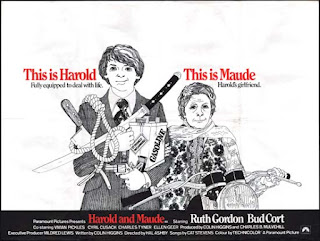
Additionally, the Blu-ray includes one of those fine inner booklets that Criterion does so well. This one spans 36 pages and is full of cute little Harold and Maude illustrations in the same vein as the cover art. It features: A new essay entitled “Life and How to Live It,” by one of the most insightful, not to mention dangerous, living movie/TV critics, Matt Zoller Seitz (whom, it must be said, I also call a friend); a reprint of a 1971 New York Times article/interview with Ruth Gordon by Leticia Kent entitled “A Boy of Twenty and a Woman of Eighty”; a transcript of a 1997 conversation between Bud Cort, cinematographer John Alonzo, and James Rogers of the Colin Higgins Trust; lastly, there’s a short 2001 interview conducted by Rogers with the film’s executive producer, Mildred Lewis, and her family, entitled “Meeting Colin Higgins.”

 [1] Bud Cort and Ruth Gordon have quite understandably gotten all the glory for Harold and Maude over the years, but damn it, Vivian Pickles, who plays Harold’s mother, is just as good as the two leads, and maybe as important to the goings-on. Through many viewings, I’ve come to really appreciate what this actress brought to the movie, and how spot on her portrayal is of a mother very much at wits end and utterly ill-equipped to deal with her emotionally disturbed son. Again, like so much of this movie, Mrs. Chasen is very much a character of her time, yet the character transcends the decades and works every bit as well today. Nearly every word that comes out of her mouth is priceless and every move she makes is calculated comedic perfection. Pickles just doesn’t get nearly enough credit for her work here.

Thursday, June 07, 2012

Doctor Who: The Seeds of Death, Resurrection of the Daleks, and Carnival of Monsters Special Edition DVD reviews


David Tennant hosts "Come in Number Five"

Back in March I did a big piece on the three classic Doctor Who Special Edition DVD sets released that month, and outlined my feelings about the SEs in general. April saw the debut of another such set, “Carnival of Monsters,” and now June sees two more, with “Resurrection of the Daleks” and “The Seeds of Death.” Together, these three titles made up the “Revisitations 2” box set in the U.K. Unlike previous double dips such as “The Caves of Androzani,” “The Robots of Death,” or even “The Three Doctors” (which, despite being a story of dubious quality, is clearly worthy of its own SE on principle alone), these tales are, simply put, not nearly as “classic.”

“The Seeds of Death” is the least successful of the trio, and I say that as a diehard Patrick Troughton fan. I’d even go so far as to say that it’s the worst of the surviving stories of his era (yes, I’d rather watch “The Dominators” than “The Seeds of Death,” but only by a slim margin). This is a six-parter featuring one of the series’ big bads, The Ice Warriors, and the viewer will feel every minute of it. It likely would’ve worked better at four episodes, and yet even that wouldn’t have helped the uninspired guest cast/characters and the often times shockingly naïve script. On the plus side, “Seeds” does offer a mildly interesting look at a potential Earth future, where the planet is completely dependent on a technology called T-Mat, which is basically teleportation. The Ice Warriors cripple the Earth by hijacking the tech from the moon, where exists the T-Mat relay station. Much wackiness ensues (well, not really).  Since the breakdown of technology is a big issue for me personally, I find at least that aspect of “Seeds” rather fascinating, though as an idea it’s hardly sustained in any kind of engaging way across six episodes.

Speaking of technological screw ups, as I understand it, a mistake was made on the original DVD release, and the film sequences of the story were VidFIREd when they shouldn’t have been, hence part of the reason for the SE. As you can see from the screengrabs at the right, the differences in quality between the two releases is imperceptible (to my eyes anyway). Perhaps the SE film sequences are a tad brighter? Beyond that, the primary extras have been ported over from the original release, although “The Last Dalek” featurette has, for obvious reasons, been moved over to the “Resurrection of the Daleks” SE, and the New Zealand censor clips from “The Web of Fear” and “The Wheel in Space” have been removed as they exist on the “Lost in Time” box set (as does “The Last Dalek,” actually).

While there is no new commentary track, original to this SE is a 30-minute doc entitled “Lords of the Red Planet,” which the DVD cover claims is a history of the Ice Warriors. While it does contain some fascinating info on the origins of their creation, that’s not quite how I’d describe it, as it’s basically just a making of “Seeds.” Also new is a very short bit with director Michael Ferguson called “Monster Masterclass” and a neat interview featurette titled “Monsters Who Came Back for More!,” with Nicholas Briggs and Peter Ware discussing many of the monsters who made return appearances over the years, as well as the ones they’d like to see return on the new series. Lastly, there are Radio Times listings in PDF form and a coming soon trailer for “Death to the Daleks,” which comes out next month. While these few new extras are fun, “The Seeds of Death” SE remains difficult to recommend to folks who own the previous edition, and equally to those who’ve never even owned it at all.

1984’s “Resurrection of the Daleks,” from Peter Davison’s final season, I’m torn over, and even this new DVD hasn’t helped me to nail down my feelings on it, though to clear up any confusion beforehand, it is a quality story on most levels. A cameo in “The Five Doctors” aside, this was the first appearance of the Daleks in the series since 1979’s “Destiny of the Daleks,” and this more or less picks up where that one left off. From a production standpoint, this thing is the tits: Excellent location shooting, tight direction, above par effects work, and even some pretty good studio work. Terry Molloy plays Davros for the first time, successfully reinventing the character for the ‘80s, and he and Peter Davison are surrounded by a sprawling, believable guest cast.

The problem with “Resurrection” is that it’s so damn bleak and without any wit or humor (though there is one scene with Davros that gives me the giggles, yet I’m unsure if that was the intention). It supposedly has the highest onscreen body count of any Doctor Who story, but the violence itself isn’t really the issue. It’s the tone of the whole thing, which just feels so un-Who-like; this is more like Blake’s 7 (specifically the final episode of that show). Now, I’ve got nothing against bringing on the darkness from time to time, and Davison’s final season as well as Colin Baker’s first are frequently loaded with grittiness, but there’s something about the balance in this particular story that simply feels off; it’s just too much. Obviously, your mileage may vary. Also, this is Tegan’s (Janet Fielding) final story, and though she has a beautiful and heartrending exit scene, she’s given barely anything to do in the 90 minutes prior to it. It just kills me that Janet Fielding didn’t get a better send-off, as Turlough (Mark Strickson) did in “Planet of Fire,” which immediately follows this tale.

One big reason “Resurrection of the Daleks” was given a double dip is because when it was originally broadcast on the BBC, it was shown as two, 45-minute episodes, even though it wasn’t produced to be shown as such. Disc One of this set for the first time on home video presents it as it aired in ‘84. The 2002 DVD release (as well as the VHS release before it) presented it as four, 23-minute episodes, which is duplicated here on Disc Two. So now you can “have it your way,” although ultimately it doesn’t make a huge difference which way you watch it, to my mind. Aside from the “Who’s Who” text feature, all the extras from the 2002 disc have been ported over, in addition to all the new features.

A new commentary track can be found on Disc One, featuring Terry Molloy, writer and script editor Eric Saward, visual effects designer Peter Wragg, and moderated by Nicholas Pegg. It’s a dry affair, but very informative nonetheless. The star attraction here should be the nearly hour-long documentary entitled “Come in Number Five,” a retrospective of the Davison era, hosted by Davison’s son-in-law, David Tennant (though Tennant hadn’t yet married Georgia when this was recorded); “should” be because I was pretty let down by this doc that I’d been looking forward to seeing since it came out in the U.K. over a year ago. One of the most refreshing aspects of the classic Who DVDs is that the participants in the bonus features are very often brutally candid about their times on the show and the quality of the stories. Like I said, this is refreshing when so many DVD bonus features of TV shows and movies exclusively showcase talent from both in front of and behind the camera insisting that everyone and everything is brilliant. That gets old.

Unfortunately, the reverse of that attitude can also be the enemy of the classic Who DVD range, as is the case here. I wanted a pleasant, nostalgic look back at Davison’s three years on the show – an era which I, and most hardcore fans, consider to be of generally high quality. Instead, this doc amounts to little more than a one-hour bitchfest about how many things went wrong, and how John Nathan-Turner fucked things up right and left – an attitude I can do without, thank you very much, especially since he’s no longer with us to defend himself. I think there must be a ten minute exchange devoted to what a bad idea it was to create a companion that was supposed to kill the Doctor, and how the idea ruined Season 20, when most fans will agree that it wasn’t necessarily a bad idea, and it didn’t actually ruin Season 20. (For further commentary on this issue, check out the DVD review of The Black Guardian Trilogy.”) None of this is Tennant’s fault, mind you. I’m sure his linking bits - which tonally are more along the lines of what I expected from this - were recorded after all of these interviews were done. If I’d seen this doc without ever having seen the Davison era, I probably wouldn’t be interested in ever checking out his Doctor, such is the excessive negativity here.

On the flip side of this is a lovely 30-minute piece called “Casting Far and Wide,” featuring Toby Hadoke interviewing five guest actors from “Resurrection” about their careers, with varying reactions and answers. It doesn’t always have a whole lot to do with Doctor Who, but it’s a nice, warm piece nonetheless. While I’m at it, let me just say that Toby Hadoke is the best thing to happen to the classic DVD range in the past year. His contributions and levels of interest and knowledge are ideally suited to exploring this series. Kudos to you, sir, if you are out there reading. “Tomorrow’s Times – The Fifth Doctor” is another entry in the ongoing exploration of the press reaction to the show. There’s also a short bit called “Walrus” with a woman and a Dalek, Radio Times listings in PDF form, as previously mentioned, “The Last Dalek” featurette, and the coming soon trailer for “Death to the Daleks.”

Finally we come to “Carnival of Monsters,” which is arguably the best of these stories, even if it’s something of an odd duck. Written by Robert Holmes with a generous amount of charm, and directed by Barry Letts with an equal amount of flair, “Carnival” is a story that’s grown on me over the years, particularly through this new edition. Part social commentary and part adventure, this was the Third Doctor’s (Jon Pertwee) first adventure after having had his ability to pilot the TARDIS restored by the Time Lords at the close of “The Three Doctors.” It appears the TARDIS has landed on a cargo ship in the 1920’s, though the Doctor is certain that can’t be the case. Meanwhile, on a distant, alien planet with class system issues, a couple of carnies have arrived with their money-making gimmick known as the Miniscope, through which spectators can view all manner of alien life.

“Carnival of Monsters” isn’t as obviously exceptional as so many other Robert Holmes scripts, but it’s still a very entertaining one. Its most memorable monsters, the Drashigs, are a great example of a one-off Doctor Who creature, and the story is just so unlike anything else from this era of the show. It seems that the aim of “Carnival” was to do something different with the series than what it had been doing for the previous three seasons. It’s ambitious, maybe sometimes even to a fault, and it seems like the sort of script you’d read about in some Who reference book as having been “ultimately passed on” because it “didn’t quite fit the show.” But it wasn’t, and it did.

Lis Sladen thinking about her old co-star and friend Ian Marter
Seems all the bonus features from the 2003 DVD have been ported over in some form or fashion. The extended and deleted footage has been replaced by an additional longer edit of Episode Two, which also features that oddball, alternate arrangement of the theme tune which was a separate extra on the old disc. New to this SE is a commentary track featuring actors Peter Halliday, Cheryl Hall and Jenny McCracken, as well as special sounds creator Brian Hodgson. While “Destroy All Monsters!” is a lovely new making of, the standout extra may be “On Target with Ian Marter,” which explores the late actor’s contributions to the Target book range, as well as the man himself. Nicholas Courtney, Tom Baker and Elisabeth Sladen (amongst a couple others) all chime in with their feelings about Ian Marter, but it’s Sladen’s emotions and choice of words that really move. When she talks of him passing at such a young age, she nearly breaks down into tears. This is made all the more poignant by her own passing at too young of an age last year. It’s anyone’s guess what was going through her mind during that interview, but the results are haunting and heartbreaking. 

Ian Marter pre-Harry Sullivan
There’s also a featurette entitled “The A-Z of Gadgets and Gizmos” that’s title is pretty self-explanatory, and another called “Mary Celeste,” in which experts discuss various historical disappearances of ships and the like. Finally, there are Radio Times listings in PDF form, and a coming soon trailer for “Nightmare of Eden,” which was released last month.

Monday, June 04, 2012

Curb Your Enthusiasm: The Complete Eighth Season DVD review


By their eighth season, most shows – if they even last that long – exhibit major signs of wear, and it’s usually past time to close up shop. By some miracle of TV magic, Curb Your Enthusiasm bucks that trend on this go round by delivering one of its most sharply observant and gut-bustingly hilarious seasons to date, and at least one episode in this block vaults instantly to “classic” status. I’m a freak for this show, yet one who’ll admit when it’s stumbling, which in recent years has been known to happen from time to time. Season Eight I swear by; it’s that good.

“I’m yelling for society – for everybody! Not just me!”

Each year of Curb revolves around some sort of event which the season culminates in for the finale. Season Four featured Larry starring in The Producers on Broadway. Last season was built around the Seinfeld reunion. For the show’s eighth season, David plays looser, and there is no big event, although these episodes do revolve somewhat around Larry on the dating scene (he has four or five different girlfriends over the ten episodes), as well as an extended trip to New York in the second half of the block. Neither of these ideas, however, dominates the proceedings, and the season finale, “Larry vs. Michael J. Fox,” is considerably more standalone than Curb finales of years gone by. Having said that, there are several jokes that dot the Season Eight landscape that do eventually come back around and into play in the finale, so this material is still best viewed in order, from beginning to end.

Read the rest of this DVD review by clicking here and visiting Bullz-Eye.

Friday, June 01, 2012

Doctor Who: Nightmare of Eden DVD review


Some years ago I kicked off a “Destiny of the Daleks” DVD review with, “You’d think that a season of Doctor Who script-edited by Douglas Adams would be a high mark in the show’s long history, but you’d be wrong. Season 17…was Who at its campiest and most goofy.” Since writing that piece, two other Season 17 stories – “The Creature from the Pit” and “The Horns of Nimon” – have been released on DVD, and on both occasions I gave the stories relatively high marks. I was surprised, as both of those tales sort of crushed their horrible reputations by being not nearly as bad as many had claimed over the years. Of course, none of these revelations really change my initial assertions. Season 17 is often campy and goofy, and, “City of Death” aside, it isn’t a Who high point. All that said, I’ve a renewed appreciation for Season 17 these days…well, most of it anyway.

Unfortunately, the story you’ve come here to read about – “Nightmare of Eden” - is almost the low point of the season. I say almost only because the derailed production of “Shada” sort of automatically wins it the lowest point status, on principle alone. At least “Nightmare of Eden” got made, though to hear the cast and crew talk about it, just barely. Two spacecraft – the Empress, a commercial airliner, and the Hecate, a smaller transport ship - collide, and are fused together. The Doctor (Tom Baker), Romana (Lalla Ward) and K-9 (David Brierly) arrive and attempt to help remedy the situation, only to discover that the accident was caused by the Empress’s co-pilot being high on a drug called Vraxoin.

For the first time in its long history, Doctor Who was suddenly tackling addiction and drugs. Does it do it in a noteworthy manner? Not really, and certainly not in any way that’s relevant to today. Although the Doctor claims that he’s seen whole planets destroyed by the drug, its effects boil down to making those high on it giggle and lose their concentration – basically about the same as smoking a joint, and hardly the scourge of the galaxy. There’s one fairly effective scene with a character jonesing for his Vrax threatens Romana, but beyond that, anyone looking for any kind of serious adult exploration of the topic won’t find it here, although credit should be given to producer Graham Williams and Douglas Adams for at least taking a chance and trying to see what might happen by going down such a road.

Mandrels & Mandrells
“Nightmare of Eden” is several mysteries intertwined, chief among them, “Who’s smuggling the Vraxoin?” The story’s monsters are called the Mandrels, who should by no means be confused with the Mandrell Sisters. Like those great ladies of 70’s and 80’s pop country music, however, they appear more cuddly than threatening. The guest cast is mostly cardboard, although Lewis Fiander offers up a cartoonish, over the top performance as the scientist Tryst, which at the very least makes him more interesting to watch than the rest, even if it’s all terribly silly. After a passable first two episodes, the events meander off into quite a bit of aimless running around, and while Baker and Ward do a decent enough job of carrying the proceedings, “Nightmare of Eden” is ultimately a pretty forgettable entry in the world’s longest running sci-fi franchise.

Yet there are two noteworthy things about “Eden.” Around the 15:30 minute mark of Episode One, Romana is looking through a window made by the story’s gimmicky gadget, the Continuous Event Transmitter, which is a most improbable piece of science fiction...but mildly clever nonetheless, especially since it sort of drives the whole story. Anyway, for about 60 seconds the show presents us with one of the most unnerving sequences ever created on classic Doctor Who. It is, in fact, so well done in comparison to the rest of the story, that one can only conclude it was an accident. I wonder who was responsible for it - director Alan Bromley, who was fired partway through the studio recording, or Graham Williams, who took over after the firing?

David Daker & Tom Baker
Secondly, and this is more personal, and far less revelatory, but the Empress ship captain, Rigg, is played by David Daker – the same David Daker who had some years before played Irongron in “The Time Warrior” (which, incidentally, was Alan Bromley’s only other Who directorial effort). I’m sure some people reading this already know this bit o’ trivia, but for me it was a minor mindfuck, compounded by the further realization that Daker was also Kevin’s Father in Time Bandits! It was Daker’s unmistakable vocal inflections that led to me piecing all this together, and then heading to IMDB for confirmation. Daker does a pretty good job here, and is far and away the standout guest actor of the serial. He’s not Irongron great – there’s no way he could be given that the writer of “Eden,” Bob Baker, is no Robert Holmes – but he does about as good a job as he could have given what he had to work with.

May was a peculiar month for Who DVDs here at the Morgue. High marks were given to one Sylvester McCoy story, fair marks to another, and finally an expression of disappointment over a Tom Baker serial. Very strange month, indeed.


DVD Extras: With this being the final story featuring Lalla Ward to get a DVD release (“Shada” aside), it seems unlikely that we’ll ever get that long awaited Ward/Tom Baker commentary track. Here Ward is joined in various turns by actor Peter Craze, writer Bob Baker, effects designer Colin Mapson, makeup designer Joan Stribling – all moderated by Toby Hadoke. As always, Lalla’s a joy to listen to. As hinted at above, “Eden” was a production fraught with problems, and so the making of, called “The Nightmare of Television Centre,” really concentrates on only two things: the dodgy videotaped special effects ship sequences, and the disastrous production that led to the firing of Bromley; as such, its running time is only 13 minutes. “Going Solo” features Bob Baker talking about writing his only Who story without writing partner Dave Martin. “The Doctors’s Strange Love” is yet another entry in the series featuring Simon Guerrier, Joe Lidster and Josie Long (would somebody please make her stop?!) chatting up all things “Eden.” There’s also an 11-minute vintage interview with Lalla on a show called Ask Aspel.  Then there’s the usual photo gallery, production notes subtitle option and Radio Times listings in PDF form. Finally, there’s a trailer for “Dragonfire” and “The Happiness Patrol.”     

Monday, May 28, 2012

True Blood: The Complete Season Four Blu-ray review

Watching a season of “True Blood” over the course of five or so days is exhausting, and there aren’t many TV shows I’d say that about. How can 12 episodes feel like 20, especially when a series moves at a breakneck pace like this one does? I’d watched the first season way back when it premiered, and viewed most of the second season with disinterest. I saw maybe five minutes of Season Three, but figured it might be a good idea to check in on Season Four to see how things are going for what remains HBO’s highest-rated program. Indeed, “True Blood” shows no signs of slowing down, as episode nine of Season Four, “Let’s Get Out of Here,” was allegedly the most watched episode of the show to date, with 5.53 million viewers.

It seems that Season Three ended with Sookie’s (Anna Paquin) fairy godmother taking her to Fairyland, which sounds ridiculous, and yet Season Four opens with a scenario rich in promise. Fairyland appears to be something of a paradise where everyone is happy and beautiful, and yet evil lurks beneath its surface, and the fairies are not what they appear to be. Soon enough, Sookie is transported back to Bon Temps, only to learn that time moves differently in Fairyland (Fairy world? Fairyworld? Whatever…), and a year has passed in the real world even though she’s only been gone for minutes. The whole fairy thing is so quickly dispensed with, I can only surmise the plan is to return to it in a later season, because it sure doesn’t get much play here.

Read the rest of this Blu-ray review by clicking here and visiting Bullz-Eye.

Thursday, May 17, 2012

Doctor Who: The Happiness Patrol DVD review


Having suffered through the dregs of Sylvester McCoy for the past few years, it feels good to be in a position to finally be able to say some nice stuff about his era as we near the end of the DVD range. I gave some relatively high marks to “Dragonfire,” and now here we are at what I consider to be the jewel in the broken crown of late 80’s Doctor Who: “The Happiness Patrol,” which fiercely divided viewers long before “Love & Monsters” was a glimmer in Russell T Davies’ imagination. Maybe it does today, too. I called upon my Who buddy Paul Deuis – who lives far away in a magical land called Australia – to throw down a few words on this most divisive of stories, simply to illustrate how strongly at least one longtime fan feels about it. Here’s some of what he wrote back to me:

“Many Doctor Who stories have taken a crack at the establishment, but whereas on other occasions there was a story to hang it all on, this lacked any subtlety whatsoever. The only thing good about ‘The Happiness Patrol’ is that it's three episodes long. With 106 episodes of Doctor Who still missing, the search is still on for more, and I'd happily swap every existing copy of this story for a 2 second grab of any of the missing episodes. Yes, even the episodes that everyone seems to think are rubbish. ‘The Happiness Patrol’ is a mockery of what Doctor Who should be like, and I'd rather have my head slammed in a car door than watch it again.”

You can’t say you weren’t warned. See, I’m about to explain that “The Happiness Patrol” is a masterpiece of sorts, but unlike plenty of other stories that might be labeled similarly, this is a case where it needs to be stressed that this is merely an opinion, and there’s no guarantee you’ll feel the same. One of the story’s strengths is its ability to polarize viewers; it’s indicative of how powerful a piece it is, just like “Love & Monsters” so many years later (though that’s about the only thing the two stories have in common).

The Doctor (McCoy) and Ace (Sophie Aldred) arrive on the planet Terra Alpha, which in the grand tradition of classic Who seems to exist entirely within one small neighborhood, constructed entirely in the BBC studios. Right off the bat it’s clear, though, that “The Happiness Patrol” isn’t business as usual, as the set is videotaped with much different lighting than the series had seen in quite some time (certainly a contrast to anything recorded the previous season). The entire story takes place in one night, and so all of the “outside” shots look appropriately dark. Scenes set in interiors are still severely overlit, but the point is, they actually tried something different here, which the series would take a step further in the next season’s “Ghost Light.”

Now the trade off for this is somewhat reduced picture quality. There’s a reason the show was so overlit during this period, and that’s because the cameras used weren’t designed for shooting in low light, and inevitably when shows were moodily shot, the BBC would get complaints from old ladies who couldn’t see the picture. (What I’ll never quite understand is how the video cameras used during the late ‘70s appear to be of a higher quality than the ones used in the ‘80s…but then again, its was during the ‘80s that electronic equipment of all kinds started being manufactured so shoddily, and I suppose that includes the expensive stuff, too. Designed or planned obsolescence is a major pet peeve of mine, and a tangent that should be saved for another rant.) The good news is that I’ve never seen this serial look as clear as it does on this DVD.  

Helen A (Sheila Hancock) and Fifi
The premise of “The Happiness Patrol” is really very simple: Terra Alpha is an Earth colony where it’s a crime to be sad, as decreed by its ruthless, ice cold leader Helen A (Sheila Hancock). As you might guess, this has led to an awful lot of Terra Alphans being very depressed. These people are labeled Killjoys, and numerous grisly fates await them. Perhaps they will be executed by the Happiness Patrol, a death squad made up of women with pink hair and heels. Or they might end up in the Kandy Kitchen, experimented upon by the diabolically psychotic Kandy Man. And it’s anyone guess what Helen A’s pet Fifi is capable of…

Ace and Susan Q (Lesley Dunlop)
“The Happiness Patrol” is a sociopolitical satire, and in an alternate universe where Terry Gilliam never joined Monty Python and became a famous Hollywood director, he helmed this story for the 25th season of Doctor Who, the powers that be having decided that his brand of weirdness was a good enough fit for Graeme Curry’s audacious script. Curry and Andrew Cartmel now freely admit that Helen A was a riff on Margaret Thatcher, and that the story was intended to be an indictment of her treatment of the working class. But you don’t care about Thatcher, right? The great thing is that, to put it mildly, there will always be rulers and politicians that treat their citizens and constituents shoddily, and when you mix that fact with the simple notion that it’s against the law to cry…voila: You have the potential for a timeless piece of satirical sci-fantasy. Thankfully, the execution of this blend is nearly flawless, all things considered, and it’s really rather surprising how incredibly well it holds up through the lens of today.

The Pipe People
Sure there are a few problems: The indigenous Terra Alphans – “the Pipe People” – don’t work at all. They’re these short, troll-like figures who live in the pipes beneath the city. Ace befriends them, but it’s never satisfyingly explained how their planet was taken from them. Further complicating matters, their speech is near indecipherable, so it’s tough to care too much about them as characters. Trevor Sigma (John Normington, who previously guest-starred as Morgus in “The Caves of Androzani”), the galactic census taker, is stunningly thick (“thick as a whale omelette,” as Prince George might say), although he does have one beautiful moment involving the word melancholy. Then there’s Fifi, which on one hand you look at and declare, “What a cool puppet!,” but on the other hand derisively moan, “That’s a puppet!” The pathetically slow go-carts used in a couple scenes dictate suspension of all disbelief. These are fairly minor complaints, though, because most everything else about “The Happiness Patrol” is just sooooo wrong that it’s so very right.

The Kandy Man and Bertie Bassett
At the top of the heap is one of the most insanely bizarre creations ever invented for this series, the Kandy Man. He’s some kind of demented, killer robot made out of candy, and looks suspiciously like advertising mascot Bertie Bassett’s mad cousin Norman. (Bassett’s did in fact get their collective panties in a wad, although it seems the worst that came of it was that the BBC had to agree to never use the character again…my, how times have changed: A wrist slap!!) But as villains go, the Kandy Man is all sugar and little substance. The real villain of the piece is Helen A, and Hancock submits to the character entirely. As unique as the Kandy Man is, Helen A is just as much of a standout in the hall of great Doctor Who villains, and her final scene is one of the most strangely moving and emotional moments in all of Doctor Who; there may not be a scene quite like it anywhere else in the franchise.

Earl Sigma and the Doctor in the Kandy Kitchen
The design is infused with imagination. Pretty much everything here evokes a mood, but the Kandy Kitchen in particular is a standout, what with the intense attention paid to detail and all. The tubes and the pipes and the oven and the chairs and the way the walls are painted with random monochromatic shapes; spend some time really studying that set as it’s something truly special. Indeed, this is a rare occasion in the McCoy era where the production team made the show’s minuses work in its favor. Even the costuming decisions and makeup choices help define and explore characters.

Since Keff McCulloch’s scores ruined or at least came close to ruining a half dozen McCoy stories (that would be half of the McCoy era for those keeping score), it’s easy to forget to give due credit to the other two composers working on the show at this time, Mark Ayres and Dominic Glynn. Amongst Glynn’s numerous Who credits is the arrangement of the theme tune for “The Trial of a Time Lord” season and “The Happiness Patrol.” His work on this show was pretty marvelous across the board (given that it was the late 80’s, anyway) and never more so than in “The Happiness Patrol,” particularly the many harmonica flourishes from the blues-playing Earl Sigma (Richard D. Sharp). 

What is likely the most shockingly great aspect of “The Happiness Patrol” is Sylvester McCoy’s performance. He’d previously been acceptable in both “Delta and the Bannerman” and “Dragonfire,” though neither story gave him much to do. He was pretty good in “Remembrance of the Daleks,” right up until his big confrontation with Davros, in which he lost a great deal of credibility. But here, he gets it just right. The script calls for his antics to exist somewhere in the middle; a place where McCoy manages to find his, well, his center. In only one scene does he flip out into clownishness, and that’s the scene in the town square in the third episode – but that’s also the whole point of that scene, so it totally works. Elsewhere there’s the great moment with the two snipers, that aforementioned final scene with Helen A that belongs as much to McCoy as it does Hancock, and perhaps his finest moment, which is just one line that he utters early on. When Ace threatens to make the Happiness Patrol “very, very unhappy”, with anger bubbling away beneath the surface, he replies, “Don’t worry, Ace. We will…” If only someone had said to him “That moment, right there! Keep doing that!,” we McCoy detractors might have a considerably different view of the Seventh Doctor today.


DVD Extras: As is often the case with stories that I adore, I found myself slightly let down by the extras, because I have in my head an idea of how I believe the story should be represented. So while the commentary track featuring Aldred, Graeme Curry, script editor Andrew Cartmel, Dominic Glynn and director Chris Clough is pretty damn good, the proceedings demanded that Sheila Hancock be here. Her presence is so important to this story that it’s a huge shame her participation wasn’t secured; nor does she turn up on the Making Of entitled “Happiness Will Prevail,” which features most of the folks from the commentary track, as well as David John Pope, who played the Kandy Man. (Not a single actress from The Happiness Patrol gang itself is anywhere to be seen on here!) Quite possibly the highlight of this disc is a 45-minute documentary called “When Worlds Collide,” which traces the relationship of politics to the series and its characters over the years; an utterly absorbing piece of work this is, loaded with clips from all eras of the series. The springboard for the topic is, I believe, the moment a couple years ago when “The Happiness Patrol” found itself in the news over 20 years after its initial broadcast. There’s also a lengthy (23 minutes) selection of deleted and extended scenes, a photo gallery, the production notes subtitle option, an isolated score, Radio Times listings in PDF form, and, as with “Dragonfire,” a coming soon trailer for “Death to the Daleks,” which will be out in July. 

Monday, May 14, 2012

Hell on Wheels: The Complete First Season Blu-ray review


As long as you don’t go into Hell on Wheels expecting TV perfection like its fellow AMC series Mad Men or Breaking Bad, you’ll probably find much to appreciate about this lawless, violent spin on the final days of the Old West. Not every series can change the definition of television, and if anything, one of the big strengths of Hell on Wheels is that it has an almost old school type of approach. Sure, there’s some creative spilling of blood, and occasionally a pop tune fills the soundtrack, but these are minor flourishes at best, and hardly define Hell on Wheels. Really, it’s the sort of show I picture Clint Eastwood kicking back at home and enjoying with Scotch and a cigar.

The action begins in 1865, with the country rebuilding after the Civil War, and at the top of the rebuilding list is the construction of the First Transcontinental Railroad. This was a massive turning point for the United States, as previous to the building of the railroad it would take six or more months to traverse the country; via the railroad, the same journey would take less than a week. In charge of building a portion is Thomas Durant (Colm Meaney), a less than ethical businessman who’s far more interested in money than philanthropy. On his watch, a mobile town of sorts crosses the country, building the tracks. This town is dubbed Hell on Wheels, and both it and Durant are factual parts of history. The rest of the show is, to my knowledge, fiction.

Read the rest of this Blu-ray review by clicking here and visiting Bullz-Eye.

Thursday, May 10, 2012

Doctor Who: Dragonfire DVD review


In my classic Who DVD reviews, “Remembrance of the Daleks” aside, I’ve been pretty hard on the Sylvester McCoy era, and his three-year stint as a whole remains the most uneven of the classic series, but that doesn’t mean I won’t call good, or even great, if and when I see it, and for every bitch I might have about this era, there's also something to praise. The McCoy years were marked by lofty ambitions and weak follow-through, which I’ve discussed variations on several times over in these reviews. These are criticisms I was preparing myself to rework yet again for “Dragonfire,” the final story of the disastrous Season 24…but as it turns out, “Dragonfire” isn’t such a disaster after all. It’s far from a great Doctor Who story – it has too many little problems to be called great – but it is a pretty good one provided you can look past those problems.

The Doctor and Melanie (Bonnie Langford) arrive on the planet Svartos, which is home to a trading colony called Iceworld. In a soda shop that’s sort of the kid friendly version of the Star Wars creature cantina, they encounter that old rascal Sabalom Glitz (Tony Selby), who was last seen at the close of “The Trial of the Time Lord.” He has a map that he claims leads to treasure buried somewhere in the depths of Iceworld, only lurking down in those depths is a dragon guarding the treasure. In the soda shop they also meet a young, headstrong waitress from Earth named Ace, who improbably claims to have accidentally “whipped up a timestorm” which brought her to this other world. As you might guess, Ace quickly becomes a rather important figure in the proceedings. Meanwhile, a creepy, soulless icy figure named Kane (Edward Peel) lurks on the periphery of the goings-on. He, too, wants the treasure called Dragonfire, and he’s been waiting 3,000 years to get it.

WHAT!?!?
Sure, the sets are overlit (every frame of Season 24 was overlit – why change things for this story?). Yes, the cliffhanger gag at the end of episode one is not just ghastly, but one of the dumbest moments ever, in all of Doctor Who. True, the bulk of the Iceworld sets are never even remotely convincing, not for a second (though Kane's lair is effective enough). The less said about the appearance of the “Dragon,” the better. And I will never in a million years understand what they were going for with the C-subplot of that irritating little girl and her mother, a strand which fails on every level, but especially at being cute. Melanie. Yep, “Dragonfire” has its fair share of fuck-ups, and yet they somehow never really overpower the stronger aspects of the story.  

While it may appear to be little more than a “let’s chase after the MacGuffin” tale, “Dragonfire” has a nice twist at its climax that rather makes the whole search feel worthwhile, and it’s a climax that influences and defines a character – maybe even several characters, so whatever problems “Dragonfire” may have, one of them isn’t that it all falls apart at the end.” The events, frequently silly though they may be, are carried by some pretty solid acting from most parties involved –these actors behave as though they believe in the universe of the show, which is imperative, because the décor and the look of the serial certainly isn’t selling the goods.

Belazs and Kane
Edward Peel is the most striking, finding character in a script that was probably lighter on such aspects than is readily apparent. His Kane is ruthless and hell bent on revenge, yet emotionally damaged and even a romantic of sorts (how often does this happen on classic Who?). His exit scene, visually ripped from Raiders of the Lost Ark, also stands the special effects test of time. Patricia Quinn (Magenta of The Rocky Horror Picture Show) makes a worthy contribution as Belazs, the woman who sold her youth to Kane, and is still paying the price today. Then there’s Tony Selby...jeez, Tony Selby. Fans often debate about which classic series characters they’d like to see pop up on the new show. I would love to see the return of Glitz/Selby – perhaps now grizzled and jaded - through the prism of one of the new series writers.

But surely the most noteworthy performance here is that of Sophie Aldred. To say, at this point of his inaugural season (i.e. its final story), that Sylvester McCoy had failed to live up to the role of the Doctor is being kind. I’m pretty sure even McCoy would admit that his first year on the job didn’t go so well. The syrupy sweet screamer Bonnie Langford wasn’t helping matters. So when Aldred enters the picture, it feels as if the cloud of phoniness may just be lifting. Now this isn’t to say she’s ideal in her freshman outing, but it is to say that this young actress, who’d never even been in front of a TV camera before, appears to be running circles around veterans McCoy and Langford in the acting department. Some have it. Some don’t. Aldred did (and still does).

In all fairness to McCoy, he isn’t a total clown here, and turns in a passable performance (he would fare much better in his subsequent two seasons). The infamous “cliffhanger” scene aside, he does little to drag the story down, nor does he do much to elevate it. Langford is as terrible as ever. But between the two the improbable sort of happens in the final moments of “Dragonfire,” which features a weirdly offbeat yet sweetly melancholic parting scene between the duo. It was something of a last minute addition (written by script editor Andrew Cartmel), and Ian Briggs swears it doesn’t work, and maybe it doesn’t entirely; yet the fact that something that doesn’t work still manages to be an acting highpoint of the year says a great deal about the faults of Season 24.

Then there’s this priceless exchange between the Doctor and some random guard who he’s attempting to distract, which holds up wonderfully:

The Doctor: Excuse me. What's your attitude towards the nature of existence? For example, do you hold any strong theological opinions?
Guard: I think you'll find most educated people regard mythical convictions as fundamentally animistic.
The Doctor: I see. That's a very interesting concept.
Guard: Personally, I find most experiences border on the existential.
The Doctor: Well, how do you reconcile that with the empirical critical belief that experience is at the root of all phenomena?
Guard: I think you'll find that a concept can be philosophically valid even if theologically meaningless.
The Doctor: So, what you're saying is that before Plato existed, someone had to have the idea of Plato.
Guard: Oh, you've no idea what a relief it is for me to have such a stimulating philosophical discussion. There are so few intellectuals about these days. Tell me, what do you think of the assertion that the semiotic thickness of a performed text varies according to the redundancy of auxiliary performance codes?


DVD Extras: A lively audio commentary here features actors Aldred and Peel, as well as Briggs, script editor Andrew Cartmel, composer Dominic Glynn and director Chris Clough - who’s an enormously pleasant man to listen to, by the way – all moderated by Mark Ayres. “Fire and Ice” is a super making of, with some appropriate emphasis on Ace and how the character came to be, as well as how Aldred came to be there. “The Doctor’s Strange Love” is another entry in the ongoing series featuring Joe Lidster, Simon Guerrier and Josie Long (who’s a true annoyance at this point) fanning out over the story. “The Big Bang Theory” compares and contrasts classic Who 'splosions to new series Who 'splosions, with new series SFX supervisor Danny Hargreaves. There’s also a series of deleted and extended scenes, a photo gallery, the production notes subtitle option, an isolated score, Radio Times listings in PDF form, and a coming soon trailer for “Death to the Daleks,” which is set for release in the U.S. in July.