Wednesday, February 13, 2013

Doctor Who: The Reign of Terror DVD review - Updated!


Go buy a copy of “The Reign of Terror.” It could very well have a direct effect on certain future titles in the classic Doctor Who DVD range**. Steve Manfred has issued a call to arms of sorts on his typically reliable Doctor Who DVD page (for anyone who collects these discs, his page is the first you should have bookmarked). He says that “The Reign of Terror” must sell well in order to affect the future presentations of five upcoming Hartnell and Troughton DVDs: “The Crusade,” “The Tenth Planet” (the final story of the First Doctor, featuring the first regeneration; also the first Cybermen story), “The Underwater Menace,” “The Moonbase,” and “The Ice Warriors.”

The latter, which is missing two episodes, was recently announced for release later this year, but what form those missing episodes might take appears to be up in the air. They could be presented in a compacted form, made up of still reconstructions that appeared on the VHS years ago. Or, those episodes could be animated, and after you see this disc (or “The Invasion,” which achieved completion via the same process), you’ll see that, for the time being, animation is probably the best presentation for missing episodes. Ideally, every single missing episode should eventually be animated (well, ideally every single missing episode would be found, but I’m trying to operate on a plane of reality here). For now though, the aforementioned stories are the obvious candidates on which to concentrate efforts, since each is missing only one or two episodes. So “The Reign of Terror” must sell well, and the only way that’s gonna happen is if fans go out and buy it. Hard cash, vote with dollars. This is important. (Read Manfred’s words by clicking here.)

For me personally, “The Reign of Terror” is a tricky tale to critique at this juncture, for it is a six-part serial that, prior to this DVD, I had never seen! Now you must understand, this is practically an anomaly as I have seen nearly all of this stuff, repeatedly. As only four of the six “Reign” episodes exist, it was in limbo for the general public up until 2003, when it was released in a massive VHS box set with something like nine other titles. I never bought that set, because the DVDs had already been coming out for a couple years, and I didn’t want to go backwards technology-wise. Fast forward ten years and BBC/Big Finish folks with money and vision have animated Episodes Four and Five, and here I am, viewing an entire Season One Doctor Who story for the first time.

I can’t be objective about “The Reign of Terror” at this time, as it’s too unique a viewing experience. If you’re familiar with historical stories from the Hartnell years, such as “The Aztecs” (also from the first season), you can sort of guess what you’re in for, only this time the adventure takes place during the French Revolution (which as an American I know precious little about). William Hartnell is very good here, as is Jacqueline Hill; William Russell and Carole Ann Ford, not so much – or rather they just aren’t given as much to do. The supporting cast is pretty fine as well, and there’s a nice revelation concerning one of them late in the story. The design and costumes are aptly elaborate, and there's some excellent location footage of the Doctor (you'll find out more about this on the DVD).

The black and white video quality is a tad rougher than usual for the first couple episodes. Episodes Three and Six, however, look pretty close to the usual VidFIRE standard. That leaves Four and Five to be animated. Animating old Doctor Who episodes is admittedly a bizarre thing to do. If it weren’t the only practical solution to the problem, nobody would ever think to do it for material like this, which amounts to a filmed stage play. It’s sort of the opposite of one of the chief functions of animation, which is to present visuals that cannot be achieved any other way. This isn’t “exciting” animation much of the time (the audio doesn't even allow it to be), though the artists here do take minor liberties, especially in regards to certain closeup shots that surely were not in the original serial. But by and large it gets done the job of presenting this material in such a way that it more or less flows with the extant episodes, which is presumably what most people want from this process.

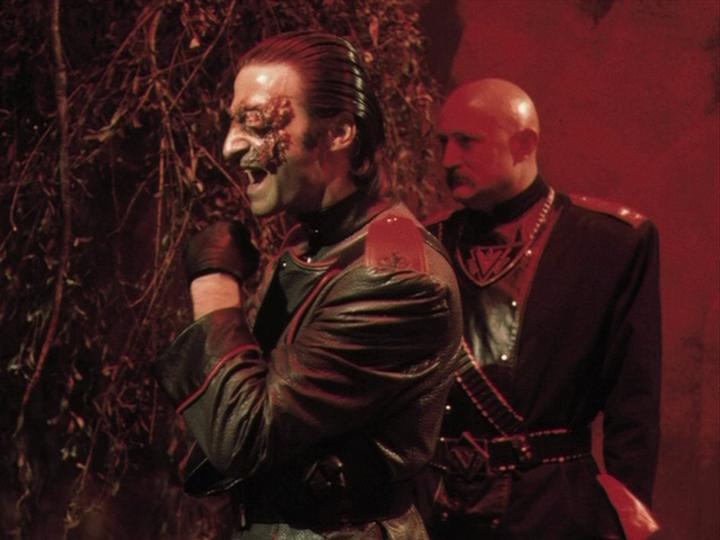
Bottom Line: You must invest a few dollars into this disc. I am the Master and you will obey me. You will buy “The Reign of Terror”…You will buy “The Reign of Terror”… You will buy “The Reign of Terror”…

DVD Extras: All six episodes – regardless of the participants – are moderated by Toby Hadoke. We love Toby. The existing episodes feature Carole Anne Ford, along with guest stars Neville Smith, Jeffry Wickham, Caroline Hunt, Patrick Marley, and production assistant Timothy Combe. Animated Episode Four features actor Ronald Pickup (The Best Exotic Marigold HotelWho was his first TV gig) and Episode Five offers a fascinating discussion with missing episode hunters Philip Morris and Paul Vanezis. “Don’t Lose Your Head” is a 25-minute making of with Russell, Ford, and Combe. There are also a couple throwaway bits of animation, but no talk of the process itself (for shame!). There’s also a gorgeous photo gallery loaded with nice color behind the scenes shots, Radio Times listings in PDF form, production notes subtitles option on the four existing eps, and a trailer for the special edition of “The Ark in Space” which will be available next month.

**Updated! March 5th - Having spent nearly three hours in the company of the classic Doctor Who DVD range commissioning editor Dan Hall at Gallifrey One a few weeks ago, this post begged for an addendum. According to Dan, the specific sales of “Reign” will not and have not had any direct effect on the potential release of future animated DVDs. This was of course backed up by the announcement of “The Tenth Planet” with an animated Episode Four less than a week after “Reign” was released. And since then, there’s also been confirmation of the upcoming “The Ice Warriors” with animated Episodes Two and Three. Both of these productions were well under way at the time of “Reign’s” release. So, Rued apologies to anyone who went out and picked up that disc at my rather frantic urging, but I imagine the worst that’s happened is that you now own a Doctor Who DVD that you previously did not.

Dan Hall at Gallifrey One 2013
On a different note, a few words about Dan Hall…this man loves classic Doctor Who as much or even more than the most fervent of us. A big reason these DVDs kick so much ass? Dan. After having been led to believe over the years that he was some sort of number-crunching suit, it was refreshing to discover that nothing could be further from the truth. As I said, he spent three hours with about a half a dozen Doctor Who DVD freaks talking over one another, patiently listening to an endless barrage of praise and complaints, never once getting ruffled. The man was a pure joy to hang with, and he’s got plenty of surprises for us in the coming year…and maybe even after.

Also check out my previous article on "The Invasion" - the only other classic Who story to get the animated treatment thus far.


Thursday, January 24, 2013

Doctor Who: Shada with More Than 30 Years in the TARDIS DVD review


The first classic Doctor Who DVD release of the year will appeal mostly to the hardcore fan and collector. This three-disc set features “Shada,” the almost preposterously infamous unfinished Season 17 serial starring Tom Baker and Lalla Ward, alongside the 1993 30th Anniversary documentary, “More Than 30 Years in the TARDIS.” Also enclosed is quite the array of documentaries and interviews, yet by the time you’re finished, the entire collection really just feels like three discs worth of extras. Now, if you’re into classic Who DVD extras, this set is prime fodder for you. If not, it’s little more than an extensive collection of bits and bobs that will likely hold zero appeal for those who’ve no interest in such minutiae. Now that we’ve got that sorted out, you can stick with me or move on.

Due to an industrial strike, only about half of the early-1980 six-episode “Shada” was completed. No doubt a big reason so much mystique surrounds the story – which centers on a powerful Gallifreyan book and a lost prison planet of the Time Lords - is because it was written by then-script editor Douglas Adams. It was a hasty contribution to the season after another story fell through, and Adams allegedly had no great love for it, though he did reuse some elements of it in his novel Dirk Gently’s Holistic Detective Agency.

The existing footage of “Shada” languished until 1983, when Tom Baker decided not to take part in “The Five Doctors,” at which point producer John Nathan-Turner (with Baker’s permission) used several scenes of the Fourth Doctor and Romana in the special. For years this was all of “Shada” that was available for public consumption. Finally, in 1992, JN-T brought what exists of “Shada” to VHS, along with a score by Keff McCulloch, some appropriately low-fi effects work, and Baker himself providing linking narration for the parts that did not exist. This program is the main feature on this DVD, “newly restored from original film negatives and studio recordings” (per the back of the set).

The concept works pretty well for the first couple episodes - much of which takes place and was filmed in Cambridge, and that footage is an absolute delight. But as the tale moves forward, the enterprise becomes increasingly clumsy, and certainly by the time one gets to the last couple of episodes it no longer works as much of anything but an uneven document of what might have been. Now if only this presentation were the final word on “Shada,” I could stop here.

The Whovian fascination with “Shada” never truly waned, which is rather understandable given how unsatisfying the VHS version was. A flash animated webcast produced by Big Finish and retconned to feature Eighth Doctor Paul McGann, alongside Ward and John Leeson as K-9, was released in 2003. It, too, is present on Disc One of this set, though it can only be viewed on computer, which is a mild shame for those of us who hate viewing programs on our PCs (granted, I am probably in the minority). The animation is extremely clunky insofar as its movement goes, though the pictures can be pretty at times. Some may find it almost as limiting as viewing the VHS version. This version is also available as an audio play through Big Finish.

Fan freak Ian Levine has since funded a full-blown animated version of “Shada,” though who knows when and where that will see the light of day. It’s a shame it isn’t part of this DVD, but given Levine’s prickly reputation, it’s anyone’s guess what hoops he’d have made the BBC jump through to include it (snarky speculation on my part - nothing more). And then, finally, there’s the official novelization written by Gareth Roberts, which was released a year ago, and was followed by an audio book read by Ward. There are all sorts of ways for the Doctor Who fan to imbibe in “Shada,” and this DVD presents two of them. Also present on Disc One is a trailer for the upcoming DVD release of “The Reign of Terror” (though curiously sans any bits of the animation that's been created to complete its visuals), and the production notes subtitle option for the VHS version of “Shada.” There is no commentary track.

Still from the flash animated McGann "Shada"
Moving on to Disc Two, which features a 25-minute documentary devoted to the tragic non-production of the serial, entitled “Taken Out of Time,” which features interviews with Baker and director Pennant Roberts among others. Another fascinating doc, entitled “Strike! Strike! Strike!” (27 min.), details the numerous times Doctor Who, as well as some other BBC programs, have been affected by strikes over the years. “Now and Then” is the now familiar location report, this time on “Shada” (it’s somewhat reassuring to see how little has changed at all the Cambridge locations). “Being a Girl” is a half-hour look at how women are represented in the series (really, this thing could have been three times as long and still not said everything). There’s also a 10 minute photo gallery from “Shada.”

For many, though, it’ll be Disc Three that shines brightest, as it contains “More Than 30 Years in the TARDIS,” a 90-minute doc that’s whimsically nostalgic magic works as well today as it did 20 years ago. Written and directed by a guy named Kevin Davies, this thing soars, and absolutely deserves to be seen and imbibed in at some point during Who’s 50th Anniversary year. The BBC is said to be producing a new documentary celebrating 50 years, however it cannot be narrated by Nicholas Courtney, as this one is, and Lis Sladen and Jon Pertwee cannot take part as they do here. This is a lovely, well-rounded piece, loaded with clips from all eras of the classic series, and featuring opinions and thoughts from a wide variety of classic Who talent, all wrapped around a storyline (of sorts) of a young boy exploring and being affected by the many worlds and aspects of Who.

Additionally, Disc Three features unrelated interviews with Peter Purves and Verity Lambert, as well as Nick Courtney’s final interview (26 min.), which is just about perfect and features a surprise guest. For the Brig fans out there, this one’s a keeper. A doc called “Those Deadly Divas” plays well alongside the “Being a Girl” doc from Disc Two; this one focuses on the darker sides of women in Who, and features interviews with Kate O’Mara, Camille Coduri, and Tracy-Ann Oberman along with Gareth Roberts and Clayton Hickman. Lastly, there’s a photo gallery of behind the scenes shots from the “More Than…” documentary.

Wednesday, January 02, 2013

Cosmopolis: Blu-ray review

On paper, the marriage of cult film director David Cronenberg and cult novelist Don DeLillo is no doubt an ideal one, but movies require bringing dozens or even hundreds of other random factors into the mix, and it’s the director’s job to bring all of it together into one cohesive vision. Cosmopolis should have been a masterpiece, and bubbling away beneath its immensely flawed surface, one can see that masterpiece lurking. Unfortunately, the film is painted wall to wall with an uninspired, thoughtless and flat performance from Robert Pattinson that drags the entire affair down to nearly unwatchable. He is in every scene and the entire picture revolves around him. Understand, I’ve nothing against Pattinson. Being largely unfamiliar with his work, I went into Cosmopolis assuming that Cronenberg would work cinematic legerdemain with the actor, as he has done countless times before with dozens of players. He did not.

Read the rest of this review by clicking here and visiting Bullz-Eye.

Wednesday, December 26, 2012

Doctor Who: The Snowmen

Back when it was announced that Steven Moffat was taking over for Russell T. Davies, he made a comment in an early interview about how his take on Doctor Who would be like a series of “dark fairy tales.” Likely realizing that phrase wasn’t the most conducive to garnering sci-fi fan support, he recanted the statement not long after, saying he’d misspoke, or whatever kind of jive doublespeak a showrunner uses when he has to cover his ass. In any case, while Moffat’s version of the series proper doesn’t warrant the label, his Christmas specials are most certainly dark fairy tales, and “The Snowmen” continues the tradition, although it centers around a Doctor in a decidedly less-than-festive mood.

The episode stops short of transforming the Doctor into a Grinch, which is a shame, because it would’ve been a bold move to showcase a Doctor with no patience for the holidays whatsoever — a harsh contrast to his attitude in all the Christmas specials that have come before. This is also one of the least Christmas-y Christmas specials yet, with only a couple throwaway lines referencing the season; drawing attention to the holiday would have been akin to throwing it in the Doctor’s face, and he’d then have had to demonstrate some annoyance with it. Variations on the rally cry “He should’ve done it this way … ” are commonplace now, seemingly with each new episode, so it’s probably better to not focus on what wasn’t but rather what was, otherwise I could be here for hours.

Read the rest of this recap by clicking here and visiting Vulture

Tuesday, December 18, 2012

Separated at Birth?


Snow Miser (voiced by Dick Shawn), from the 1970 Rankin Bass holiday special, The Year Without a Santa Claus, and the Third Doctor (Jon Pertwee)? 

Tuesday, December 11, 2012

Doctor Who: Series Seven, Part One Blu-ray Review


Having recapped/reviewed all five of these episodes for Vulture back in September, I’m not going to talk specifically about each of them, but since the folks at BBC America were kind enough to slide me a review copy of this set, it seemed like the decent thing to do would be to write a few words about it.

Aside from the stellar audio and video quality, I was most taken with the extras on the second disc. The entirety of the web series “Pond Life” is available on here with a “play all” feature, effectively turning it into a seven-minute short film, which now makes for quite the nice preamble to the mini-season which saw the exit of the Ponds. Likewise, the prequel for “Asylum of the Daleks” should also be viewed prior to watching the episode itself. Really, this stuff should’ve been placed on the first disc, but that minor gripe aside, it’s all a welcome inclusion. However, a second prequel, entitled “The Making of the Gunslinger,” is best viewed after watching “A Town Called Mercy,” otherwise it robs the story of some of its dramatic heft.

Beyond those narrative-enhancing bonuses, the set also offers up one of the four 45-minute specials – “The Science of Doctor Who” - presented by BBC America in the weeks leading up to the premiere of “Asylum”; the other three specials are available on their own disc in the massive and probably now hard to find Doctor Who gift set that was released last month. Lastly, there’s a ten minute piece with Smith, Gillan, Darvill and Moffat fawning and being fawned over at Comic Con.

All in all, this is a fine set and an excellent stocking stuffer for the Whovian in your life. Sure, most of what’s on here will be duplicated on the inevitable Season Seven box set, but this Blu-ray makes a lovely placeholder for those who don’t want to wait another six months to see these final adventures of the Doctor and the Ponds in full, uncompressed 1080i glory.

P.S. Asylum of the Daleks gets better with each viewing; best Dalek story since 2005's “Dalek from Rob Shearman, by a mile.

Monday, December 10, 2012

Doctor Who: The Claws of Axos Special Edition DVD review


“Look, Lois, ever since marijuana was legalized, crime has gone down, productivity is up, and the ratings for Doctor Who are through the roof!” - Brian, Family Guy, “Episode 420”

For no less than three different reasons, that remains some of my favorite Family Guy dialogue ever written. It’s anyone’s guess how many Doctor Who fans watch the show in altered states of mind, but now, here in the States, folks in Washington can at least do so openly and without fear of persecution. They can hold massive, marijuana-fueled Who marathons, and any such festival will most surely want to include “The Claws of Axos,” which is not necessarily one of classic Who’s greatest stories, but it’s certainly one of the trippiest.

The plot is no great shakes. It’s a standard alien invasion yarn, that’s hook is “they appear to come in peace, but actually have ulterior, sinister motives.” This is the sort of sci-fi tale that’s been told thousands of times, and by that measure, “The Claws of Axos” will not rock your world. However, Roger Ebert’s old rule – one by which I live and never pass up the opportunity to quote - is, “It’s not what a movie is about, it’s how it is about it.” And it’s the “how” of “Axos” that makes it such a classic. Just recently one of my Whovian brethren, Lee Hurtado, of The Hurtado Street Theater, was telling me how he got into Who, and explained that even though he’d seen several stories prior, it was “Axos” that eventually sold him on the series. The serial is so damn committed to its own weirdness, that you really cannot take your eyes off of it, and it does sort of beg the question, for the uninitiated at least, “What the fuck is this!?!?”

The first ten minutes of the first episode alone declare, like Laverne and Shirley, “We’re gonna do it our way,” due in no small part to the character Pigbin Josh, a filthy, disgusting, seemingly homeless man (played by stuntman Derek Ware), whose sole function in the story is to be the first victim of the claws of Axos, so that the viewer knows right off the bat that the golden Axons are hostile, despite their benign presentational ruse later on in the tale. Anyway, during this first ten minutes, the action cuts back and forth from the arrival of the Axons, to the Doctor and UNIT, to this character, Pigbin Josh, wandering around in the snow, doing an awful lot of talking to himself, and none of it intelligible. Thankfully, somebody has transcribed some Pigbin speak and put it on the official BBC classic Who website for all to attempt to decipher:  

“Furge thangering muck witchellers rock throbblin' this time o' day Ur bin oughta gone put thickery blarmdasted zones about, gordangun, diddenum? Havver froggin' law onnum, shouldnum? Eh? Eh? Arn I?”

Ahem. Ah, well, yes. If youre an American fan raised on the Peanuts, you’ll quickly begin referring to him as Pigpen Josh, because that makes more sense to a Yank. Now if only Josh were the end of The Weirdness of Axos, which would’ve been a wholly appropriate name for this tale. The Axon ship, years before Farscape’s Moya, is a living ship. Its organic interior is the sort of thing to be hallucinated in the most unsettling of LSD trips, and even as I sit here trying to think of how to describe it, I’m resigning myself to falling back on some sort of clichéd “it defies description” type of line. Really it does, much of which is due to Who’s low budget. Had millions been pumped into this, we may have had a place from which to start talking, but as is, it’s just weird a hodgepodge of bizarre soft angles, vaginal doorways and the occasional crab claw. Oh, and plenty of acid slides. 

Nothing will prepare you for the arrival of the eyeball of Axos, which dangles in exactly the same way a limp penis might, and issues commands and orders in a creepy, hollow voice. Then there are the golden Axons themselves, who are such a striking creation that even in a story that’s as visually whacked as this one, they’ve sort of become the thing “Axos” is most well known for. Or are they? Because later in the story, the Axons reveal another form, which is a hulking, red mess of tentacles - a look which is almost as iconic as the golden versions of Axos. It is debatable, I suppose, which Axon form is the more iconic; the tentacled version has actually been turned into an action figure, while the golden has not (updated 01/06/2014 - now it has), which could be part of the debate. In any case, the fact that the production team achieved two entirely different looks for this race that are both iconic to such degrees is high praise indeed.

So, I’ve pretty much gotten to the point where I’m realizing exactly how balls out crazy I’ve made “Axos” sound, which was sort of the point, because you’ll see things here you can’t unsee, or see in any other Doctor Who story. Should you, as Dazed and Confused advised upon its release, “See it with a bud!”? Most certainly, if and only if that’s your sort of thing. The story works just fine, however, if you’re sober. For a more coherent breakdown, and one mired in actual criticism, I turned to the aforementioned Lee Hurtado, who, to the best of my knowledge, does not engage in the sorts of activities spoken of here. He laid it out thusly:
           
“There was alchemy at work in the story, something that brought its disparate elements together in a way that shouldn't have worked as it did. The limited production values, the garish visual aesthetic of the Axons, a plot that's at once simple and well over the top, and (of course) the marvelous performances of [Jon] Pertwee and [Roger] Delgado - all combined to create something I recognized as truly alien, and therefore truly original. From then on, my fate was sealed. I was, and am, the Doctor's.”

On a completely different, and in my opinion far less interesting level, anyone who owned the original DVD of “Axos” no doubt knows that the quality of Episodes Two and Three was dodgy at best. New tech has emerged since then, bringing both eps up to a quality comparable to Episodes One and Four, and therefore totally justifying this special edition. For the hardcore Who nut, this isn’t just double-dipping for double-dipping’s sake, it’s quite possibly an essential.


DVD Extras: Almost everything that was on the original DVD (including the commentary with Katy Manning, Richard Franklin, and Barry Letts) has been ported over onto this new double-disc set, except for a ten-minute documentary entitled “Reverse Standards Conversion: The Axon Legacy,” which was a look at the restoration given to the story for the original DVD release; that information is not applicable to this new release, so it has been excised. No new doc, detailing the recent restoration work, was produced to take its place, however there is a fresh, new article up at the Restoration Team’s website detailing the work that went into this special edition.

New to the table is a 26-minute making of doc entitled “Axon Stations!,” which, amusingly, goes into detail about the sheer drugginess of this story, and also spends time discussing the story’s writers, Bob Baker and Dave Martin (the former went on to write Wallace and Gromit). Quite possibly the best extra, however, is “Living with Levene,” in which Toby Hadoke spends the weekend with John Levene (Sgt. Benton), who comes across as a fascinating eccentric, and quite possibly Doctor Who’s most uncelebrated MVP. Finally, partially new to the table is 73 minutes worth of rare “Axos” studio recording, some of which appeared on the old disc in a much shorter version (inexplicably duplicated here as well on Disc One). The Radio Times listings are also presented in PDF form. Additionally, there’s a coming soon trailer for the long awaited release of the unfinished story “Shada,” which will be hitting DVD in January, in a box set along with the 1993 documentary “More Than Thirty Years in TARDIS.”


Saturday, November 03, 2012

Binder's Full of Women: The Evolving Art of the Classic James Bond Title Sequence


Over the years James Bonds came and went. Directors and writers shifted and changed. Vocalists were routinely swapped out. Though not the only constant in the Bond franchise, Maurice Binder, as the primary designer of the instantly recognizable title sequence, was certainly one of the most noticeable ones. For the bulk of Bond’s first 27 years, Binder brought us a cavalcade of swirling colors and curvaceous ladies, typically set to the tune of a current pop sensation. His job was to help set the tone for the film to come by presenting elements and themes from the movie in an abstract, artistic fashion. For many, these title sequences became an important, even necessary part of the Bond movie-going experience, and remain so today, over 20 years after Binder’s passing. Here we take an entirely subjective look at his ongoing contributions to cinema’s longest-running movie franchise.

The first thing ever seen in a Bond movie is the opening gun barrel sequence, and no amount of praise can be too effusive for Maurice Binder’s creation of it. James Bond emerges in profile from the right, caught in the movie viewer’s cross hairs. He then spins around, shoots, and the gun sight fills with, presumably, the viewer’s blood.


It’s become part and parcel of the Bond films ever since, though only in Dr. No is it part of the title sequence proper; afterwards, it would be separated from the titles by the now also iconic pre-credits sequence. Coupled with the infamous Monty Norman-composed Bond theme song, the gun barrel sequence is that instantaneous moment when everyone simultaneously acknowledges they’re watching a Bond film.

After the gun barrel sequence, flashing colored lights set to the Bond theme reveal the title “Dr. No” as well as the cast, followed by the silhouettes of people dancing a sort of Jamaican mambo, and, finally, a calypso version of “Three Blind Mice” dovetails nicely into the movie itself. The Dr. No titles are a lot fun and unique in the Bond film series; the only real element of them that would come to feature heavily in the future is Binder’s inventive, energetic use of silhouette.

Read and watch the rest of this piece by clicking here and visiting the Bullz-Eye Blog.

Friday, October 05, 2012

October 5th, 1962


Oct. 5th, 1962: The first James Bond film, Dr. No, is released in U.K. theatres. On the very same day, the Beatles released their first single, "Love Me Do."

So somewhere in London, somebody walked out of a screening of Dr. No, dazzled by Ursula Andress, and then headed over to the record shop and picked up a new single, by a then unheard of band.

Little did that person know that these two pieces of art would be benchmarks by which so much other pop culture is measured 50 years later.

What a thoroughly amazing day Oct. 5th, 1962 was!

Sunday, September 30, 2012

Doctor Who: The Angels Take Manhattan


It would be easy to pull “The Angels Take Manhattan” apart for one little thing after another, and many people no doubt will. Even if they do, that doesn’t make it a bad or a weak episode, but it does point to how complicated this series has gotten over the years, much of it due to the heavy injection of romance. “Angels” isall about romance, though it wants to be about plot, too. Here’s where Steven Moffat has a tendency to trip up in his writing, because his aim is to deliver a big twisty-turny story alongside gushy-wushy emotions, and it’s becoming increasingly difficult for him to do both, especially where long term arcs are concerned. Classic Doctor Who didn’t have this problem, as it wasn’t cluttered with complicated feelings between its characters (or extended story arcs, for that matter). If the Doctor said he couldn’t go back and save Adric from being blown to smithereens, we believed him. There were certain laws of time that couldn’t or shouldn’t be broken, and it made perfect sense.

Now we have a Doctor Who that not only features a godlike central character who appears to be governed by nobody outside of himself, but who’s also an extremely clingy, emotional being, desperate to hang on to his companion, possibly even at the expense of her own husband. So when the script puts him into the position of claiming to be unable to do anything about the situation Amy and Rory find themselves in at the close of this episode, it’s an almost impossible notion to swallow, because in any other episode besides this one, it would’ve been quickly remedied, probably with the wave of the sonic screwdriver.

Read the rest of this recap by clicking here and visiting Vulture.

Thursday, September 27, 2012

Absolutely Fabulous: 20th Anniversary Specials DVD review


A few years ago, in a review of the complete series box set of Absolutely Fabulous, I wrote, “Even though the name of this set is ‘Absolutely Everything,’ I wouldn’t put it past Jennifer Saunders to revisit Edina Monsoon at some point in the future. She’s seemingly ended Absolutely Fabulous so many times and then come back to it that it’s hard to believe that it’ll ever truly be over.”

If it weren’t such a no-brainer that Saunders would've again charted the Ab Fab waters, I’d be tempted to gloat. The 20th Anniversary Specials are three, 30-minute episodes, and they’re every bit as funny as the reams of bawdy, satirical nonsense that preceded them. I’m not sure I have a whole lot more to say about this show that I didn’t say in the last review, other than Saunders is more than welcome to continually drop in on these characters time and again, forever, because the joke never gets old (at least not in these tiny increments), and even 20 years after it all began, Jennifer, Joanna, Julia, Jane, and June still have the ability to make me fling my arms around, and cackle at the ceiling.

The first episode, “Identity,” sees Saffy returning home after having done a couple years in prison for creating fraudulent passports. She invites a fellow inmate, Baron (Lucy Montgomery), to come and stay at the flat. Turns out, Baron and Patsy have a sordid history together, and suddenly the inmate’s stay takes a potentially dangerous (but still funny) turn. In this one, Edina has a brief dream sequence that’s the result of her watching the Danish version of The Killing, and the star of that series, Sofie GrÃ¥bøl, makes a brief cameo.

“Job” sees Edina and Patsy attempting to resurrect the career of fictional faded 60s film icon Jeanne Durand (Lindsay Duncan), who’s sort of a version of Catherine Deneuve, I guess, if Deneuve had quit working 20 or 30 years ago. Only problem is, she cannot sing, literally – no sounds comes out of her mouth, and Edina and Patsy have booked the Royal Albert Hall! This episode features appearances from Emma Bunton, Lulu and La Roux.

The third and final installment is probably the one to beat. “Olympics” guest-stars Stella McCartney, as well as Olympians Kelly Holmes and Tanni Grey-Thompson, yet the plot is threadbare, but involves lots of sight gags and physical humor, and is chock full of the sort of stuff Ab Fab does best.

Additionally, classic guest characters Justin, Sarah, Bo, Marshall, and Patsy’s co-workers Fleur and Catriona, each get a few minutes here and there, but once again, as has so often been the case, Jane Horrocks steals every scene she’s in as Bubble (and she’s in all three episodes). This is a fine celebration of 20 years of Ab Fab, that never goes overboard, or feels pathetic or dreary like so many such celebrations. It’s just more, good Ab Fab, plain and simple, and this disc would make a great birthday gift or stocking stuffer for the Ab Fab fan in your life, or indeed, for you sweetie dahling!

DVD Extras: A quick Comic Relief sketch, “Ab Fab Does Sports Relief,” also featuring Bunton and McCartney, is best viewed in between “Job” and “Olympics.” There’s also a behind the scenes bit on the sketch.   


Sunday, September 23, 2012

Doctor Who: The Power of Three


If you didn’t find yourself humming the tune (and theme song to Weeds) “Little Boxes,” after watching this week’s episode of Doctor Who, you’re made of much stronger (or are at least less pop culturally obsessed) stuff than I. Too bad that isn’t the worst thing that can be said “The Power of Three,” which was a mighty letdown after the last three installments, and only one week before the big Pond finale.

"It’s Doctor Who from Amy and Rory's point of view. We're in the last days of the Ponds as everybody keeps saying, and it was really a chance to see where they've got to in their lives since “The Eleventh Hour,” and to see what it’s like to be them. And I think what’s interesting is that the companion/Doctor relationship in this series is very different to any we’ve seen before because really, they're part-time travellers. They’re living at home, and the Doctor pops in and goes, "Shall we go somewhere?", and they're off. That's very new, because they're not permanently with him, and I wanted to see what that would mean. I think it's very different to pretty much any other episode of Doctor Who ever, which is both wonderful and terrifying." - Chris Chibnall, writer of “The Power of Three”

Let’s start by addressing the “it’s different than any other episode” claim, which is simply not true. “The Power of Three” is all but a carbon copy of the Gareth Roberts penned episodes, guest starring James Corden, of the last two seasons, except that instead of the Doctor hanging out with Craig, or Craig and his baby, he’s hanging out with Amy and Rory. That formula was novel the first time in the form of “The Lodger,” but had the serious stench of been there, done that surrounding it once “Closing Time” came around, and by now it just smacks of desperation, and the need to make an episode which will save the season some money. That last part is perfectly understandable, but couldn’t something better than this have been devised?

Wednesday, September 19, 2012

Doctor Who: Vengeance on Varos Special Edition DVD review

A couple years ago, upon the release of “The Twin Dilemma” - which despite being the first story of the Sixth Doctor, was the final tale of Colin Baker’s to get a DVD release – it felt like the last time I’d be writing about this most divisive era of the classic series for a good long while. But then came the special edition double-dip craze, and a question was posed to fans, “Would you like to see a special edition of ‘Vengeance on Varos’?” And the answer was an enthusiastic yes. But since this is a double dip, rather than talk about “Varos” exclusively, I’d like to use this space to discuss Season 22 as a whole.

“Varos” in many ways exemplifies and is emblematic of the season, given its dark and violent satirical nature. Many claim the story the high point of Baker’s entire stint, something I probably wouldn’t argue, though it’s never been a big favorite of mine. From his era I prefer “The Two Doctors,” “Revelation of the Daleks,” and even “Mindwarp,” which was a sequel (of sorts) to “Varos” from the “Trial” season. Yet through this DVD I gained a considerable appreciation for “Varos” that I didn’t have before, or at least the first half of it, as the second half never quite delivers on the promise of the setup, though your mileage may vary.

There’s a bigger picture here, though, and for better and/or worse, Season 22 is unique in the history of the series. Though the previous season had toyed with a 45-minute episode format via “Resurrection of the Daleks,” that story wasn’t envisioned, scripted or shot to be screened as two 45-minute episodes. But the screening was judged a success, and so when Season 22 was commissioned, the plan was to move ahead with an entire season of 13 45-minute episodes. Sound familiar? It should, because that's essentially the format for a season of the new series. Unfortunately, Season 22 was such a departure on so many levels from the Doctor Who BBC audiences had come to know and love over the previous 21 years, that it was ultimately deemed a failure, and the show was put on hiatus, and ended up going back to the 25-minute format a year and a half later. But as a result of the format change, these six stories have a much different feel than other tales of the classic series. They do not move in quite the same way as the 25-minute format, and it’s typical for the Doctor and Peri to become involved in their adventures at a much more leisurely pace, for instance. They are closer to the tempo of two-parters of the new series, than they are to the four-parters of the classic.

Season 22 has a pretty bad reputation, mostly for all the wrong reasons, and there’s only one truly poor story (“Timelash”) in the half dozen, with the other five ranging from watchable (“The Mark of the Rani”) to good (“The Two Doctors”) to arguably excellent (“Revelation of the Daleks”). There’d certainly been plenty of Doctor Who seasons past with far worse good to bad ratios, though as with so much TV, ratings played a part, and the ratings for Season 22 were less than stellar. But the content was the real killer, and one wonders what might’ve been if Season 22 hadn’t felt like such an upheaval.

The new Doctor was considered by most to be unlikable. There’s surely no Doctor in the history of the series that was and is less liked en masse than the Sixth…though personally I’ve an enormous appreciation for him, and even many fans have grown to love Colin Baker and Doctor #6 through his work on the Big Finish audios. But it’s easy to look at his performance from the time, and see why it was so unpopular. This Doctor didn’t feel like a hero, and the Doctor, no matter how diverse his personality may become, must always be portrayed as a hero, even if it’s a flawed one. Perhaps the Sixth Doctor was a flawed hero, but his boastful, obnoxious manner wasn’t the right complement for viewers adjusting to the loss of Peter Davison. Yet from the vantage point of today, the Sixth Doctor is arguably a fascinating slice of Who, and one that’s much easier to digest as a small part of the now much larger whole.


Nicolas Chagrin as Quillam and Forbes Collins the Chief Officer

Perhaps even more controversial than the abrasive Doctor, was the show’s violent content, which appears to be a logical extension of the violence in the preceding season’s “Resurrection of the Daleks,” as well as “The Caves of Androzani,” both of which were considered successful serials. But whereas the violence in those stories was mostly justified, there are too many times in Season 22 in which the show feels as though it’s engaging in mayhem just for the sake of it. Random acts of brutality occur around and sometimes even because of the Doctor, which he’s uninterested in addressing (or if he does, it's with a tasteless pun). As a teenager, it didn’t occur to me that Baker’s era was necessarily harsher than the material that came before it, but as an adult I’m able to see what all the fuss was about. Thing is, I really don’t mind it, because the violence here remains child’s play compared to the endless displays of cruelty I’ve seen in all manner of TV and film over the years, and because it hardly defines the series as a whole, and just happens to be where the series was at this particular point. 

Martin Jarvis as the Governor
It’s the satire, probably, that really kills this season for so many people. There’s often a wry undercurrent of sadistic humor that pervades these stories (which, when presented alongside the violence and the snotty Doctor, can feel weirdly oppressive) and never more so than in “Vengeance on Varos,” which thrives on it. The story revolves around the class and political structure of the titular planet, which is a dreary sort of place that can most easily be described as Orwellian. On Varos, the populace seemingly works all day at the mines (the planet’s most valuable resource is an ore called Zeiton-7), and spends all night viewing the cruel displays of torture of political prisoners on their big screen TVs. Meanwhile, the actions of their leader, the Governor (Martin Jarvis), must be voted on from within individual households. Basically, everyone has access to their very own “yes” and “no” buttons, and if enough nays are pressed, what appears to be a beam of radiation comes cascading down onto the Governor for all his constituents to see. So it’s only a matter of time until a new Governor must be put into place, because the system is set up so that its leaders must ultimately fail and die.

Nabil Shaban as Sil
If you’ve not seen “Varos,” you can already pretty much glean whether or not it’s your cup of tea, and it’s hardly light entertainment. It boasts an early performance from the 21-year old Jason Connery, as the rebel Jondar, but what “Varos” is probably best known for is the reptilian villain Sil (Nabil Shaban), who’s sort of the breakout creature of the second Baker’s era. Again, I’d take some issue with that, as I’ve never been a giant Sil fan, yet it’s easy to see why many folks are. He’s a sleazy, slimy creepy little thing, that’s something of a triumph of the makeup and/or effects departments of the time. And he’s got a fair share of decent lines, assuming you can understand him.

“Vengeance on Varos” is tough to recommend for, well, for all the reasons I’ve written here. For someone who’s never seen it, it’s a fair representation of this era of the series, and - my overall opinion of it notwithstanding - there’s no question that it’s the most original story of the season, and probably of the entire Colin Baker era. And here in the States there can be no better time to view it than now, given that the political season is upon us, and there’s nothing in “Varos” uglier than what we’re often seeing on TV right now, or reading on the internet every day. You may even find it a sort of release from the frequent mockery of the American political system you’re forced to endure from one day to the next, and you’ll very likely come away from it wishing you had “yes” and “no” buttons of your very own.


Jarvis, Jason Connery and Baker

DVD Extras: All the extras from the original disc seem to have been ported over, including the commentary track featuring Baker, Nicola Bryant and Nabil Shaban, so if you’re a “Varos” fan, you can safely pass your old disc on to a newbie. And if you are a “Varos” fan, I’m pretty confident in predicting you’ll want to make the double dip for this double-disc set. There’s a 32-minute making-of called “Nice or Nasty” that’s appropriately over the top in its exploration and presentation. (Sadly, no Jason Connery, though!) “The Idiot’s Lantern” is a fine, but short piece on the show’s relationship with television over the years (as in how TV is portrayed within the series itself). There’s a 17-minute selection of deleted and extended scenes, which is more than what was on the original disc I think, as well as three minutes of outtakes. The infamous acid bath scene is presented with alternate music in the extras as well. “Tomorrow’s Times – The Sixth Doctor” was reason enough for this double dip; the DVD range would’ve had a big hole without it!

There is also a news item on Colin’s casting, and some Colin talk show appearances from Breakfast Time and Saturday Superstore (the latter also features Bryant, and a phone-in from the Master!). I guess these haven’t been on DVD before, but honestly it’s hard to keep track. There’s a rare French & Saunders sketch with the ladies playing Silurians on the set of a fictitious Who taping that’s great fun, and the opposite of the Jim Broadbent bit I recently trashed. There are the usual Radio Times listings in PDF form, as well as a trailer for the eagerly anticipated “The Ambassadors of Death,” which is due out in October. Finally, the disc features a half a dozen different audio track options, which must surely be a Who DVD record: Aside from the commentary, there’s the original mono mix, a 5.1 Surround mix (that I personally found exceptional), an isolated music score, and the isolated music score in 5.1, and finally a clean production track with no sound effects or music! Go figure. Even better, go and enjoy!

Sunday, September 16, 2012

Doctor Who: A Town Called Mercy


The modern western is a fertile ground for writers to play around with morally ambiguous characters, and it was refreshing to see how deep “A Town Called Mercy” was willing to go in its exploration of morality, given that Doctor Who remains family viewing. What was touted to viewers as some kind of shoot ‘em up romp, ended up a thoughtful riff on maybe a half a dozen concepts of different shapes and sizes: High Noon, Leone’s spaghetti westerns, High Plains Drifter, Blade Runner, Frankenstein,The Terminator, and Westworld all leaped to mind while taking in this clever amalgam of ideas. Yet for all its inspirations, “Mercy” was mostly just some excellent, thought-provoking Doctor Who.

Rory: “The sign does say ‘Keep Out.’”

The Doctor: “I see ‘Keep Out’ signs as suggestions more than actual orders. Like ‘Dry Clean Only’!”


“Mercy” writer Toby Whithouse penned the second season Who tale “School Reunion,” in which Lis Sladen’s Sarah Jane Smith came back to us. It was early days still, and he was working with an iconic figure, so it was easy to forgive some of that story’s weaknesses, particularly in regards to the batlike, shape-shifting Krillitane, who weren’t especially memorable villains. A couple years later, he unleashed what he’s perhaps best known for, the supernatural vampire/werewolf/ghost series, Being Human.

Whithouse finally returned to the Who fold during the last two seasons with “The God Complex,” a script that felt like it was maybe trying too hard, and the year before that, with “The Vampires of Venice,” a script that felt like it wasn’t trying quite hard enough. Aspects all of his Who scripts share, however, are complex, sympathetic villains next to complex, flawed portrayals of the Doctor. With “A Town Called Mercy,” Whithouse has done it again, and this time better than ever before.

Read the rest of this recap by clicking here and visiting Vulture.


Tuesday, September 11, 2012

Doctor Who: The Gunfighters DVD review


With “A Town Called Mercy” debuting this weekend, it seemed like a good time to go back and take a look at the DVD of the last Doctor Who story that tackled the western, which was a long time ago - like, 46 years. Yes, we’ll have to travel all the way back to 1966, the third season, when William Hartnell was still the Doctor – the first Doctor…

The TARDIS arrives in Tombstone, Arizona, in a stable near the O.K. Corral. Predictably, it’s just days before the infamous shootout, but the Doctor hasn’t chosen the time and place on purpose. No, the TARDIS has randomly chosen Tombstone, while the Doctor has a serious toothache, and is in need of a dentist. Bizarrely, the fact that the American Old West may not be an ideal place to seek medical attention only becomes an issue when it's too late. The Doctor heads out into the town, along with Steven (Peter Purves) and Dodo (Jackie Lane) - collectively one of the least effective TARDIS teams, perhaps never more so than here – in search of a dentist. He finds one in the form of Doc Holliday (Anthony Jacobs), who’s just set up practice, and the Doctor is his first customer.

Post surgery, our Doc is mistaken for the other, and the first couple episodes mostly revolve around the time travelers being threatened and intimidated by the Clantons. But then Johnny Ringo (Laurence Payne[1]) shows up in episode three (aptly titled “Johnny Ringo”; “The Gunfighters” is in fact the final story to give individual episodes their own title), and events escalate towards the Gunfight at the O.K. Corral, around which the final episode is set.

“The Gunfighters,” back when I was a teenager, had one of the worst reputations of the entire series. People don’t say quite as many bad things about the “The Gunfighters” these days, but then again people don’t really say much about it at all. According to Wikipedia, back in ’66 it wasn’t the ratings that were a disaster, but rather the Audience Appreciation scores, which were among the lowest Doctor Who has ever received. It’s sort of easy to see why, too, for much of “The Gunfighters” is intentionally played for laughs, yet the jokes exist side by side with a fair amount of ruthless bloodshed.

So, “The Gunfighters” is funny and violent, and neither thing, at that time anyway, was Doctor Who necessarily well known for, never mind mixing them together. Add into that mix some frequently dodgy accents (though they’re not nearly as bad as reputation suggests), and the song The Ballad of the Last Chance Saloon[2], which plays ad nauseum throughout the entire four episodes, essentially narrating the story in a Greek chorus kind of way, and you’ve got a recipe for potentially one of the worst Doctor Who stories ever.

Except that it isn’t. Not quite. Looking at “The Gunfighters” through the eyes of today, it holds up well enough, all things considered, and kudos should be given to something that dared to be so bold and different during what was a fairly turbulent time for the series. Its moody lighting and the direction from Rex Tucker are also rather impressive. 

If it fails to engage, it’s not because its tone shifts all over the place, but rather because the leads are so ineffectual and unimportant to the storyline. The Doctor is utterly ill-equipped to deal with these ruthless sorts of folk. He’s out of his element here, and Hartnell seems to grasp that, and in turn does a remarkable job of doing almost nothing, aside from being a flustered old man. He’s hardly the hero of the tale, which makes for a much different dynamic, as one character after the next has no patience for this seemingly doddering geriatric and his goofy companions. It’s as if the story happens around them, and they have little effect on the outcome of events. On the other hand, it could be argued that this is a strength of “The Gunfighters”; that the Doctor cannot stride into every situation and have influence on the outcome. Indeed, the events of the O.K. Corral may very well be a fixed point in time, of the type that was outlined in “The Waters of Mars.”

It’s tough to recommend “The Gunfighters” to anyone but completists and the like, but at the very least, it’s certainly a more entertaining viewing than something like, say, “The Ark.” By premature comparison, “A Town Called Mercy” likely has nowhere to go but up. Last but not least, I would personally love to someday see the Doctor’s extracted tooth come back into play ala the Tenth Doctor’s severed hand. Silly fanboy wish; nothing more.

[1] Laurence Payne would go on to play major roles in the 80’s Doctor Who stories “The Leisure Hive” and “The Two Doctors.  

[2] The Ballad of the Last Chance Saloon was sung by Lynda Baron, who 17 years later played Captain Wrack in “Enlightenment,” and then 28 years after that, played Val, the department store clerk in “Closing Time.”


DVD Extras: Easy enough to recommend is the fascinating 43-minute documentary on this disc entitled “The End of the Line,” which details all the behind the scenes turmoil of the show’s third season. It’s worth checking out this disc for the doc alone. Beyond that, there’s a commentary track featuring actors Peter Purves, Shane Rimmer (Seth Harper), David Graham (Charlie), Richard Beale (Bat Masterson), and production assistant Tristan de Vere Cole, all moderated by the mighty Toby Hadoke. “Tomorrow’s Times – The First Doctor” is a featurette which looks at press coverage of the series during the Hartnell era. There’s also a photo gallery, production notes subtitle option, Radio Times listings in PDF form, and a coming soon trailer for “Paradise Towers.”