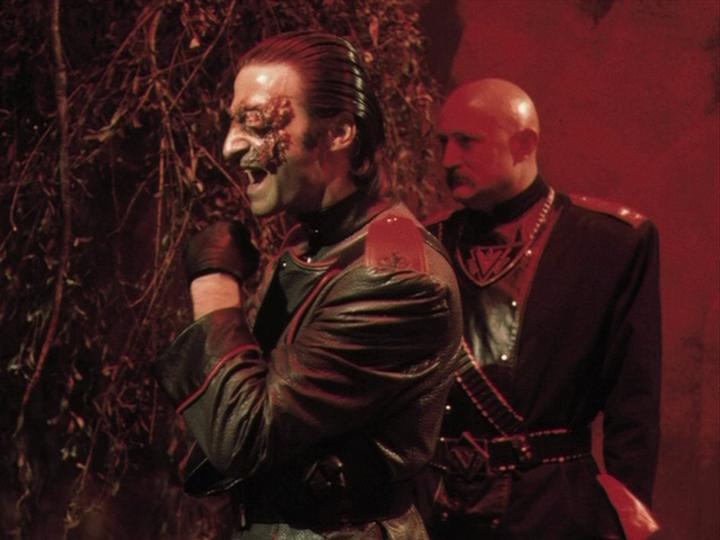
Showing posts with label Colin Baker. Show all posts

Tuesday, October 01, 2013

Doctor Who: The Doctors Revisited - Fifth to Eighth DVD review

And so BBC America’s celebration of 50 years of Doctor Who continues with “The Doctors Revisited” series, not only on the network, but also on DVD, where its presentation is considerably more celebratory, rather than an irritant. As you may recall, in my recent review of the first volume of this DVD series, I ranted and raved about the decision to stretch the 4:3 image to fit 16x9 flatscreen TVs, but ultimately forgave it since the DVD presents, alongside the distorted version, the original square(ish) imagery, in its original episodic format.

The presentation has not changed for the second volume, though it’s worth mentioning that the prints used for the stretched feature presentations are in much better shape than some of those used on the previous set (no doubt due largely to the newer age of the serials). One thing that I didn’t make room for in the previous review is the method used to stretch the serials, which is something I’m not sure I’ve seen before. If you look closely at the images, you’ll see that about the center third of the original image – the area where the eye is typically focused – is not actually stretched at all, and that the real stretching is only of either side of the image. This is a pretty fascinating technique, and is probably why these presentations don’t look particularly offensive to many an eye (most people are not as fussy as I am). Of course, this presents a problem if you use the aspect ratio buttons on the TV remote to try to alter the image back to its 4:3 image – it simply doesn’t work, and results in a different kind of stretching altogether.

So once again we come back to the original episodic broadcast versions to get us through the night. Given that the aim of these sets is to introduce viewers of the new incarnation of the series to the classic, this volume strikes me as being friendlier toward modern audiences than the last one. While I find it difficult to believe that “Pyramids of Mars” would turn anyone off the classics, who but the most hardcore among us will find a great deal of entertainment value in “The Aztecs?” The serials (and movie) presented here are somewhat closer in pacing and characterization to what audiences of today are used to seeing. 

Peter Davison: A Doctor of action?
This set kicks off with friggin’ “Earthshock,” – a hugely entertaining serial brimming with action, suspense and emotion, featuring redesigned Cybermen, making their return to the series after a mind-boggling seven year absence and…something else. On the off chance that somebody unfamiliar with this serial is reading this, I don’t want to get into the “something else,” as it’s rather special, and should be viewed spoiler-free by virgin eyes...which the accompanying 25-minute Fifth Doctor retrospective on here doesn’t take into account - it completely lays out the end of this story! So my advice when watching this set is to just go ahead and dive into the serial, and then come back and watch the Fifth Doctor piece afterward. Two other things worthy of mention: The single disc edition of “Earthshock” is currently out of print on DVD, and now going for $50 $100 on Amazon, and the version presented on this set is the original, not the one with updated effects work, which was available to view on the now OOP single disc DVD.

Of the other three stories presented here, “Remembrance of the Daleks” is another major highlight, and, like “Earthshock,” is almost sure to entertain new series fans. Funny that it took getting to Seventh Doctor Sylvester McCoy’s era for “Revisited” to showcase a Dalek tale, but what a tale it is! Any fan who was around at the time will tell you how enthralled we all were with this story, as it seemed to signal a bold new era for a series that for several years seemed to many to be in a fair amount of trouble. The versions presented on this set still omit the Beatles tunes, as did the previous DVD incarnations – sorry folks. My review of the double disc special edition of “Remembrance” is over at Bullz-Eye.

The 1996 TV movie stars Paul McGann in his sole TV outing as the Doctor (as well as McCoy in his final TV appearance, prior to regenerating into the new leading man), and Eric Roberts as the Master. The movie is tricky, and I’ve still no idea what newbies think of it. It lacks many of the fantastical elements we associate with Doctor Who – there’s no question this is largely a product of ‘90s American television. Shot in Vancouver for Fox, its texture and look is comparable to The X-Files. While many will not care for Roberts on principle, few will dislike McGann, who’s utterly charming as the George Lazenby of the TV Doctors. Likewise, the TARDIS interior is really rather gobsmacking, all decked out in Jules Verne décor; clearly the bulk of the film’s design budget went into creating it. My extremely long-winded review of the special edition DVD of the TV movie can also be found over at Bullz-Eye.

And finally there’s “Vengeance on Varos,” which I wrote about here at the Morgue not too long ago when its special edition was released. It’s the true wild card of this set, and it’s anyone’s guess what a newbie might think of this entry from Sixth Doctor Colin Baker’s era, but folks with a taste for wicked satire and black humor will surely find something to appreciate within this tale of a society gone mad. Indeed, I personally think “Varos” is stronger now than it was back in ’85, but then I expend far more energy and thought being angry and disappointed with my government than I did when I was I was a teenager.

As with the previous collection, there are no extras, beyond a set of four fridge magnets, featuring each Doctor from this set.


Fridge Magnets

Wednesday, September 19, 2012

Doctor Who: Vengeance on Varos Special Edition DVD review

A couple years ago, upon the release of “The Twin Dilemma” - which despite being the first story of the Sixth Doctor, was the final tale of Colin Baker’s to get a DVD release – it felt like the last time I’d be writing about this most divisive era of the classic series for a good long while. But then came the special edition double-dip craze, and a question was posed to fans, “Would you like to see a special edition of ‘Vengeance on Varos’?” And the answer was an enthusiastic yes. But since this is a double dip, rather than talk about “Varos” exclusively, I’d like to use this space to discuss Season 22 as a whole.

“Varos” in many ways exemplifies and is emblematic of the season, given its dark and violent satirical nature. Many claim the story the high point of Baker’s entire stint, something I probably wouldn’t argue, though it’s never been a big favorite of mine. From his era I prefer “The Two Doctors,” “Revelation of the Daleks,” and even “Mindwarp,” which was a sequel (of sorts) to “Varos” from the “Trial” season. Yet through this DVD I gained a considerable appreciation for “Varos” that I didn’t have before, or at least the first half of it, as the second half never quite delivers on the promise of the setup, though your mileage may vary.

There’s a bigger picture here, though, and for better and/or worse, Season 22 is unique in the history of the series. Though the previous season had toyed with a 45-minute episode format via “Resurrection of the Daleks,” that story wasn’t envisioned, scripted or shot to be screened as two 45-minute episodes. But the screening was judged a success, and so when Season 22 was commissioned, the plan was to move ahead with an entire season of 13 45-minute episodes. Sound familiar? It should, because that's essentially the format for a season of the new series. Unfortunately, Season 22 was such a departure on so many levels from the Doctor Who BBC audiences had come to know and love over the previous 21 years, that it was ultimately deemed a failure, and the show was put on hiatus, and ended up going back to the 25-minute format a year and a half later. But as a result of the format change, these six stories have a much different feel than other tales of the classic series. They do not move in quite the same way as the 25-minute format, and it’s typical for the Doctor and Peri to become involved in their adventures at a much more leisurely pace, for instance. They are closer to the tempo of two-parters of the new series, than they are to the four-parters of the classic.

Season 22 has a pretty bad reputation, mostly for all the wrong reasons, and there’s only one truly poor story (“Timelash”) in the half dozen, with the other five ranging from watchable (“The Mark of the Rani”) to good (“The Two Doctors”) to arguably excellent (“Revelation of the Daleks”). There’d certainly been plenty of Doctor Who seasons past with far worse good to bad ratios, though as with so much TV, ratings played a part, and the ratings for Season 22 were less than stellar. But the content was the real killer, and one wonders what might’ve been if Season 22 hadn’t felt like such an upheaval.

The new Doctor was considered by most to be unlikable. There’s surely no Doctor in the history of the series that was and is less liked en masse than the Sixth…though personally I’ve an enormous appreciation for him, and even many fans have grown to love Colin Baker and Doctor #6 through his work on the Big Finish audios. But it’s easy to look at his performance from the time, and see why it was so unpopular. This Doctor didn’t feel like a hero, and the Doctor, no matter how diverse his personality may become, must always be portrayed as a hero, even if it’s a flawed one. Perhaps the Sixth Doctor was a flawed hero, but his boastful, obnoxious manner wasn’t the right complement for viewers adjusting to the loss of Peter Davison. Yet from the vantage point of today, the Sixth Doctor is arguably a fascinating slice of Who, and one that’s much easier to digest as a small part of the now much larger whole.


Nicolas Chagrin as Quillam and Forbes Collins the Chief Officer

Perhaps even more controversial than the abrasive Doctor, was the show’s violent content, which appears to be a logical extension of the violence in the preceding season’s “Resurrection of the Daleks,” as well as “The Caves of Androzani,” both of which were considered successful serials. But whereas the violence in those stories was mostly justified, there are too many times in Season 22 in which the show feels as though it’s engaging in mayhem just for the sake of it. Random acts of brutality occur around and sometimes even because of the Doctor, which he’s uninterested in addressing (or if he does, it's with a tasteless pun). As a teenager, it didn’t occur to me that Baker’s era was necessarily harsher than the material that came before it, but as an adult I’m able to see what all the fuss was about. Thing is, I really don’t mind it, because the violence here remains child’s play compared to the endless displays of cruelty I’ve seen in all manner of TV and film over the years, and because it hardly defines the series as a whole, and just happens to be where the series was at this particular point. 

Martin Jarvis as the Governor
It’s the satire, probably, that really kills this season for so many people. There’s often a wry undercurrent of sadistic humor that pervades these stories (which, when presented alongside the violence and the snotty Doctor, can feel weirdly oppressive) and never more so than in “Vengeance on Varos,” which thrives on it. The story revolves around the class and political structure of the titular planet, which is a dreary sort of place that can most easily be described as Orwellian. On Varos, the populace seemingly works all day at the mines (the planet’s most valuable resource is an ore called Zeiton-7), and spends all night viewing the cruel displays of torture of political prisoners on their big screen TVs. Meanwhile, the actions of their leader, the Governor (Martin Jarvis), must be voted on from within individual households. Basically, everyone has access to their very own “yes” and “no” buttons, and if enough nays are pressed, what appears to be a beam of radiation comes cascading down onto the Governor for all his constituents to see. So it’s only a matter of time until a new Governor must be put into place, because the system is set up so that its leaders must ultimately fail and die.

Nabil Shaban as Sil
If you’ve not seen “Varos,” you can already pretty much glean whether or not it’s your cup of tea, and it’s hardly light entertainment. It boasts an early performance from the 21-year old Jason Connery, as the rebel Jondar, but what “Varos” is probably best known for is the reptilian villain Sil (Nabil Shaban), who’s sort of the breakout creature of the second Baker’s era. Again, I’d take some issue with that, as I’ve never been a giant Sil fan, yet it’s easy to see why many folks are. He’s a sleazy, slimy creepy little thing, that’s something of a triumph of the makeup and/or effects departments of the time. And he’s got a fair share of decent lines, assuming you can understand him.

“Vengeance on Varos” is tough to recommend for, well, for all the reasons I’ve written here. For someone who’s never seen it, it’s a fair representation of this era of the series, and - my overall opinion of it notwithstanding - there’s no question that it’s the most original story of the season, and probably of the entire Colin Baker era. And here in the States there can be no better time to view it than now, given that the political season is upon us, and there’s nothing in “Varos” uglier than what we’re often seeing on TV right now, or reading on the internet every day. You may even find it a sort of release from the frequent mockery of the American political system you’re forced to endure from one day to the next, and you’ll very likely come away from it wishing you had “yes” and “no” buttons of your very own.


Jarvis, Jason Connery and Baker

DVD Extras: All the extras from the original disc seem to have been ported over, including the commentary track featuring Baker, Nicola Bryant and Nabil Shaban, so if you’re a “Varos” fan, you can safely pass your old disc on to a newbie. And if you are a “Varos” fan, I’m pretty confident in predicting you’ll want to make the double dip for this double-disc set. There’s a 32-minute making-of called “Nice or Nasty” that’s appropriately over the top in its exploration and presentation. (Sadly, no Jason Connery, though!) “The Idiot’s Lantern” is a fine, but short piece on the show’s relationship with television over the years (as in how TV is portrayed within the series itself). There’s a 17-minute selection of deleted and extended scenes, which is more than what was on the original disc I think, as well as three minutes of outtakes. The infamous acid bath scene is presented with alternate music in the extras as well. “Tomorrow’s Times – The Sixth Doctor” was reason enough for this double dip; the DVD range would’ve had a big hole without it!

There is also a news item on Colin’s casting, and some Colin talk show appearances from Breakfast Time and Saturday Superstore (the latter also features Bryant, and a phone-in from the Master!). I guess these haven’t been on DVD before, but honestly it’s hard to keep track. There’s a rare French & Saunders sketch with the ladies playing Silurians on the set of a fictitious Who taping that’s great fun, and the opposite of the Jim Broadbent bit I recently trashed. There are the usual Radio Times listings in PDF form, as well as a trailer for the eagerly anticipated “The Ambassadors of Death,” which is due out in October. Finally, the disc features a half a dozen different audio track options, which must surely be a Who DVD record: Aside from the commentary, there’s the original mono mix, a 5.1 Surround mix (that I personally found exceptional), an isolated music score, and the isolated music score in 5.1, and finally a clean production track with no sound effects or music! Go figure. Even better, go and enjoy!

Tuesday, January 05, 2010

Doctor Who: The Twin Dilemma

A recent poll conducted by Doctor Who Magazine asked readers to rank every single story from 1963 all the way to “Planet of the Dead,” which apparently can be calculated to a nifty, even 200 stories. “The Twin Dilemma” came in dead last; in an odd twist, the story that immediately precedes it, “The Caves of Androzani,” took the #1 spot. It’s true, “The Twin Dilemma” is not a great story, but it is also not nearly as bad as reputation would suggest. There are plenty of other entries that are far worse than this one (for instance, “The Keys of Marinus”). It’s mildly noteworthy that this story should be released at this time, as it’s the first story of the Sixth Doctor (Colin Baker), and since we just saw David Tennant regenerate into Matt Smith a few days ago, there might be slightly more interest in the title than there would otherwise be. While the storyline is a bit duff and the creatures look rubbery and fake, the road the production team went down to unveil the new Doctor was probably the boldest experiment ever conducted under that banner. Whether or not you’ll find the experiment a success will largely depend on your feelings about Baker’s Doctor. If you didn’t like him before, nothing here is going to change that. If you enjoy his take on the character, however, he throws down a pretty dazzling, crazed performance for his freshman outing, and this is well worth checking out.

The story involves the kidnapping of two twin boy geniuses (what exactly is it with '80s Who and boy geniuses!?) by a benign rogue Time Lord going by the name of Professor Edgeworth (Maurice Denham). In reality, he’s an old friend of the Doctor’s named Azmael, and he’s using the boys’ skills to aid one Mestor the Magnificent, the leader of a race of giant slugs who has plans of galactic conquest (don’t they always?). If you saw the finale of Extras, which guest-starred David Tennant, the ridiculous creature Ricky Gervais played in that scene was likely based on Mestor. Azmael is only begrudgingly doing this as a last ditch effort to save the planet Jaconda, which appears to hold the same sentiment for him as Earth does for the Doctor.

Read the rest of this DVD review by clicking here and visiting Bullz-Eye.

Tuesday, July 07, 2009

Doctor Who: Attack of the Cybermen

I imagine the same can be said of many genre shows, but when you’re a fan of Doctor Who, there are always a few stories that you enjoy but the rest of fandom shuns. For me, “Attack of the Cybermen” is such an installment, and a big part of my appreciation for it comes from having viewed it repeatedly at a time in my life when I only had about five different Who stories on VHS. I know every beat of it as well as I know The Rocky Horror Picture Show. During those precious teenage years, criticism was much harder to come by than it is today, so I was blissfully unaware that “Attack” was unpopular with the fans. Having read plenty of critical pieces on it since then, I can sort of see where the distaste comes from, and yet it hasn’t really changed my feelings about the story. Sure, it’s far from a sterling example of the show, but it’s an immense amount of fun regardless.

Probably the most controversial aspect of the story – the one that folks rant about incessantly – is its over-reliance on continuity. It is true, “Attack of the Cybermen” is quite the fan-wankfest, and in order to get the most out of it, it helps to know some Cyber-history. For starters, it’s something of a sequel to 1968’s “Tomb of the Cybermen,” and along the way it also pays homage to the ‘60s serials “The Invasion” and “The Tenth Planet.” Further, there’s a major reference to the very first Who story ever, “An Unearthly Child,” and it brings back the character of Lytton (Maurice Colbourne), the intergalactic mercenary who’d worked for the Daleks in the previous season’s “Resurrection of the Daleks.” And just to make sure you’ve been paying attention all these years, it features the singular instance of the Doctor actually fixing the TARDIS’ chameleon circuit, so that for this story only, the exterior of the time/space machine changes to fit in with its surroundings (or not, as it turns out, but those are gags better left seen than talked about here).

Read this entire DVD review by clicking here and visiting Bullz-Eye.

Sunday, November 23, 2008

Happy Birthday, Doctor!


On November 23rd, 1963, the Doctor made his first appearance on British TV screens.
Cut to 45 years later...

Monday, October 13, 2008

Doctor Who: "The Trial of a Time Lord"

The mid-‘80s were a turbulent time for Doctor Who. After the 22nd season, which ended in March of ‘85, the show was cancelled. There was a considerable uproar from the public, BBC bosses were forced to rethink the move, and its status went from cancelled to 18-month hiatus. But the reprieve came with a few conditions.

The 22nd season had been viewed by some as considerably more violent and adult in tone than such family-friendly fare ought to be, and so producer John Nathan-Turner was asked to tone down the gore and emphasize wit and humor for the 23rd season (which, all things considered, wasn’t an unreasonable request). Season 22 had also, for the first time in the show’s long history, been comprised entirely of 50-minute episodes – 13 of them, in fact. Season 23 was granted a 14-episode order! Sounds positive, right? The catch was that the show would revert back to its 25-minute format, so the seasonal running time had been effectively halved (and it retained this episode/minute count until the show finally did end in 1989.) Finally, the show needed to prove itself, and this wasn’t a guarantee of further seasons. This was no longer the ‘70s, and certain higher-ups were frankly embarrassed by Doctor Who, and thought it looked cheap compared to other film and television sci-fi (again, a valid point). In an inspired move, the art imitating life notion of putting the Doctor on trial for the entire season was born.

Read the rest of the DVD review for "The Trial of a Time Lord" by clicking here and visiting Bullz-Eye.

Tuesday, September 09, 2008

Doctor Who: The Time Warrior & Timelash

In a recent review of Robin of Sherwood, I wrote that it was “like attending the greatest renaissance festival of your life.” If so, then watching “The Time Warrior” is akin to experiencing the cheesiest ren-fest of your life – which isn’t necessarily a bad thing, especially for those who don’t care how such material is presented, as long as it’s with conviction. “The Time Warrior” overflows with conviction, and the cheese has aged quite nicely over the past 35 years. If you’re mostly familiar with the new series, this classic entry is worth checking out for two reasons.

Find out what those two reasons are by clicking here and visiting Bullz-Eye.


And click here to read a quicktake on "Timelash" over at Premium Hollywood.

Friday, December 21, 2007

Doctor Who: "Time-Flight" & "Arc of Infinity"

Two Who DVD reviews for your perusal...

"Time-Flight" is a Doctor Who story I hadn’t seen since I was a teen, so I looked forward to checking it out all these years later. Unfortunately, it turns out that it actually has one of the worst reputations of the entire Peter Davison era.

Surely it couldn’t be that bad, right?

Find out exactly how bad "Time-Flight" may or may not be by clicking here and visiting Bull-Eye.

"Arc of Infinity" occurs right after “Time-Flight” in the Who timeline, and any story following that one would have to look good by comparison. “Arc,” the first tale in the show’s 20th season, [has] so many intriguing elements banging into each other that it always manages to rise up above its pedestrian script.

Read the rest of the piece by clicking here to visit the universe of anti-matter known as Bullz-Eye.