Showing posts with label Sean Connery. Show all posts

Sunday, December 28, 2014

Time Bandits: The Criterion Blu-ray review

The movie portion of this review was previously published at Bullz-EyeStills are not screengrabs from the Criterion Blu-ray.

If you were a certain kind of boy or young teenager in the ‘80s, then there’s a good chance Time Bandits was a very important film for you. Sure, you loved Ghostbusters, Raiders of the Lost Ark and The Goonies, but Time Bandits was special in a different way because not everyone else was in on it; it was seemingly dismissed even by most adults (well, the ones I grew up around anyway). For many young people, it was our first introduction to the whacked out joys of Monty Python, even if we didn’t realize it at the time, as Time Bandits is not a proper Python film. But half of the six-man comedy troupe is involved in the picture, and so when we finally got around to discovering Python, we recognized John Cleese and Michael Palin from this film. Little did we know, though, that all of Python’s strange animations were the handiwork of the guy that directed this piece. Wasn’t it refreshing to not have every fact and figure at your immediate disposal way back then? You picked up information over the years while actively seeking it out. Perhaps, as Time Bandits hints, computers really are the playthings of Evil.

David Rappaport and Craig Warnock
However, it’s also possible you were not a certain kind of boy in the ‘80s, or that you’ve never even seen Time Bandits. If so, let’s lay it out there. One night, 11-year old Kevin (Craig Warnock) lies in his bed. Out of his wardrobe tumble six dwarfs on the run from God (who here is referred to as the Supreme Being). He’s their employer and they build trees for him. But they’ve stolen a powerful map from God, and now travel around through history, attempting to loot the past for riches. Kevin follows, and finds himself in all manner of incredulous situations, such as bantering with Robin Hood (John Cleese) or conning Napoleon (Ian Holm) out of his wealth. At the same time, Evil (David Warner, in one of his very best roles) watches over, secretly plotting his takeover of the world via the map, and eventually, an understanding of computers. Exactly what is “The Most Fabulous Object in the World,” and can the inept group of thieves procure it? 

Sean Connery as Agamemnon
As is probably to be expected, Time Bandits works on two different levels. There’s the fantasy/adventure angle for younger viewers, and a sharp, comical script loaded with observations and commentary for the adults. Much of the film’s satire revolves around consumerism and greed, and the lengths to which people will go in order to satiate such desires. Although John Cleese and Sean Connery get top billing (albeit alphabetical), the film’s stars are Warnock and the dwarf actors. David Rappaport plays the leader, Randall, and the emotional backbone of the film is really the relationship between him and Kevin, which is not even remotely a feel-good sort of thing. In fact, the dwarfs aren’t even particularly nice people, and in one segment, when Kevin is separated from them in Ancient Greece, he meets King Agamemnon (Connery), who is more of a father to him than his real father ever was. The dwarfs kidnap Kevin away from his new, perfect life, because they realize he’s actually smarter than they are, and they need him to further their schemes.

David Warner as Evil
Time Bandits didn’t seem a particularly dark movie to me as a kid, but in rewatching it today, I find myself somewhat aghast at how cynical it really is (although even when I was young I realized how fucked up and bleak the final moments of the film are). This really should come as no surprise when you consider that Terry Gilliam unveiled Brazil, the ultimate dark, fantastical social commentary of the 80s, a few years later. (Gilliam was even trying to get Brazil made before Bandits.) While this was Gilliam’s third film (he’d previously co-directed Monty Python and the Holy Grail and helmed Jabberwocky solo), it was the first in which he indulged himself seemingly every whim and idea. Each frame of the movie is crammed with detail, from the important to the trivial, and perhaps what’s most striking about it today is that all the effects are handmade (also the name of the production company – Handmade Films). This is a CGI-free picture, from back when there was no CGI, and it’s all the better for it. It’s a tangible universe; one that you can feel and believe in.

John Cleese as Robin Hood
None of this is to imply it’s a perfect film - just that it’s an ambitious and fun one. While the movie spares little time getting going, it takes forever to end, and much of the big finish, in which Kevin and the dwarfs battle Evil, goes on for far too long, and undercuts some of the intelligence the film is rooted in. When the Supreme Being (Ralph Richardson) shows up, the movie somewhat recovers, but even by then it feels as though the joke has perhaps gone on for a little too long. Yet these are nitpicks from someone who’s seen it countless times, and is possibly taking it all a bit too seriously. Time Bandits remains Fantasy 101, and a must see for people who enjoy this kind of fare. While you’re at it, why not share it with an impressionable 10-year old?


Blu-ray Review & Extras: The previous Image Entertainment Blu-ray release was a visual letdown, and barely deserving of the format, so thankfully Criterion has finally stepped up to the plate and delivered their shining goods via this new 2K digital restoration supervised by Gilliam. Time Bandits soars once again! Ported over from their own previous DVD release is a commentary track featuring contributions from Gilliam, Craig Warnock, Michael Palin, John Cleese, and David Warner (though not all together in one room). A new 23-minute piece traces the design aspects of the film through interviews with costume designer James Acheson and production designer Milly Burns.

Running at a whopping 81 minutes is a revealing conversation between Gilliam and film scholar Peter van Bagh. From the Midnight Sun Film Festival in 1998, the interview was recorded not long after Gilliam finished Fear and Loathing in Las Vegas, though that particular film is only briefly discussed at the close. The rest of the conversation traces his growing up in Minnesota, his joining of Monty Python, and talk of each his classic films made until that point. If it’s not the definitive Gilliam interview, it’s certainly up there, and it is always a delight to listen to Gilliam talk life and shop, and here he’s given plenty of time to pontificate.

A short, vintage 8-minute piece from Tom Snyder’s Tomorrow is an interview with Shelley Duvall tied to the film’s release, which more than anything else is a great reminder of how obnoxious Tom Snyder was. There’s a short gallery of photos from the set, and a very funny three-minute trailer that wreaks havoc with the concept of trailer voiceovers - also ported over from the Criterion DVD. (The “Time Bandits Scrapbook,” which ran for 3:13 is absent.) Instead of a booklet, this disc’s essay, entitled “Guerrilla Fantasy” by critic David Sterritt, is printed on a large fold out piece of paper, which flips over to reveal a recreation of the iconic map. It’s not as large as the one in the film, yet would look very nice framed, though I suspect David Sterritt would rather me not recommend doing that. Finally, the disc features a snazzy lenticular slipcover, which may or may not be available on future pressings of the disc.


Photo of fold-out map included in the Criterion disc

Saturday, November 03, 2012

Binder's Full of Women: The Evolving Art of the Classic James Bond Title Sequence


Over the years James Bonds came and went. Directors and writers shifted and changed. Vocalists were routinely swapped out. Though not the only constant in the Bond franchise, Maurice Binder, as the primary designer of the instantly recognizable title sequence, was certainly one of the most noticeable ones. For the bulk of Bond’s first 27 years, Binder brought us a cavalcade of swirling colors and curvaceous ladies, typically set to the tune of a current pop sensation. His job was to help set the tone for the film to come by presenting elements and themes from the movie in an abstract, artistic fashion. For many, these title sequences became an important, even necessary part of the Bond movie-going experience, and remain so today, over 20 years after Binder’s passing. Here we take an entirely subjective look at his ongoing contributions to cinema’s longest-running movie franchise.

The first thing ever seen in a Bond movie is the opening gun barrel sequence, and no amount of praise can be too effusive for Maurice Binder’s creation of it. James Bond emerges in profile from the right, caught in the movie viewer’s cross hairs. He then spins around, shoots, and the gun sight fills with, presumably, the viewer’s blood.


It’s become part and parcel of the Bond films ever since, though only in Dr. No is it part of the title sequence proper; afterwards, it would be separated from the titles by the now also iconic pre-credits sequence. Coupled with the infamous Monty Norman-composed Bond theme song, the gun barrel sequence is that instantaneous moment when everyone simultaneously acknowledges they’re watching a Bond film.

After the gun barrel sequence, flashing colored lights set to the Bond theme reveal the title “Dr. No” as well as the cast, followed by the silhouettes of people dancing a sort of Jamaican mambo, and, finally, a calypso version of “Three Blind Mice” dovetails nicely into the movie itself. The Dr. No titles are a lot fun and unique in the Bond film series; the only real element of them that would come to feature heavily in the future is Binder’s inventive, energetic use of silhouette.

Read and watch the rest of this piece by clicking here and visiting the Bullz-Eye Blog.

Wednesday, February 22, 2012

Robin of Sherwood on Blu-ray


If you’ve not seen or heard of Robin of Sherwood, don’t be dismayed by the fact that this article focuses on material from later in the series. It’s Robin Hood, OK? How lost can you possibly be, and how many spoilers can possibly be revealed? What might be important to know, is that I have no great love for the myth of Robin Hood. There are really only two versions[1] of the story that have ever jazzed me, and one of them is this series, which I’m slowly becoming rather fanatical about. Now this could mean one of two things to you, depending on your feelings about all things Hood. If you are a Hood fan and you haven’t seen this show, then by all means seek it out, and there’s no better way to do that than via Acorn’s recently released Blu-ray sets[2]. If you are not a Hood fan, then, like me, you may very well find Robin of Sherwood to your liking. Read on…   

Few TV series are able to creatively move past replacing their lead actor. Obviously, Doctor Who is the major exception to the rule, going so far as to incorporate the change into the narrative of the story, to the point where it’s not only something people accept, but actively embrace (well, the smart ones do anyway). Robin of Sherwood had been on the air for two seasons when its lead actor, Michael Praed, decided to jump ship to star in a Broadway revival of a musical version of The Three Musketeers, which must have been quite a disaster as it closed after a mere nine performances. Praed picked himself up and moved on to play on Dynasty for a season, while the producers of Robin moved ahead as if the death of peasant-turned-hero Robin of Loxley had always been a part of their masterplan.

Series creator and lead writer Richard Carpenter came up with a wonderful invention by pillaging and altering the Robin Hood myth even further (by this point, he was clearly adept at making it his own). In the history of Hood, there are, apparently, two very different origin stories. Carpenter’s preferred origin – that Robin was a man of the people – is the one he used to introduce and explore Praed’s Robin of Loxley. But with Praed leaving the show, he was forced to kill off his central figure, and he envisioned the mystical Herne the Hunter choosing a new man to don the mantle of Robin Hood. He turned to the other origin story, in which Robin Hood was disgraced nobleman Robert of Huntingdon, who gave up his position in society to fight for the common man. To play Robert, the son of a big screen Robin Hood was chosen: Jason Connery, son of Sean, who’d starred in the lovely, heartfelt Robin and Marian a decade earlier.

Obviously taking over the lead role in a successful series is no small feat, and perhaps for Connery the task was even more daunting given his father’s history (be he a Hood or not!). I’d kind of written off Jason’s Hood in the past, but if I’m being honest, I didn’t really give his episodes a fair shake. With the release of this Blu-ray, I set out to rectify that, and lo and behold I discovered a character that was more enjoyable and interesting than Praed’s take (who, admittedly, felt a little stiff). The thing with Connery’s Hood is that he spends a great deal of time proving his worth, whereas the Praed incarnation, being the original, had it pretty easy.

Clive Mantle as Little John & Ray Winstone as Will Scarlet
The action picks up about a year after the events of the Season Two finale, with the Merry Men[3] having dispersed and moved backwards into simple lives once again. After being bullied into adopting the mantle of Robin Hood by Herne, Robert must round each of them up and convince them to return to dangerous lives of derring-do, which isn’t an easy task. Amongst the trials he must suffer is getting into a massive, epic brawl with Will Scarlet (Ray Winstone). But there’s perhaps no area where Robert has a tougher time than in the wooing of Marian (Judi Trott), who’s devastated by the loss of Robin of Loxley, and doesn’t want to fall in love again, despite the fact that she does indeed take a liking to Robert. Their story plays out over the course of the 13 episode season, and it doesn’t have quite the happy ending one might hope for.

Judi Trott as Marian
Season Three was twice as long as each of the two seasons that preceded it, resulting in Praed and Connery basically getting equal screen time, despite the fact that the former technically played the lead for a longer period of time than the latter. Admittedly, Connery takes a bit of time to fall into the part, but certainly by mid-season he arguably plays it with more zeal than Praed did over his two season stint. His Robin also seems to be having more fun, and as a result, maybe the series is more fun, too. (Granted, these are all semantics – the show is mostly wonderful from start to finish.) What’s perhaps most noteworthy about Connery is that he really doesn’t resemble his famous father at all – not in appearance, and certainly not in sound; you’ll find no Scottish brogue here. This guy is definitely his own dog, and his lineage is quickly forgotten.

Richard O'Brien as Gulnar
So what of the series itself? What makes it so special, and sets it apart from all the other Hoods? For starters, it’s steeped in mysticism, which isn’t something that any Robin Hood before it featured. This adds the element of surprise, because once characters can use magic, anything can happen. Season Three features a wicked sorcerer named Gulnar (played almost ludicrously over the top by Richard O’Brien of Rocky Horror fame), whom Robin makes an enemy of in the opening two-parter, and who comes back to haunt our hero and his allies a couple more times throughout the season. One of the season’s best episodes is called “Cromm Cruac,” in which Gulnar raises a village from the dead, and ensnares Robin and the Merry Men into its seductive gaze. In addition to being one of the most compelling, it’s also one of the most emotional outings of the season. Another great revisionist piece is entitled “The Sheriff of Nottingham,” in which the Sheriff (Nickolas Grace) loses his standing and is put through all manner of indignities. Grace is the ace up the show’s sleeve. Anytime he’s onscreen the show is all the better for it, yet it also knows how to use him and his sidekick, Guy of Gisburne (Robert Addie), sparingly and properly.

Robert Addie as Guy and Nickolas Grace as the Sheriff
Surely you remember Costner’s Robin Hood: Prince of Thieves? That movie stole liberally from Sherwood. Alan Rickman’s Sheriff was a pale imitation of Grace’s, and Morgan Freeman’s Azeem was clearly a riff on the Saracen Nasir (Mark Ryan), a character created solely by Carpenter. (I’m sure there are other instances, but boy it’s been a few years since last I viewed it.) Costner’s was a typical, watered-down Hollywood version of something very special that came before it. Ironically, it may have been that very movie that so put me off the Robin Hood myth for the past 20 years. Now, all these years later, the series that inspired it, is providing me loads of entertainment. Go figure.

If you’re anything like me - and certainly you must be, or else you wouldn’t frequent The Rued Morgue - you hate the Bryan Adams song “Everything I Do, I Do It For You” with an unbridled passion. You’ve probably even hurt yourself trying to change the radio station when it’s quietly crept up on you, or maybe you’ve even hurt someone else, desperately escaping from a department store, when you realized exactly what it was that was playing over their sound system. You’ll find no such song in Sherwood. Instead you’ll find a score written and played entirely by Irish band Clannad, who provide a soundtrack that’s nearly a perfect match for the dually heroic and dastardly goings-on. A year after they weren’t used in Prince of Thieves, they scored a modest hit with “I Will Find You” for Michael Mann’s Last of the Mohicans. This is music that stays with you long after episodes are over, and lovingly greets you when you come back to the show a week or two later for more installments.

Finally, there’s the look of it all. In Costner’s flick everything appeared squeaky clean. It looked like a Hollywood production, rather than a slice of history. Not so with Sherwood, and that’s another of its many charms. Its texture is reminiscent of Monty Python and the Holy Grail, which is an odd comparison, sure, but if you’ve seen that movie, you’ll no doubt know what I’m talking about. That grainy, dirty look just so ably defines the Middle Ages, and Sherwood has it and then some. Yet it also, frequently, offers up lush, green forests, misty moors, and gorgeous sunsets and sunrises. This is a show that’s as much about its look and sound as it is its acting, plot and action. Of course, there are some recognizably ‘80s haircuts on display, which I suppose could be a deal breaker for some folks, but if something that minor gets in your way of enjoying this otherwise fantastic series, then poor, poor you. If only somebody could steal from the rich and reward you.

Robin of Sherwood wasn’t really cancelled, but behind the scenes money troubles kept it from moving on to a fourth season, so Season Three was to be its last. It doesn’t end on any massive cliffhanger, however, and while some issues are never resolved, it mostly feels like it comes to a proper “open end.” It covered quite a bit of ground over its three seasons, and too many more years would’ve no doubt found the series repeating itself (there are only so many stories that can be told under the Robin Hood banner, magic or no magic), and as it stands there’s a perfect balance between the two lead actors, so neither man can claim to be the “real” Robin of Sherwood which, I think, is as it should be.

[1] The other version of Robin Hood that I love is, perhaps unsurprisingly, the aforementioned Robin and Marian.
[2] Blu-ray Set 1 contains the first two seasons of the series starring Praed, while Set 2 contains the third season with Connery.
[3] The phrase “Merry Men” is thankfully never used in this series. Above all else, these men aren’t merry much of the time, so it would be a very silly way to refer to them.   

Blu-ray Extras: The real reason to buy these sets is for the High Def upgrade, and this show looks bloody gorgeous in 1080p, but it’s worth mentioning that it was shot on 16mm, so expectations should be kept in check, in that regard. But as an example of period, non-BBC British TV from the ‘80s, you’ll likely find none that looks better than this. It was easy enough to fall into this show’s hypnotic universe via DVD, and now the Blu-ray makes it even more so. (All the screengrabs in this review were taken from the DVD, and not from the Blu-ray, by the way.)

The High Def extras on the two Sherwood sets are minimal, as both sets are comprised of three Blu-rays each, which feature the series proper, and a fourth disc – a DVD – with all of the extras ported over from the previous DVD editions. However, Set One does feature, in High Def, a new, longer (by about 13 minutes) version The Electric Theatre Show documentary which was on the DVD set, as well a photo gallery of “nearly 500” images that runs for 24 minutes. The Blu-ray also features five commentary tracks and four music-only tracks that were available on the DVDs, although those can hardly be considered High Def extras (though I suppose some might consider the music-only tracks presented in a lossless format to be a nice bonus). Set Two also features nine commentaries and three music-only tracks, and another nice 23 minute photo gallery.

Beyond that, the fourth disc, DVD extras presentation is a killer on both sets. Many people put a great deal of work into these sets to bring viewers all sorts of oddball extras (that I’m not going to line list), but the highlight must surely be the exhaustive talking heads and clips documentaries that feature on each set. Between the two sets, over the course of nearly three hours, just about every single person involved in the making of this show – both in front of and behind the camera – is interviewed at length. I don’t think they missed out on anyone, including Praed. And it’s a huge testament to the power of this series that all of these people are so incredibly happy to sit around and talk so enthusiastically some 15 or 20 years on (I’m unsure of when these were recorded actually). Winstone claims the series spoiled him for every acting job he’s had since. There isn’t a single person who has anything even remotely bad to say about working on Robin of Sherwood, and this isn’t a case where anybody has any reason to lie. They’re clearly being genuine and full of good will toward this series that in many cases catapulted its players to fame. These people had a blast making this series, which is reflected in the quality of the series itself.

Sunday, August 22, 2010

Time Bandits

If you were a certain kind of boy or young teenager in the 80s, then there’s a good chance Time Bandits was a very important film for you. Sure, you loved Ghostbusters, Raiders of the Lost Ark and The Goonies, but Time Bandits was special in a different way because not everyone else was in on it; it was seemingly dismissed even by most adults (well, the ones I grew up around anyway). For many young people, it was our first introduction to the whacked out joys of Monty Python, even if we didn’t realize it at the time, as Time Bandits is not a proper Python film. But half of the six-man comedy troupe is involved in the picture, and so when we finally got around to discovering Python, we recognized John Cleese and Michael Palin from this film. Little did we know, though, that all of Python’s strange animations were the handiwork of the guy that directed this piece. Wasn’t it refreshing to not have every fact and figure at your immediate disposal way back then? You picked up information over the years while actively seeking it out. Perhaps, as Time Bandits hints, computers really are the playthings of Evil.

However, it’s also possible you were not a certain kind of boy in the 80’s, or that you’ve never even seen Time Bandits. If so, let’s lay it out there. One night, 11-year old Kevin (Craig Warnock) lies in his bed. Out of his wardrobe tumble six dwarfs on the run from God (who here is referred to as the Supreme Being). He’s their employer and they build trees for him. But they’ve stolen a powerful map from God, and now travel around through history, attempting to loot the past for riches. Kevin follows, and finds himself in all manner of incredulous situations, such as meeting Robin Hood (John Cleese) and conning Napoleon (Ian Holm) out of his wealth. At the same time, Evil (David Warner, in one of his best roles ever) watches over, secretly plotting his takeover of the world via the map, and eventually, an understanding of computers. Exactly what is The Most Fabulous Object in the World, and can the inept group of thieves procure it?

Read the rest of this Blu-ray review by clicking here and visiting Bullz-Eye.

Wednesday, April 22, 2009

Never Say Never Again: Collector's Edition

Often viewed as the ugly stepchild of the James Bond movies, Never Say Never Again may be the most polarizing movie to feature the martini-swilling superspy (unless, of course, one counts the ‘67 spoof Casino Royale – but really, who would?). But can a Bond movie starring Sean Connery ever really be that bad? It depends who you ask. While this re-release isn’t exactly brimming with extras, there’s just enough on here to give some insight into a production about which most people (myself included) are largely ignorant.

The movie is usually described as “a remake of Thunderball,” which isn’t quite the truth. As it turns out, the one thing producer Jack Schwartzman (the late husband of Talia Shire, as well as father of Jason the actor and John the cinematographer) was basically forbidden to do was remake Thunderball. Due to legalities too complex to elaborate on here, the producers were instead allowed only to work from Ian Fleming’s original text to create their version of this story. Pretty much anything created for the previous movie that wasn’t in the book was off limits.

This in and of itself makes the movie a curiosity piece, as it’s the only time in Bond film history that we’ve gotten two different versions of the same Fleming story (again, let’s not bring the Casino spoof into the equation). The final product really doesn’t bear much resemblance to the ‘65 outing. It features some of the iconography and many character names are the same or similar, but otherwise it might as well just be another James Bond movie (especially when one considers how similar all the movies in the franchise are to one another.) Further, Thunderball is actually a pretty boring movie, and while many a criticism may be launched at Never Say Never Again, boring probably wouldn’t be the first word used to describe it.

Read the rest of this DVD review by clicking here and visiting Bullz-Eye.

Thursday, July 12, 2007

007 in '007: Dr. No


World domination. The same old dream. Our asylums are full of people who think they're Napoleon. Or God.


--James Bond


To go back and watch the first Bond film is fascinating because so much of the formula is already intact. Aside from a few notable absences, which will be addressed below, most everything is in place, not just the unmistakable theme music, but the stylish set designs and frantic editing…all the technical stuff that is unforgettable. The megalomaniac villain – grand in ego, singular in purpose, is alive and well right out of the gate. The women and their names – the stuff of legend. Hot. With the first Bond film comes Ursula Andress right out of the surf to become the most recognizable Bond girl. And then there’s Connery – James Bond fully formed with his postmortem sarcasm, particular tastes and cold animal sex drive in full gear. As much as I enjoyed watching Daniel Craig reboot the character and start the developmental process from getting his double 0, honing his taste for inebriants, learning the place of love in the workplace, etc…I couldn’t help but think that as the end credits for Casino Royale rolled, the Bond character was ready to emerge again as the final product that is Sean Connery in Dr. No. And yet, with so much of the formula and style in place, the film manages to be exotic and thrilling to anyone flirting with becoming a Bond aficionado. It was clear that producers Broccoli and Saltzman wanted to make a series of pictures and it’s as if their first experiment was such a home-run that almost everything stuck. The only thing that wasn’t there was the budget, but with such expert filmmaking, you never miss it. And gadgets would come later.


Tuneage – The Dr. No soundtrack is somewhat of an anomaly, based primarily on Monty Norman’s theme and the work of the hottest Jamaican band at the time, Byron Lee & the Dragoneers. John Barry was involved, too, but he was un-credited. It is a livelier soundtrack, with more pop sounds than orchestral sounds, included catchy Carribean dance tunes such as “Jump Up,” and the reoccurring “Underneath the Mango Tree.” The highlight, though, is Norman’s James Bond theme, which has enjoyed a multitude of variants over the last forty-five years, but is most indelibly rendered in Dr. No.

Monsieur Binder – The two spheres and the gun barrel are there and so is a black and white Bond wearing a hat, but where are the opening horn blasts introducing the theme? Instead we hear psychedelic radio beams, the types of beams that might topple a guided rocket or missile. The most striking anomaly of Dr. No is the lack of a pre-credit sequence. Instead, the film launched directly into the inspired graphic design credits of Maurice Binder. It is his crudest effort in the series, but one that is nevertheless striking with its bold dots and vibrantly colored dancing silhouettes. (I had a crush on the one with tassels on her dress. The first one, not the second). They are simple images, but stylistically potent. There are three segments to the credit sequence: the dots and cubes digitally dancing to Monty Norman’s classic theme, then young people dancing to Caribbean music and finally, the blackened silhouettes of three old Jamaicans with walking canes bouncing to a calypso version of “Three Blind Mice.” The lyrics are brutal, much like the film that lies ahead.

Monsieur Hunt
– What lies immediately ahead in the picture is the jarring assassination of Mr. Strangways, the British agent stationed in Kingston. The sequences that cover the killing of Strangways and then the killing of his secretary have curious jumps and cuts that give the scenes a staccato momentum. The result is a hastened sequence that would set the pacing for this film and the series beyond. According to editor Peter Hunt, director Terence Young left out shots that would traditionally be thought essential for the coherence of a scene, but Hunt managed to mix it up enough to convey the momentum of the action, defying certain established rules by cutting into a panning shot or violating aspects of continuity. The end effect is a uniquely stylized technique that is forever attached to the series. Peter Hunt is not afraid to speed up a motion or cut it off prematurely to get the timing right and the result is high impact fight sequences.


Monsieur Adam
Ken Adam loves circles in the ceiling almost as much as he loves grates in the ceiling. And he’s happiest when he can combine the two, as in the scene where the treacherous Professor Dent visits with the voice of Dr. No. Adam would go on to do a variety of variations around that circle in the ceiling in countless Bond films. He also likes staircases without hand rails (it’s about comfort, not safety), the combination of natural rock with steel and open fire pits in lavish living areas below the earth’s surface. All present in Dr. No. The villain’s lair contains all the combinations of classical and modern that defines the tastes of Bond villains: copper doors and elevators, wood floors, Victorian and contemporary furnishings, carefully mixed. The villain doctor’s criminal bona-fides are confirmed with the careful placement of a recently stolen Goya portrait of the Duke of Wellington.


Zee Villain –Even without the kicking pad, Dr. No (Joseph Wiseman) would still be the total embodiment of the Bond villain. He’s a recluse with huge ambition. While he is cold and diabolical, he is also refined, and when he meets a worthy adversary, such as Bond, he is civilized enough to treat him and his lady to a nice meal. I’ve never heard of a Bond villain that did not offer Bond a drink. No self-respecting SPECTRE agent goes through life without knowing the libation habits of 007 – so when Bond finally meets the evil villain, Dr. No already has Bond’s drink prepared.


Dr. No – [as the drink is handed to Bond] Medium dry martini. Lemon peel. Shaken and not stirred.

Bond – Vodka?

Dr. No – Of course.

And he calls himself a terrorist?


Like a good villain, Dr. No is always calm and collected. He never shares in the blame when something goes wrong, as when Bond luckily escapes an assassin’s bullet. The man in charge of the mission was the nervous Professor Dent, an agent of Dr. No’s who no doubt had a hand in hiring the killers to kill Strangways as well. When Dr. No asks the professor why Bond is still alive, Dent explains: “Our attempts failed.”


The soft voice of Dr. No (that’s all the audience is getting at this point) says: “Your attempts failed. I do not like failure.”

With Dr. No, the buck stops at the lower echelons. And fear is his motivator. Still, it’s hard not to blame Dr. No for the next failure, since it was his concoction. It is one of the weakest, most absurd sequences which has Dent placing a tarantula into Bond’s hotel room – something that might make a man shit the bed, but not kill him.

Still, Dr. No remains somewhat daunting if only for the fact that he hasn’t been shown yet. He only appears in the last quarter of the picture, but his presence is obviously felt through a total of four and a half murder attempts (the driver in the beginning did not actually try to kill Bond, but he might have if given the chance and therefore counts for the half). And the visit to his base island, Crab Key, is filled with things to terrorize visitors – high-powered boats with machine guns, the dogs, and, not least, a dragon. All are part of Dr. No’s efforts to keep people off the island. It would take a special kind of man willing to look death in the face in order to confront the villainous doctor.


Les Girls
– Besides the introduction of the durably charming Miss Moneypenny (Lois Maxwell), Dr. No also introduced another character intended to continue in the series, Sylvia Trench (Eunice Gayson). Trench is the type of girl that, through sheer sex appeal, could make a man’s departure change from “immediately” to “almost immediately.” She represents Bond’s off-duty time in Dr. No and From Russia With Love, and is more than suitably hot in that role. The shot of her in Bond’s bottomless night shirt, Porky Pig style, playing put-put in Bond’s room while her smackwarm gams steal the show is the first iconic Bond girl image. When Bond throws open the door and squats down low to shoot the intruder dead, she huffs: “There, now you made me miss.”

“You don’t miss a thing,” Bond replies. And he’s right. It’s impossible to look at Sylvia Trench and not take note of the sex appeal that emanates from her like a fine perfume animated by Tex Avery. If the average Bond girl sends a man’s eyes about a foot away from his socket, then Eunice Gayson sends them 10 foot away with a good dozen smaller tracer eyeballs in between.


But the sexy girls don’t stop there. The lovely Marguerite LeWars (former Miss Jamaica) tries twice to snag Bond’s picture for Dr. No before getting her arm twisted and being sent away. Granted, she’s always in duress and therefore has little opportunity to turn on the sex appeal, but she does get to pout like a hellcat, and act like one, too, when she claws Quarrel’s right cheek with a broken light-bulb. The producers managed to get a lot of talent from the local resources of Jamaica, and LeWars was no exception, as she was found working as a flight attendant for Pan Am.

The femme fatale, Miss Taro (Zena Marshall), looks slightly awkward in makeup designed to give her a Chinese look, but nevertheless serves well as the bait to lead Bond into a harrowing, if artificial looking, chase sequence that sends the first flaming car off a cliff in a Bond movie. Taro’s main job is to look worried and suspicious…and sexy.


Finally, there is Ursula Andress as Honey Ryder emerging from the surf (with a wounded hind leg according to the commentary track to the film, though you’d never know it). It is a scene that is the most closely identified to the idea of the Bond girl. Her character is remarkably close to Ian Fleming’s Honey Ryder – tough, smart and goddess-like in beauty, but wholly uneducated and a sort of child of nature. Fleming would create several female characters with these types of traits, but Andress comes closest to putting that on film. Fleming was so smitten with Andress during the shooting of the film that he gave her a cameo spot in the ski-lodge of the novel On Her Majesty’s Secret Service, written in 1963, directly after the film. Although Andress did not get the chance to kick some butt, as Ryder did in the novel, she certainly manages to come across as self-reliant in the extreme. Her planned execution in the novel, as laid out by Dr. No, is to be bound to the ground as the tide changes so that black crabs will crawl over her and eat her flesh. The plan comes to naught because Ryder knows the crabs are harmless if she doesn’t resist – another failure that Dr. No would have blamed on others, had he lived to do so. In the film Terrence Young had intended a similar scene, but when the flesh eating crabs arrived to the set frozen and half dead, they had to resort to a simple flooding effect. One can only imagine that this impromptu change was for the best.


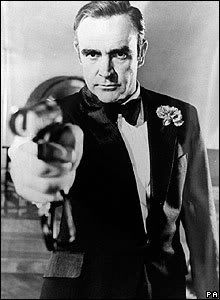
Bond, James Bond - The search for an actor to play Bond led Broccoli and Saltzman to consider a number of choices, including Cary Grant (Broccoli decided against him because he wanted an actor that would become part of the series and Grant would have likely been a one time deal) as well as Roger Moore, who was tied up at the time with The Saint. Sean Connery was an up and comer, having worked with Terence Young in Action of the Tiger (1957). Broccoli was impressed with him in Disney’s Darby O’Gill (1959) and he landed the part. It is hard to think of an actor, including Moore, who could have more firmly established the character as quickly and fully as Connery did. Sean Connery in 1962 was, quite simply, a perfect specimen of a man – athletic as hell (he was a Mr. Universe) and equally refined. Although his performance comes across as effortless onscreen, Connery went through an intense Bond indoctrination under the tutelage of director Terence Young. From the style of Bond’s suit to all the particulars of his taste, Connery was a rough cut stone that Young chiseled into the pure dazzling diamond. Bond’s panache is an extension of Young’s panache, something that would endure beyond Dr. No and even beyond Connery. From the very beginning of the series, Sean Connery is a perfect mixture of roughness and sophistication, brute and gentleman. He is at his most ruthless in Dr. No, particularly when he shoots a man in cold blood. Bond explains to the soon-to-be-dead Professor Dent (Anthony Dawson) after the hapless professor has emptied his revolver into the pillow likeness of 007: “That’s a Smith and Wesson and you’ve had your six,” and then pumps three silent slugs into the disarmed doctor. There’s no doubt that Bond is the hero and that his foes are the villains, but rarely does an audience see a hero employing his license to kill in as nonchalant and calculating a way as Connery in Dr. No. In future films, he would make a habit of using femme fatales as body armor, but the cold caste is set in Dr. No. with his murder of Professor Dent.

His humor, too, must have been something new to audiences. This particular hallmark of Bond’s character was the result of impromptu changes by Connery and Young. When he pulls up to Government House with the imposter chauffeur dead in the back seat, he quips to the entrance guard, “Make sure he doesn’t get away,” and hands the guard the keys, walking calmly into Government House without further explanation. Perhaps his death jokes are a subconscious way of dealing with the guilty pain his license to kill forces him to endure. If so, then it apparently turns his skin into a veritable shield of Teflon where guilt slides off of him faster than a fried egg. I think he just likes a good joke. It should be noted that as quippy as he got, Connery never quite reached the sarcastic levels of Roger Moore, but his comments, especially in Dr. No, do tend to be darker.

Connery’s Bond is not only graceful, brutish and athletic, but he’s a scrapper, too. When he’s completely at the mercy of Dr. No, eating his fine cuisine, he still manages to do everything in his cordial way to needle the villain. When Bond picks up a bottle to use as a weapon, the doctor points out that it is a Dom Perignon ’55 and, thus, a pity to waste, in which Bond replies (setting the bottle down): “I prefer the ‘53, myself.” He asks, off-handedly, to his threatening host whether the “toppling of American missiles really compensates for having no hands?” Even though he’s powerless, Bond continually looks for that one thing that might jolt the doctor or change the circumstances. When the doctor boasts about the greatest minds that make up SPECTRE, Bond corrects him by interjecting “criminal brains.” Of course, the doctor has his reply: “The criminal brain is always superior, it has to be.”

I’m of the mindset that there really have been no bad Bonds, just unlucky ones. Connery was fortunate enough to enjoy the longest run of Bond masterpieces with the first three films, but it was, in part, due to his immediate ownership of the role.

The Novel – Although the first film in the series, Dr. No was the sixth novel. It brought up the tail end of Flemings early stories (the collection of short stories in For Your Eyes Only being the center point in the series). The film is more or less faithful to the novel with a few notable exceptions. The character of Miss Taro is crooked in the book, but even more crooked in the film. Felix Leiter was a return character in the novel, with a significant handicap he obtained in the second novel, Live and Let Die. The film does not mention the Audubon Society, which, in the novel, is responsible for shedding light on Dr. No’s activities as well as affording Bond’s superior, M, with a chance to share his worldview. Fleming spends a chapter on Bond, Quarrel and Ryder trekking through the mangroves in thrilling detail. The tarantula in the film is a centepede in the book, and it drinks the sweat off Bond's forhead (or so he senses). Also, Bond’s passage through the pipes of Dr. No’s fortress is part of the doctor’s obstacle course of death – planned out by the doctor with a finale confrontation with a giant squid. Finally (and if you plan on reading the book beware of the spoiler that follows), Dr. No meets his fate at the business end of a pile of guano. Oh yeah, and the dragon serves as an escape vehicle for Bond and Ryder. Virtually all of the deviations from the novel were wise moves on the part of the filmmakers.

The hidden hand in the creation of the first James Bond film is Terrence Young. He would go on to make two more Bond films: what many consider the best, From Russia with Love, and the lesser, though grander in scope, Thunderball. But Young’s influence went well beyond the films he directed. He, more than any other, brought the Fleming Effect to the screen. He provided the stylistic essence in the series and molded the character of Bond.

Dr. No remains one of the best loved Bond films. I rate it as my favorite, with From Russia With Love and Goldfinger as close seconds. It, along with From Russia With Love and On Her Majesty’s Secret Service, is one of the closest to the novels. It is also one of the simplest.

This entry in the 007 in '007 series was written by Jeffrey of Liverputty fame. Be sure to stop in at Liverputty and check out his ongoing collection of Ian Fleming Bond novel excerpts titled The Fleming Lumber Room. -RR

Wednesday, May 02, 2007

Coolest. Goldfinger. Screening. Ever.

One of Austin, TX's greatest contributions to film is the Alamo Drafthouse movie theatre chain...for too many reasons to list. Over the past two summers the Drafthouse has sponsored the Rolling Roadshow, where they travel around the country and play movies in the unlikeliest -- and yet most appropriate -- of locations. One of last year's highlights was a screening of Close Encounters at the Devil's Tower in Wyoming.

Drafthouse owner Tim League has unveiled the 2007 Rolling Roadshow tour schedule and lo and behold - amidst the numerous cool moviegoing opportunities - is the chance to see none other than Goldfinger at Fort Knox, on Friday Aug. 3rd. Talk about 007 in '007!

Monday, April 23, 2007

Steal James Bond from Amazon

UPDATED!

Amazon is practically giving away Bond movies at criminally insane prices: Goldfinger, Thunderball, For Your Eyes Only, The Spy Who Loved Me and Goldeneye are selling for $7.99 apiece!!!

And it looks like more are on the way...

This "breaking up of the box sets" must have happened around the time Casino Royale hit DVD, but I didn't notice. I'd heard the films would be available individually sometime this year, and clearly they're now trickling out.

While these aren't the double disc versions available in the box sets, they're still the same transfers and include the commentary tracks. What you get here for $8 a pop is still a pretty sweet bang for your Bond buck - and if you only want to own Goldfinger, you don't also have to buy The World Is Not Enough just to get it.

Status? Highly recommended.

UPDATE: It looks like the prices on these discs are fluctuating a bit - a couple of them have gone up a dollar or two since I posted this earlier this afternoon.

Friday, March 09, 2007

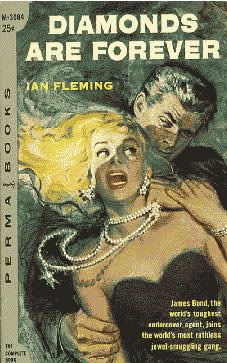
007 in '007: Diamonds are Forever

Diamonds are Forever begins with a faceless figure beating the crap out of a couple different guys over a couple quick scenes – all he wants to know is how to find Blofeld. In the third scene of the sequence, the figure’s face is revealed to be that of Sean Connery, and he isn’t much nicer to the babe at the pool than the other guys. Diamonds follows On Her Majesty’s Secret Service, which ended with the murder of Bond’s (George Lazenby) new bride Tracy (Diana Rigg) at the hands of Blofeld (Telly Savalas).
Clearly this was a defining moment in Bond’s life, but with Diamonds the lead role shifted back to Connery, and in doing so the producers seem unsure about how to address the tragedy. The pre-credits sequence seemingly straddles the fence: The upfront, violent inquisitions are for the viewer who wants to pick up where the last film left off -- Bond is on a rampage and wants revenge…and yet Tracy is never mentioned. The viewer who’d rather forget the previous events (or is simply not privy to them) is free to do so: Maybe James is just tired of Blofeld’s shenanigans and wants to put an end to the cat and mouse nonsense?

Which he seemingly does -- by dumping Blofeld (now played by Charles “No Neck” Gray) into a pit of lavalike mud. Then the cat meows and we hear Shirley Bassey for the first time since Goldfinger

Diamonds are forever,
Sparkling round my little finger.
Unlike men, the diamonds linger.
Men are mere mortals who
Are not worth going to your grave for.


I’ve got a huge soft spot (somewhere between my legs) for Diamonds are Forever. It’s the first Bond flick I ever saw, and that network airing left a big impression on the 9 or 10-year old me[1]. Despite being blissfully unaware it was part of a larger picture, afterwards I somehow didn’t miss any future airings of Bond flicks.

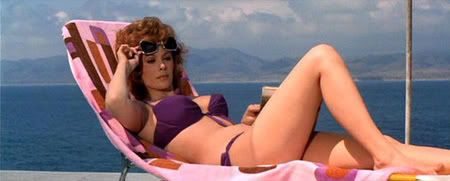
Les Girls: Once again, the central Bond babe knocks it out of the park. Jill St. John’s Tiffany Case is a highlight of the proceedings. As is the case (ahem…) with the rest of the film’s components, Tiffany’s part is greater than the whole. As the first American Bond girl, she trumps many a U.S.-based successor by believably taking care of herself, whilst at the same time not really being the sharpest crayon in the box. Tiffany is something of a survivor, due in no small part to her sizzling sex appeal and easy-going demeanor, and given the body count in Diamonds, that’s noteworthy. Allow me some bluntness: Miss Case may well be the most bangable Bond girl of them all, which is no trivial honor.

Bond first meets Tiffany in her apartment where she gives him this funny little (completely gratuitous) fashion show, sporting various wigs and negligees. Her hair color & style change each time she exits and reenters the room:

Bond: “Weren’t you a blonde when I came in?”
Tiffany: “Could be.”
Bond: “I tend to notice little things like that – whether a girl’s a blonde or a brunette.”
Tiffany: “And which do you prefer?”
Bond: “Oh, providing the collars and cuffs match…”


A bit later there’s this priceless reaction:

Bond: “That’s quite a nice little nothing you’re almost wearing. I approve.”

Even James seems mildly taken aback by her audacity. If Diana Rigg’s Tracy was the culmination of the ‘60s girls, then Tiffany is a sound jumping-off point for the girls of the ‘70s. In the hands of a lesser actress, Tiffany probably wouldn’t come off nearly as sparkling as she does. For all of John’s assuredness and appeal, how she really sells Case is with her easy-going sense of humor. She really gets Bond, and seems to understand the fly-by-night nature of his being: Tiffany’s having fun for as long as the fun might last.


Also skimping about in various states of bimbocity is Lana Wood’s Plenty O’Toole – great character name and nice to look at, but not much else. And who can forget the combo of Bambi and Thumper, the sexy pair of guards James tussles with outside of billionaire Willard Whyte’s (Jimmy Dean) “prison”? Last but not least, there’s Mrs. Whistler (Margaret Lacey) -- possibly the oldest Bond girl in the series -- a sweet old lady masquerading as a teacher who’s really part of the diamond smuggling ring. She, like Plenty before her, ends up sleeping with the fishes. (OK, maybe she doesn't count, but I couldn't resist mentioning the woman who was probably Whistler's mother.)

Zee Henchmen: And who’s in charge of executing nearly every noteworthy (i.e. creative) death? Mr. Wint (Bruce Glover, father of all that is Crispin) and Mr. Kidd (Putter Smith, a jazz bassist with no prior acting experience). Some say that Wint & Kidd are an ambiguously gay duo -- I say they’re watching the movie with their eyes closed. There’s no way that Wint & Kidd are anything but heaping tablespoonfuls of Queer as Folk. Dare I mix some hackneyed Seinfeld standbys? “Not that there’s anything blah, blah, blah.” Props must be given to whomever’s idea it was for these guys to have a gay old time; this wasn’t the norm back in ’71 and in fact things have come so far in the other direction, it’s difficult to imagine it flying today.

I love Wint & Kidd because they love what they do. They’re not even particularly mean about it; the pair just matter of factly take delight in offing one person after the next. I could watch an entire movie detailing the antics of Wint & Kidd; it’d be like Rosencrantz and Guildenstern are Dead only funny.

Zee Villain: Only a dyed-in-the-fishnet Rocky Horror nut would choose Charles Gray as his favorite Blofeld; add in worship of The Devil Rides Out and the deal’s sealed. After the Pleasance & Savalas incarnations (as well as the “unseen” Blofeld from the earlier films), Gray’s casting seems borderline ridiculous -- the guy’s suddenly got a full head of hair and has lost any sort of imposing demeanor or freak factor. He’s this prissy dandy about to explode in a ball of flame at any second. Diamonds are his hangup, fer christsakes!!! Certainly no other Blofeld would’ve hired Wint & Kidd to do his evil bidding. Queerest of all? The baffling intimation that Miss Case shacks up with him to save her skin in the third act. Maybe he’s just keeping up appearances? Tiffany’s certainly got the style, class and wit to play fag hag should the situation demand it.

All supposition aside, fact remains it’s Charles flippin’ Gray. His Blofeld demands no exploration due to the actor alone. He stands apart from all other Blofelds, and it’s no wonder the series closed the curtain on the character after Diamonds (aside from a brief cameo in For Yours Eyes Only) -- Gray killed it for any actor who might have come afterwards. Who else can deliver--with panache--this sort of tongue-in-cheek nonsense?:

Blofeld: “The satellite is at present over…Kansas. Well, if we destroy Kansas the world may not hear about it for years.”

Tuneage & Credits Sequence: Of Bassey’s three Bond tunes, Diamonds are Forever is easily my favorite. It’s a sexy, cool number that slinks along, doing exactly what it’s supposed to do, which is set a tone for the film to come. Binder’s credits sequence also gets the job done, but ultimately feels as if it’s going through the motions: Diamonds, Blofeld’s pussy, the standard cache of scantily clad women and not much more.

Bond, James Bond: So what of Sean Connery in his official series swansong? Assessing his performance as bored or lackluster (which is where I was inclined to head) just doesn’t seem right. It’s Sean Connery, and of the three primary Bonds, he delivers the tightest goods upon exiting the franchise. There’s certainly never the impression that he’s done all he can with the role or that it’s past time for him to go (unlike, say, Moore in A View to a Kill). And yet the franchise itself had probably done all it could with Connery.

Diamonds are Forever is not an especially good film (by Bond standards anyway), and when compared to the Connery flicks that preceded it, it comes up laughable. When compared to the Sean-less movie that preceded it, it comes up insulting. (Do Bond flicks tend to polar react to the films that preceded them?) For all the missiles fired at the Moore era, one need look no further than Diamonds to see the campiest sides of James Bond originated here. Much of the blame can likely be laid at the feet of co-screenwriter Tom Mankiewicz, who seems the logical candidate for the camping up of Bond. He continued variations of the trend with Live and Let Die and The Man with The Golden Gun and pretty much developed the template for the Moore era. One of the dumbest trends that started on Mankiewicz’s watch is the placing of 007 into stupid, cumbersome vehicles in which he’s forced to engage in ludicrous chase scenes – here it’s a moon buggy.

But maybe, as the first Bond flick of the ‘70s, that’s how it should be. Diamonds feels transitional; maybe even like a Moore flick that Connery’s been plopped down into the middle of. Had it starred Moore, he’d have the necessary doubletakes to pull it off. With Connery, it too often seems out of time and place and it’s no wonder he didn’t return for Live and Let Die, despite being offered what at the time was considered a small fortune.

The movie was allegedly a conscious revamp of the series for the American market and as such it’s a success. If James Bond is going to do America, Las Vegas (the primary locale) is the perfect fit. The movie, like Vegas, is gawdy, over-the-top and features silly one-liners, bad puns, ridiculous chase scenes, the words “goddamn” & “bitch” and some fairly excessive violence. I remain grateful that--despite numerous considerations--the series has never cast an American as James himself...


[1] Time for a Bond talkback game! Aside from popping my Bond cherry, Diamonds are Forever also came out in December of 1971 -- when I was about a month old. This, of course, means nothing to most readers, but it means a little something to me. Most people under the age of 45 can figure out the Bond flick that was most likely in the public consciousness around the time they were born. If you were born in or around either ‘67 or ‘83 you get the added bonus of claiming two flicks. If however, like my kid, you were ushered into the world in the early ‘90s, you’re sorta screwed.

Wednesday, November 22, 2006

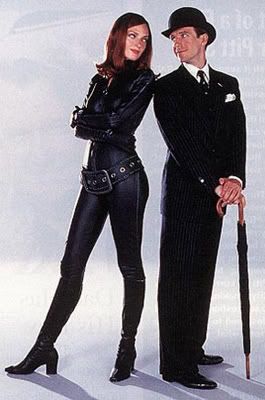
Avenging The Avengers

In the midst of all the Bond-age going around, it seemed like a good time to mount a defense for a true underdog: the oft-maligned and unjustly scorned 1998 film version of The Avengers. Make no mistake, The Avengers is not a great movie, but it’s far from the train wreck it was painted upon release -- and since it’s never shaken that stench, nor stirred up a massive cult following, the Morgue aims to set matters straight.

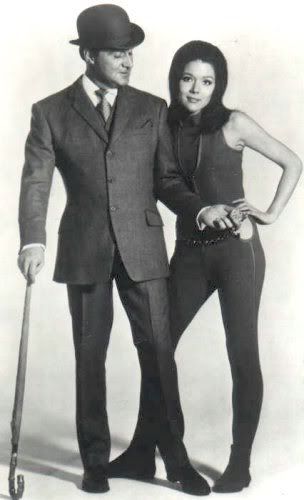
I’m a huge fan of The Avengers TV series – well, let me rephrase that…I’m a huge fan of the Diana Rigg / Emma Peel-era[1]. If anyone might’ve been a harsh critic of this redux it was going to be me, but upon seeing the film’s trailer, it became a must-see movie. The style, the vibe, the look – everything about that 2 minutes smacked of slavish faithfulness to the series. There was no other popcorn flick I was looking forward to that summer as much as this one. So you can imagine how my heart and hopes sank when the buzz started mounting. Word from across the pond following the British premiere was dire; Warner Bros. opted to not screen it for U.S. critics, so reviews were scarce upon its U.S. opening.

Regardless, I went to an early screening on opening day and was weirdly entertained by what I viewed. It wasn’t the masterpiece of which I’d dreamed -- nor was it the steaming pile I’d been hearing about. Were people seeing the same film as me? A quote I distinctly recall reading after the Brit premiere: “I don’t know what that was, but it certainly wasn’t The Avengers”. Um, yes it was…and there’s no way it could ever be mistaken for anything other than The Avengers. Of the many who were so quick to trash the movie, I wondered who’d even seen an episode in at least 20 years. Maybe that person meant, “It wasn’t Patrick Macnee and Diana Rigg”. If so, fair enough - it’s not, nor could it have been unless the movie was set in a nursing home for retired secret agents...bringing me to the film’s problematic conundrums, which I’ll address before moving on to my likes.

Screenwriter Don MacPherson undoubtedly wrote the script with Macnee and Rigg’s characterizations of John Steed and Emma Peel at the forefront of the concept. And really, how else would one write such clearly defined, iconic characters? Remove stars Ralph Fiennes and Uma Thurman, and it isn’t a huge stretch to picture Macnee and Rigg playing the parts. It’d be blasphemous to write them any other way and still call the movie The Avengers.

Let’s get Mrs. Peel out of the way first. No actress could’ve done justice to Rigg’s definitive performance. Rigg as Peel is like James Arness as Marshall Matt Dillon. Leonard Nimoy as Mr. Spock. Bob Denver as Gilligan. I’m hardly an Uma devotee and despite my pre-release enthusiasm (ahem…that sounds filthy), never harbored illusions that she’d live up to Rigg. She is probably miscast, but what actress wouldn’t have been? All that said, she’s surprisingly watchable and most importantly, wears leather like a second skin and catsuits with confidence. Her British accent is consistent, even if a tad flat. She plays Peel with a light, flirty coolness, paying homage to Rigg’s legacy without xeroxing the past. For every complaint one might have about Thurman’s take, there are kudos to be given – to be sure, this was an odd job.

Fiennes is a bit more complicated. He’s far more even than Thurman, but his biggest problem is in choosing to make the role his own, rather than play it with the carefree demeanor Macnee infused into Steed, as it appears to be written. Fiennes instead wants his Steed to be serious, never minding that the material doesn’t really call for it. He plays Steed as Bond minus the sex and violence – the equation totaling an emasculated secret agent of sorts. Forgive Fiennes this transgression -- had he invoked Macnee, he likely would’ve come across as a dandified homosexual. For once the famous Seinfeld quote can be corrupted: “And everything would have been wrong with that”. Macnee straddled the fence in this area due to the naïveté of ‘60s TV audiences and the ongoing conviction of his performance…but whittle the Steed basics down to a 100-page script, and you might as well cast Rupert Everett (which, now that I think about it, would have rocked).

So at this point you might wonder what exactly it is that I like about this movie (even I’m having a tough time getting there). Outside of its conceptual devotion to the original, I like The Avengers for the sheer scale of its out-of-time-and-place imagination (which again, is what the series was always about). The plot revolves around the megalomaniacal Sir August de Wynter’s (played to the robust hilt by Sean Connery) plan to control the weather and sell it to world leaders. Audacious! Clima-terrorism!! Control the weather and you control the world!!! Few screen villains concoct such ideal schemes. Blowing up the world is a hell of a lot less fun than making it snow in San Antonio. It’s nearly impossible to tell where Connery’s heart is throughout the proceedings. Is he phoning it in? Is he hamming it up? Does it even matter? When the granddaddy of all super spies channels Goldfinger, Largo and Blofeld into one deliciously camp creation, it’s best not to ponder the how’s and why’s. Accept that this is unique film history, whether you like it or not.

The film exists in an idealized ‘60s pop limbo where normal rules of spy fare simply don’t apply. Nor does it look anything like our reality. It exists in one place only -- the hyperreal world of John Steed and Emma Peel, which is a wholly distinctive universe. It's a world where deadly, remote-controlled mechanical bees attack our heroes. Where villains gather together dressed in rainbow-coloured teddy bear costumes. Where Eddie Izzard plays a mute henchman and Shaun Ryder is one of his lackeys. It feels like a greatest hits package of the TV series. Scene after set piece echoes many an Avengers episode of days gone by – it’s difficult to believe any true fan wouldn’t find themselves intoxicated by the attention paid to detail.

Borderline amazing is the film working at all. Early test screenings led to hasty, massive recutting. I’ve read that the original cut ran anywhere from 115 minutes to 2 and half hours – its final running time is a measly 89 minutes; imagine if literally more than a third of the film is missing! Despite the cuts, and perhaps due to the film’s somewhat compartmentalized structure and fairly simple plot, it miraculously moves along with an amiable stride. Aside from a few minor continuity glitches, one wouldn’t guess it was such a rape victim. And yet I cannot help but think of what might have been, what director Jeremiah S. Chechick and MacPherson envisioned.

Bits of the excised material can be glimpsed in the trailer (the only real “extra” on the DVD); IMDB also provides a list of numerous cut scenes. It’s a travesty that the stink still surrounding The Avengers is likely the only thing keeping a Director’s Cut DVD from happening. IMDB users rate (at the time of writing) the film a paltry 3.3/10. In comparison, IMDB users currently rate A View to a Kill (which coincidentally co-stars Patrick Macnee) a whopping 6/10. I’d put Moore’s swansong up against The Avengers and challenge anyone to prove Bond's superiority. Same for Moonraker. Heck, I’d even put it up against The World Is Not Enough, which came out a year after The Avengers, and is as bloated a misfire as anything the Moore era produced (which is not to bag on Moore's Bond, who is, strangely enough, my favorite).

When it comes right down to it, The Avengers should probably never have been turned into a film. The whimsical, flirtatious, non-cynical nature of the concept is rooted in a time and place that bears no resemblance to today. Surely there’re a surplus of Avengers fans that abhor the piece, but they’re missing out on the filmmakers' affectionate attempt to do right by the show’s spirit, rather than modernize it into something rooted in the present. Do that and you end up with movies like The Saint or the Mission: Implausible flicks. Maybe these are better films than The Avengers, but do they embody the spirit of their source material? I can picture such an Avengers film and it would be anything but The Avengers.

Lest anyone believe I've got beefs with Bond, that's not the case. Here are my Top Five Favorite Bond Theme Tunes:

1. "Nobody Does It Better" by Carly Simon
2. "Live and Let Die" by Paul McCartney and Wings
3. "Tomorrow Never Dies" by Sheryl Crow
4. "For Your Eyes Only" by Sheena Easton
5. "Licence to Kill" by Gladys Knight

[1] I’ve seen bits and pieces of the Honor Blackman/Cathy Gale era, but the videotape quality is pretty rough and they lack that Avengers feel. Seen most of the Linda Thorson/Tara King period, but it's too camp even for my tastes. Never seen even a single episode of The New Avengers. So why the indulgent qualifiers? Maybe I’m no more of an Avengers authority than the Doctor Who viewer that’s only ever seen Tom Baker.