Malcolm Tucker is a character played by Peter Capaldi on a British series called The Thick of It, which is very similar in tone and execution to HBO's Veep. Both series are created and co-written by the same man, Armando Iannucci, who's very clearly a master at creating artful vulgarity. Somebody, somewhere on the internet, created these panels which I happen to find endlessly amusing, so I'm reposting them here.
At the moment, The Thick of It is nearly impossible to find if you live in the U.S., but a couple years ago Iannucci refashioned the concept into a movie called In The Loop, which is very easy to get your hands on.
Updated on 08/04/2013!: So, not only has Peter Capaldi been cast as the Doctor (a casting decision clearly sent down by the gods of comedy and tragedy), but also, The Thick of It hits R1 DVD on Tuesday, the 6th of August, in a big, fat complete series box set (yes, it includes the two Christmas specials in addition to the four seasons and loads of extras).
Also, check out my new piece for Vulture, "Why Peter Capaldi Is the Ideal 12th Doctor" by clicking here.
Monday, April 23, 2012
Sunday, April 15, 2012
Treme: The Complete Second Season Blu-ray review
What’s so sensational about Treme is how unsensational the show is. This is storytelling that shies away from phoniness, yet it’s unveiled via a medium that’s all about pretense. Now, that isn’t to bag on the rest of television, but you just have to tip your hat to Treme, which seemingly goes out of its way to break the established rules so it can do its own thing.
Season Two, which kicks off 14 months after the storm, sees the show heading into darker territory, with sporadic acts of violence erupting throughout the city of New Orleans. Meanwhile, the myriad residents that we came to know through their struggles in the first season are trying to move forward and get their lives back to places of normalcy, as the city itself enters the post-Katrina recovery stage. There will be food, there will be dancing, there will be misfortune, and there will be bliss, but most of all, there will be music.
Read the rest of this Blu-ray review by clicking here and visiting Bullz-Eye.
Labels:
Blu-ray review,
Bullz-Eye,
David Simon,
Eric Overmyer,
Lucia Micarelli,
Treme,
TV Shows
Saturday, April 07, 2012
Doctor Who: The Daemons DVD review
And the hits just keep on coming. “The Daemons,” the onscreen title of which is “The Dæmons” (note the “æ” ligature), is yet another serial deserving of the label classic. It’s one of the most memorable and popular storylines of Jon Pertwee’s era, and probably the first Doctor Who tale to so clearly take mankind’s belief in a higher power to task, via that old chestnut from Arthur C. Clarke, “Any sufficiently advanced technology is indistinguishable from magic.”
The tale turns on the opening of an ancient burial mound in the tiny village of Devil’s End. The event, which will take place at the stroke of midnight on April 30th (Beltane), is to be broadcast on BBC Three, which, in reality, didn’t come into existence until many, many years later. The whole thing is reminiscent to someone of my age of Geraldo Rivera’s opening of Al Capone’s vaults…only in this instance, something is found, or more precisely, unleashed. The Doctor and Jo (Katy Manning) head to Devil’s End to investigate, only to discover the Master (Roger Delgado) is behind the sinister goings-on. He’s summoning forces that have existed since the dawn of man – an alien called Azal, who belongs to a race known as the Daemons, and he’s very displeased with mankind’s lack of progress.
Also to my eyes, neither of
the monsters in this tale are realized as well as they could’ve been, due
mostly to ill fitting tights. Bok, the stone gargoyle come-to-life, is cuter
than he is threatening, and Azal is one of those great examples of how
much more effective it is to not see
the goods. “The Daemons” does such a fantastic job of teasing the viewer as to
Azal’s appearance, that it almost has
to be a letdown when he’s finally shown. It sort of is (seriously – keep an eye
out for the tights), and the less said about Stephen Thorne’s booming, one note
performance as the beast, the better. (This is the same guy who played Omega in
“The Three Doctors,” FYI.)
Now all of that
said (ahem…), “The Daemons” remains benchmark, must-see classic Who. It’s one of the best UNIT stories, with the Brigadier (Nicholas Courtney), Mike
Yates (Richard Franklin) and Sgt. Benton (John Levene) each getting their
moments on the spotlight. The Doctor and Jo are both in prime form, with the
story thematically being something of a culmination of her season-long
introduction to the world of the Doctor, as well as their mentor/student
relationship. The script is crammed with great one-liners, with my personal
favorite being the moment in which one of the townspeople thinks the Doctor is
part of the BBC TV crew because of “the costume and the wig.” To which Pertwee,
aghast, replies, “Wig!?”
Then there’s the local white witch, Miss Hawthorne, played to utterly kooky perfection by Damaris Hayman, a character that’s sort of emblematic of how much fun this story is. Another great character is Professor Horner, played by Robin Wentworth. He only appears in Episode One, but every single utterance that comes out of his mouth is priceless. It’s almost a shame he wasn’t kept around for the rest of the story. Words escape me for how perfect Roger Delgado is here. But then, words always escape me for how good he was as the Master. There have been many Doctors, and there have many fine debates over which is the best, but anyone, with any amount of taste, must surely admit that Delgado’s Master has never been bested (and maybe, at this point, never will be). “The Daemons” has finally found its way to DVD, but there’s more to the matter than just the quality of the story. What of the disc itself?
Back to “mostly all,” from
above…Episode Four has always existed in its original PAL color videotape form,
and as a result, Episode Four looks and sounds amazing
on this DVD. The problem is that one ends up comparing the other four episodes
to it, and they can’t help but come up a little short in comparison. The
location film sequences, of which “The Daemons” has many (more of this story
was shot on location than in the studio), still look somewhat muddy at times,
but presently this is surely about as good as it gets. It’ll break both of your
Whovian hearts to know that, if not for archaic BBC shortsightedness, the entire
serial could look as great as Episode Four. Mind you, that’s not a specific criticism
of this DVD, just an observation of the cruelty of fanboy life. On the flip
side, the videotaped studio material looks really nice, although every once in
a while there seems to be some brief color bleed, but I’m talking matters of
split seconds here. On the scale of "massive overhaul" type restorations, I’d put this one ahead of
“Terror of the Autons,” but still not as near-perfect as “Planet of the Daleks”
Part Three, which (for me anyway) remains the gold standard.
DVD Extras: It is in this area that “The Daemons” DVD truly falls short. Although the commentary track featuring Manning, Franklin, Hayman, and director Christopher Barry is a nice one (particularly the contributions from Damaris – the woman’s a hoot), it’s a massive oversight and shame that Barry Letts and Nicholas Courtney weren’t secured for participation. I know for a fact this was Letts’ favorite story, because he told me as much when, upon meeting him back in the late ‘90s, I asked him what his favorite story was. Nicholas Courtney went so far as to call his autobiography Five Rounds Rapid!, after a piece of dialogue from the story – one that is quite possibly the Brigadier’s most famous.
Now there’s a competent
enough making of on here (amusingly) called “The Devil Rides Out,” which
features the same folks that are on the commentary, plus a few others,
including some archival interview footage with Letts (yet not nearly as much as
one might’ve hoped for), yet Courtney’s nowhere to be seen. It sure would have
been nice if the ’96 doc “Return to Devil’s End” could’ve been secured for this
release, as it isn’t owned by the BBC, but its inclusion would’ve made up for
some of the other oversights. Rarely do I complain about what’s not present on
a classic Who DVD, but this is a case where I feel I must, as the extras
here just don’t quite feel like they’re doing “The Daemons” justice.
The tale turns on the opening of an ancient burial mound in the tiny village of Devil’s End. The event, which will take place at the stroke of midnight on April 30th (Beltane), is to be broadcast on BBC Three, which, in reality, didn’t come into existence until many, many years later. The whole thing is reminiscent to someone of my age of Geraldo Rivera’s opening of Al Capone’s vaults…only in this instance, something is found, or more precisely, unleashed. The Doctor and Jo (Katy Manning) head to Devil’s End to investigate, only to discover the Master (Roger Delgado) is behind the sinister goings-on. He’s summoning forces that have existed since the dawn of man – an alien called Azal, who belongs to a race known as the Daemons, and he’s very displeased with mankind’s lack of progress.
Since most everything that
happens on Doctor Who must have some sort of scientific explanation, Barry
Letts couldn’t do a straight-up horror tale, but with “The Daemons,” he gave
viewers the next best thing, and that’s a tale of science masquerading as, or
rather being mistaken for, mysticism, and according to “The Daemons,” which
Letts wrote with Robert Sloman under the pen name Guy Leopold, it’s been going
on for centuries. The central premise of the story is a great one, and “The
Daemons” drips atmosphere and sports one memorable moment after another. There
are many different reasons to appreciate all the many different classic Doctor
Who stories, but for sheer fun, “The Daemons” is right up there with
the best of them. Certainly if you appreciate Hammer horror films – especially
fare like The Devil Rides Out, written by Dennis Wheatley, whose work
was a clear inspiration for “The Daemons” – then this you just gotta see. (Of
course if you know who Dennis Wheatley is, maybe you already have.)
Now all of that said, don’t
peel the curtain too far back, otherwise you’ll notice that “The Daemons” is
riddled with what I like to call “Yeah right!” moments; the sort of stuff you
have to deal with when viewing an action movie, which, when it comes right down
to it, is what “The Daemons” basically is: a low budget sci-fi/horror/action
film. For instance, in this five-episode tale that’s set entirely within the
confines of a tiny English village (which in turn is enveloped by a massive
heat barrier for most of the story, so nobody can enter or exit Devil’s End),
the Doctor and the Master do not meet until the final episode. It’s
mind-boggling that the Doctor never marches several hundred feet over to the
church (the Master’s base of operations) to simply confront his enemy head on,
especially since he’s been battling the Master in story after story throughout
all of Season Eight, which “The Daemons” closes out. To my eyes, that’s a
pretty serious “Yeah right!” aspect of the story.
Then there’s the local white witch, Miss Hawthorne, played to utterly kooky perfection by Damaris Hayman, a character that’s sort of emblematic of how much fun this story is. Another great character is Professor Horner, played by Robin Wentworth. He only appears in Episode One, but every single utterance that comes out of his mouth is priceless. It’s almost a shame he wasn’t kept around for the rest of the story. Words escape me for how perfect Roger Delgado is here. But then, words always escape me for how good he was as the Master. There have been many Doctors, and there have many fine debates over which is the best, but anyone, with any amount of taste, must surely admit that Delgado’s Master has never been bested (and maybe, at this point, never will be). “The Daemons” has finally found its way to DVD, but there’s more to the matter than just the quality of the story. What of the disc itself?
There’s no question that
with this release, “The Daemons” looks and sounds better – much better – than ever before. This is a story with a problematic
history of video and audio quality, and I grew up watching it in black and white,
because for years all (well, mostly all…but we’ll get to that shortly) that
existed were tapes made from the 16mm monochrome telerecordings. In the early
‘90s, “The Daemons” became one of the Restoration Team’s first projects. Using
their own “black magic,” a color version was released on VHS in ’93. I remember
being pretty bowled over by it at the time, but by today’s Who DVD standards, it
would no doubt look pretty creaky. So another round of work has gone into “The
Daemons,” although I’ve honestly no idea what exactly was done to it, or how
they got it to the level of quality displayed here. Sorely missing from this
release is any kind of featurette on the restoration. Perhaps such mini-docs
are considered redundant at this point? They shouldn’t be, as not every fan
buys every Who DVD. The Team has recently started updating their site once
again (after a period of inactivity), so hopefully they’ll put up an article on
this release some time in the near future.
DVD Extras: It is in this area that “The Daemons” DVD truly falls short. Although the commentary track featuring Manning, Franklin, Hayman, and director Christopher Barry is a nice one (particularly the contributions from Damaris – the woman’s a hoot), it’s a massive oversight and shame that Barry Letts and Nicholas Courtney weren’t secured for participation. I know for a fact this was Letts’ favorite story, because he told me as much when, upon meeting him back in the late ‘90s, I asked him what his favorite story was. Nicholas Courtney went so far as to call his autobiography Five Rounds Rapid!, after a piece of dialogue from the story – one that is quite possibly the Brigadier’s most famous.
Aside from the commentary
and the making of, also present is a very nice 33-minute documentary called
“Remembering Barry Letts,” which traces the man’s career, and features both of
his sons discussing him at length. This is a sweet, warm piece, and even though
there’s nothing in it that’s “Daemons” specific, it’s a welcome addition. There’s
six minutes worth of silent “amateur” 8mm film footage that was made during the
original “Daemons” shoot; doesn’t sound all that interesting, yet it really
rather is. The entirety of Episode One is also presented as it looked after the
very first colorization test in 1992, along with a short piece on the ‘92
colorization from a show called “Tomorrow’s World.” These seem like somewhat
baffling inclusions (talk about redundant!) given that they don’t reflect the
current work put into this story, although the ability to do a “now and then”
comparison of Episode One 1992 vs. Episode One 2012 is fairly enlightening in regards to the strides that have been
made in technology over the past 20 years. (Again, here’s where a short piece
on the current restoration would’ve fit in nicely.) Finally, there’s the usual
photo gallery, production notes subtitle option, Radio Times listings in PDF form, and a coming soon trailer for “Nightmare of Eden” which will be out next month.
Labels:
Barry Letts,
Classic Doctor Who,
DVD,
DVD Review,
Jon Pertwee,
Katy Manning,
Roger Delgado,
TV Shows
Monday, April 02, 2012
Torchwood: Miracle Day Blu-ray review
Here I am, in the unenviable
position of having to defend the fourth season/series of Torchwood, also known as Miracle
Day, not out of a sense of duty, but because I was genuinely enthralled
by its story arc (twice – last year upon its broadcast on Starz, and now again
on Blu-ray). “But Ross…it’s a Doctor Who spinoff. No wonder you love it. How can your opinion
on the subject be even remotely objective?” That might be sort of true if not
for one thing: I never felt similarly inclined to champion The Sarah Jane Adventures,
which starred freakin’ Elisabeth Sladen,
and detailed the further adventures of my favorite Who companion ever.
Captain Jack Harkness - though I appreciate, nay, adore numerous aspects of his character - isn’t even in my Top
Ten.
Miracle Day, as I understand it, was loathed by more fans than
it was tolerated. Hasn’t this always been the case with Torchwood? People always
seem to be so wronged by this series,
as if it’s gone out of its way to attack them personally. Even Children
of Earth, arguably the jewel in its crown, had its detractors – mostly
those who couldn’t bear to see Ianto killed off. Russell T Davies allegedly got
death threats over that one, the poor man. These are the same people who refer
to the first two seasons as the “real” Torchwood, yet everything that comes
after warrants no reference at all. Still others would argue that Children
of Earth was the only decent
thing ever produced under the franchise name. The real truth, it seems, is that
there is no real Torchwood. The series is like Russell T Davies’ personal
narrative playground, to do with as he pleases, with whomever he pleases, as the revolving talent roster (both in
front of and behind the camera) seems to suggest. Miracle Day further
proves that it’s an ongoing experimental work in progress, as it once again
offers up storytelling that’s quite unlike all that’s come before.
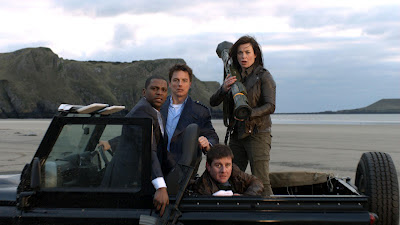
| (l-r) Mekhi Phifer, John Barrowman, Kai Owen & Eve Myles |
Miracle Day is the most audacious series of scripts the show has
yet rolled out, but the problem with audacity is that, if one isn’t game for
it, it tends to leave one at best uncomfortable or at worst dismissive. There
are moments in Miracle Day that’ll have viewers shifting in their seats, and
many more that those same viewers will fluff off as laughable. The premise, for
those few of you who are unaware, is that one day, all of a sudden and without
explanation, nobody on Earth dies. Then another day goes by, and the same thing
happens. And so forth, and so on. This is dubbed “the miracle.” The first six of
its ten episodes are an exploration of humanity’s reaction to this brand of
immortality. Davies says on a commentary track here that much of the idea was
to explore the way mankind would overreact
to such a scenario, which, if taken into account, might put a considerably different
spin on the events. Either way, as Torchwood is wont to show us,
humanity comes off looking ugly and self-absorbed. Give humanity immortality,
and they’ll immediately find ways to kill themselves or one another. There’s a
grim, joking outlook to much of the proceedings, but that’s only when it isn’t
offering up genuinely horrific material. Miracle Day puts knots of various
types in my stomach, and that’s why I love it, flaws and all.
And there are flaws. It’s
never discussed or mentioned how the miracle affects life on planet Earth
outside of mankind. How about plants and animals? Surely they, too, should play
a huge role in the proceedings? Alas, we never find that out. The concept is potentially so vast, that the season could have taken twice as much time to explore the idea and still come up short. The oft-tossed about notion that ten episodes was too long a time to tell this story is, dare I say it, horseshit. Many viewers will
immediately want to know why the miracle is happening, but the answer to
that isn’t revealed until Episode 10. This is likely part of the reason folks
started tuning out en masse when the series was broadcast last summer; for many viewers it was
simply taking too long to find out why all of this madness was happening, and
the myriad red herrings along the way were probably frustrating. Misguided though
this line of thinking is, it nevertheless, as of late, seems to be a real problem. (See also
AMC’s The Killing.) Blu-ray or DVD alleviates this problem. You don’t
need ten weeks. You just need ten hours.
| Bill Pullman as Oswald Danes & Lauren Ambrose as Jilly Kitzinger |
The character of Oswald
Danes (Bill Pullman) is one such red herring. Since the series doesn’t have a
villain proper until the eleventh hour (or the tenth, as the case may be), it
gives us pedophile Danes as a through line substitute (mind you, this narrative
contains many other “short-term” villains along the way). Danes was the first
high profile figure to escape death, and has since used the entire situation to
his benefit. The idea of Oswald is maybe a good one, but the execution of the
character less so, and even after two viewings I’m not sure if this is because
of Pullman’s performance, or because of how the character was (or rather
wasn’t) written. For the first couple episodes, Pullman is mesmerizing, playing the character
with tics and vocal inflections that are quite unlike anything we’ve ever seen
the actor do before. However the gimmick becomes stale, and we care less and
less about his story as the show marches on (he probably should’ve been written
out halfway through the season, but no, he’s there, unwanted, ‘til the very
end).
There’s other stuff the
season probably gets wrong, and certainly in tone it shifts wildly all over the
place from one episode to the next, but as is always the case (or at least
always my case) with Torchwood,
it gets more right than wrong. It’s
the journey that makes Miracle Day alternately fun and
horrifiying, not the destination. That’s why even if the finale feels a little
off, or maybe doesn’t make a whole lot of sense, or, alternately, is perhaps too damn convenient, I’m not inclined to
bash those aspects. Its divisiveness is exactly what makes this must see sci-fi TV. This is a story that’s about the ride, and first time
viewers need to know, going in, that it's simply not about what happens at the end.
| (l-r) Alexa Havins (as Esther), Phifer, Myles, Barrowman |
Fans worried about
involving American money and talent in Torchwood, and the effect it would
have on the production. They needn’t have, and clearly Starz knew the show they
were getting involved with; if anything, Torchwood is bolder here in its
outlook than ever before. It’s bloodier and more violent. It’s as bleak as
ever. You want gay sex? An entire episode revolves around Jack’s relationship
with a man in 1927, featuring some very graphic sex scenes, and an emotionally
engaging storyline to go along with it. (It’s certainly not exploitative just
for the sake of it.) The only way the show has been “Americanized” is in its
look and location, as there’s no mistaking it’s now being made with American
money and equipment, with the bulk of it being shot in L.A. (although much of
the story is still set in Wales, and the production did spend three weeks
there).
I’ve become accustomed to
believing, over the years, that Torchwood is Captain Jack’s show,
and that without John Barrowman, there is no series. With Miracle Day, though, I’m
starting to see that maybe that’s not the case, and in fact this concept is
even more flexible than I’d previously given it credit for. While new team
member Rex Matheson (Mekhi Phifer), with his awesome swagger, might be part of
that train of thought, what really led me down this road is Gwen Cooper (Eve
Myles). Miracle Day is far more Eve Myles’ show than it is Barrowman’s.
She’s the character who’s grown and learned throughout the entirety of Torchwood,
not Jack. She’s always the character who’s got the most to lose, and never more
so than in this story arc.
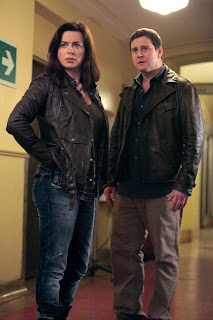
Let’s be honest: John
Barrowman isn’t a great actor. He is, however, a great screen presence, and
aspects of his personality have been used over the years to help create Jack. On the
other hand, Eve Myles is one hell of
an actress, and she gets to do stuff with Gwen in Miracle Day that it feels
as though she’s been waiting for years to do. Here she’s not someone with whom
to fuck, and even Jack learns that. She’s gone far past being the student.
She’s his equal, and just as adept at deciphering the cruel way the universe
operates as he. On the watch of Miracle Day, Gwen Cooper has become
every bit the central figure that Jack Harkness is. If, for whatever
unfathomable reason, Barrowman wasn’t available, or no longer wanted to do the
show (hey, the thought was prefaced with “unfathomable”), at this point Torchwood
could easily continue on with Gwen as the central figure.
Perhaps the most polarizing
character in Miracle Day, though, is Jilly Kitzinger (Lauren Ambrose), who,
like Oswald, is another surrogate villain, although I wonder if people realize
she’s supposed to be this crazy bitch
in heels? I mean, you do get that the
idea here was to create a camp, over the top villainess, right? Jilly’s a publicist
who finds herself thrust in the middle of the miracle madness, and with every
step she takes, she finds herself enmeshed deeper in the conspiracy, until
finally, at the end, she’s at the very center of it all. I’ve been a fan of
Ambrose since her days on Six Feet Under, so I was perhaps
predisposed to appreciating her work here, although Claire Fisher Jilly is most
certainly not. However, she attacks this role with the same kind of ferocity as
she did Claire for five seasons. Unlike Children of Earth, Miracle
Day doesn’t end with a complete sense of closure. Although its storyline is tied
up nicely, its characters are left dangling, and Jilly is one of them. I don’t
pray, but if I did, I’d pray for more Torchwood and more Jilly Kitzinger,
because I had so much fun with Miracle Day, and this just simply
cannot be the end. Yes, like the best professional entertainers, Russell has
left me wanting more.
Blu-ray Extras: This is a crisp, beautiful sounding and looking Blu-ray that to my eyes and ears replicates the experience of watching it in High Def last summer. The star attractions here are probably the two
commentary tracks, on the first and last episodes, featuring Davies and Julie
Gardner. They’re a reliably fun and informative couple of hours, which cover a
great deal of ground and are well worth a listen. Only problem is, they were
recorded after only the third episode had aired, so neither of them have any
idea that the general public isn’t going to be eating this material up,
although Davies confesses that he’s unsure if it’s going to be everyone’s cup
of tea. Next up is the bonus web series entitled “Web of Lies,” which is
similar in style to one of those animated motion comics. I don’t know exactly
how this was presented on the internet, but here all the bits and pieces are
edited together into one 30-minute piece. It tells two alternating tales – one
in the past with Jack and Gwen, and another set concurrent with Miracle
Day, featuring the voice of Eliza Dushku.
There is also a series of
character profiles, a behind-the-scenes special, a special effects featurette,
and a short selection of utterly worthless deleted scenes. The most annoying aspect of this set, however, are the intros for each episode featuring Davies and Barrowman talking directly to the camera. These are lowest common denominator type bits, for the dumbest viewers in audience. I can sort of see why they were made for the TV broadcasts (though I'll be damned if I can remember them playing on Starz), but here they're nothing more than an intrusion, taking you out of the drama each and every time. They can be skipped with your remote, yes, but the set should've offered up the option to not play them at all. Your mileage may vary.
Labels:
Blu-ray review,
Eve Myles,
John Barrowman,
Russell T Davies,
Torchwood,
TV Shows
Friday, March 23, 2012
A Dangerous Method Blu-ray review
![]() |
Knightley plays Sabina Spielrein, who in 1904 is admitted by her mother to the Burgholzli Clinic in Zurich for bouts of hysteria. She finds herself in the care of Carl Jung (Michael Fassbender), who, unusually for the time, uses the “talking method” of treatment. These days we call it psychoanalysis. Slowly, Jung helps Sabina to realize the roots of her problems and the pair forms a friendship. Enter Otto Gross (Vincent Cassel), a free-thinking, cocaine-sniffing psychoanalyst who encourages Jung to explore a sexual relationship with Sabina, which Jung does, complicating his own psyche, as well as his marriage to Emma (Sarah Gadon). Perhaps the only person that can help him is his mentor and father figure, Sigmund Freud (Viggo Mortensen), whose views only make the situation that much more complex, as does Sabina’s own interest in psychoanalysis, at which she herself is becoming more and more adept.
Read the rest of this Blu-ray review by clicking here and visiting Bullz-Eye.
Wednesday, March 21, 2012
Telstar (The Joe Meek Story) DVD review
Joe Meek is not a figure
many Americans have ever heard of (me included), but sit down for a viewing of Telstar,
a rock and roll biopic which details the highs and lows (mostly the latter) of
his life, and you’ll likely never forget him. Few such biopics have a happy
story to tell, and Meek’s is as bleak as any I’ve seen, and yet it may be worth a gander, if for no other reason than the riveting performance of Con O’Neill,
who portrays its central figure.
The history of art is
riddled with one hit wonders, and while Meek, a producer, seems to have been
quite the innovator in his time, from today’s vantage point, he’s largely known
for one thing, and that’s the 1962 instrumental tune “Telstar,” which he wrote
and recorded with his studio band The Tornados. The song was a massive hit on
both sides of the Atlantic, reaching #1 in both the U.S. (a first for a British
band) and the U.K. Unfortunately for Meek, a French film composer sued him for
plagiarism over the song, and the millions of dollars in royalties he would
have received from “Telstar” were held up in court for years, forcing Meek to
struggle with his art and money over the following years. On February 3rd,
1967 – the eight year anniversary of Buddy Holly’s death, a figure with whom
Meek was borderline obsessed – Meek pulled a shotgun on his landlady, Violet
Shenton (Pam Ferris), and killed her. Then he killed himself. Three weeks later
the French courts ruled in favor of Meek. The movie Telstar aims to show how
it all went so wrong for Joe Meek.
![]() |
| Pam Ferris as Violet Shenton and Con O'Neill as Joe Meek |
Telstar has its roots in the theatre, as it was first a 2005
stage play, written by Nick Moran and James Hicks, with O’Neill playing Meek.
Moran helms the film version, and though he seems eager for the material to
shed its staged roots, much of the movie is still set in Meek’s flat, which
doubled as his recording studio (no doubt this was the primary set used in the
play). It first premiered at the London Film Festival in 2008, so Telstar is also several years old,
and now, nearly three years after its U.K. release, it quietly makes its
debut on DVD here in the States. While this might normally indicate an inferior
film, I think what’s really going on here is that Telstar was found to be a
nearly impossible film to market to American audiences. Kevin Spacey is part of
the cast (as Major Banks, Meek’s financial backer), yes, but a small part, and not
one the movie could be sold on. The rest of the players are nearly as foreign to U.S. audiences
as the story being told here. (Fine, fine, fine...yes, James Corden does indeed have a fairly important part as drummer Clem Cattini.)
![]() |
| O'Neill and JJ Feild as Heinz |
The movie offers up numerous
reasons for Meek’s downfall, with his money problems being only one of them.
His interest in the occult plays a part. He held séances on a regular basis,
and thought that Buddy Holly was speaking to him from the grave. He was
addicted to pills; a steady regimen of uppers and downers. He was tone deaf,
which, as you might surmise, wasn’t a good thing for a music producer. He
seemingly had the inability to recognize mega talent when it was presented to
him. The movie highlights his dismissing of The Beatles when Brian Epstein
sends him a demo reel (while his Wikipedia page also mentions David Bowie and
Rod Stewart as artists he could’ve worked with, but chose not to). Meek was also a homosexual at
a time when it was illegal to be a homosexual in England , and in one scene he’s
arrested for cruising public bathrooms. However, what Telstar really seems to
indicate was the cause of his demise, was his blind faith in Heinz Burt
(JJ Feild), his lover and musical protégée. Here, Meek seems to believe that
Heinz will rule the pop music world, never seeming to notice that audiences
can’t stand the guy, and view him as a joke.
![]() |
| Kevin Spacey as Major Banks |
Clearly O’Neill had several
years to hone his performance before going before the cameras, and it shows. He
attacks the role of Meek with fearless gusto, and in doing so creates a
character who’s almost impossible to like, yet enormously easy to sympathize
with. The movie itself is a rambling affair, with what feels like at least a
couple dozen characters, veering in and out of Meek’s life. Many of them are
present for only a scene, and it feels as if they’re going to be important to
the proceedings, but then they quickly disappear (much like in life, I suppose
– though it doesn’t necessarily make for easy to follow filmmaking). I honestly
couldn’t tell what the filmmakers thought of Joe Meek, as they didn’t go out of
their way to showcase him in much of a positive light, and the entire film
builds and builds toward the murder suicide. Yet they’ve shepherded this
material a long way, and O'Neill's dedicated a large chunk of his career to the role. (A commentary track would've been a welcome inclusion on this disc.)
Telstar has a great central performance from Con O’Neill,
but a flawed execution of the film itself. It’s nearly impossible to recommend
this to anyone except those who’ve an interest in pop music history, however
they may very well love it, especially as the movie is jam-packed from beginning
to end with all sorts of oddball British music from the era it chronicles. The DVD has no extras outside of a theatrical trailer.
Labels:
DVD Review,
Movies,
Music
Wednesday, March 14, 2012
Doctor Who: The Tomb of the Cybermen, The Robots of Death, and The Three Doctors Special Edition DVD reviews
“The Robots of Death,” “The
Tomb of the Cybermen,” and “The Three Doctors” have all previously been released on DVD, and
these special edition double dips are akin to last month’s “The Caves of Androzani,” and “The Talons of Weng-Chiang,” which came out late last year.
Those two titles were originally bundled together with “Doctor Who: The Movie,” and sold as a box set entitled “Revisitations 1” over in the U.K. This
month’s three special editions were sold as “Revisitations 3,” and here in the
States, we’ve still not gotten the
content of “Revisitations 2,” although beginning next month, that’s going to
change with the release of the special edition of “Carnival of Monsters,” and then the June releases of both “The Seeds of Death” and “Resurrection of the Daleks,” all of which together made up the second set in the U.K.
So beyond potentially making
more money off of you, the loyal customer, what’s it all about? I’ll try to
explain based on what I know. Do the powers that be intend to rerelease the
entire catalogue on DVD a second time? Not to my knowledge. As I understand it, there will be no more “Revisitations” sets released in the U.K., although there will be some single story rereleases such as “Vengeance on Varos.” Is the video/audio quality an
improvement? In some cases, yes, but in most cases upgrades in those areas are
negligible at best, an assertion based strictly on my perception, mind you. (Much of what can visibly be done for old videotape was fixed for the original releases.) Recently, Dan
Hall, the head honcho at 2 Entertain, was quoted as saying something along the
lines of how his goal was to make the DVD range similar to a set of
encyclopedias, and indeed, anyone who basks in the special features of the
classic series DVDs will know that typically each disc offers up a substantial
amount of extras that explore each story from numerous
angles – commentaries, making of documentaries, vintage interviews, and so
forth and so on.
![]() |
| From "Girls, Girls, Girls - The 1970s" |
Surely you’re at this point
familiar with VidFIRE, the process that’s applied to the Hartnell and Troughton
stories so they look closer to their original, broadcast form? Well, it’s been
used on all[1] of the existing released ‘60s stories except for one: “The Tomb of the Cybermen,”
and that’s because the title was such an early release in the range that the
process was only in its earliest testing stages. So now, finally, after all
these years, VidFIRE has been used on “Tomb,” and the results are predictably wonderful.
It’s been a long, crazy ride for “Tomb”; I can still remember when this lost
story was found in Hong Kong back in ’92, and
subsequently released on VHS. To have discovered such a holy grail was indeed the Who
equivalent of a religious experience (it’s probably the best existing Troughton
story, and it may even be the best Cybermen story, period), and here we are,
20 years later, and it’s looking better than ever. Back then, on the
cusp of that find, it felt like lost stories would start popping up right and
left…but it was not to be. While individual episodes of various stories have
since been discovered, no lost story has been found in its entirety since
“Tomb” in ’92.
“The Tomb of the Cybermen” Special Edition
DVD Extras: First things first:
those who upgrade may want to hang on to their original release, because while
most of the extras from the old disc have been ported over to the new set, not
all of them have. In particular, the 30-minute “Tombwatch” documentary is gone
from the new set due to rights issues. This was a piece that featured many of
the story’s cast and crew gathering together after having watched “Tomb” after
it was found in ’92. Also missing is a featurette entitled “Remastering for
DVD,” although since that specifically addressed the work put into the first
DVD release, it’s understandably excised, and the “Who’s Who” text featurette,
which in this day and age of Wikipedia isn’t important anyway.
![]() |
| Deborah Watling as Victoria |
What’s new to the
encyclopedia? In addition to the commentary track from the first release (which
featured Deborah Watling and Frazer Hines), there’s a new commentary track with
both of those actors, as well as guest actors Bernard Holley, Shirley Cooklin,
Reg Whitehead, and script editor Victor Pemberton, all moderated by Toby
Hadoke. There’s a new 27-minute making of entitled “The Lost Giants,” a
15-minute piece entitled “The Curse of the Cybermen’s Tomb,” which explores the
influence of mummy lore on the story, and a 32-minute featurette hosted by
Matthew Sweet entitled “Cybermen Extended Edition.” This traces the history of
the Cybermen from their beginning up to their reintroduction during David
Tennant’s first season (a few clips from later new Who seasons dot its
landscape as well, but there’s not much talk about new series Cybermen outside of the first
“Rise of the Cybermen” two-parter). Even if it’s a tad incomplete, it doesn’t
feel like it, and it’s a wonderful piece. There’s also a short featurette on
VidFIRE, a lovely color TV commercial for Sky Ray popsicles featuring the
Daleks battling a Second Doctor double, a coming soon trailer for “The Face of Evil,” and an Easter Egg on Disc One. In addition to the usual Radio Times listings in PDF form, that
section of the disc also features tons (over 100 pages) of material centered
around the Sky Ray popsicles, including Doctor
Who’s Space Adventure Book.
One of the most enduring and
popular classic Doctor Who stories is surely “The Robots of Death” - so
popular, it was chosen as one of the first three Who DVDs to be released
here in the States way back on that horrible date of Sept. 11th, 2001
(yes, that’s as true as Who’s Kennedy connection). It’s easy
to see why the serial is so memorable, too, as it’s a murder mystery (albeit
one set in outer space), in which its characters, one by one, get picked off,
all while the viewer wonders who the killer is. As TV tropes go, you almost
can’t find one more accessible and easy to understand than that. Yet that
all too familiar trope could just as easily have been turned into a boring
stinker. Thankfully, “The Robots of Death” rises to the occasion by sporting an
alternately witty and horrifying script by Chris Boucher, one of the best guest
casts the series ever assembled in one studio, and costume and set design work
that’s truly out of this world.
| A Host and a Voc |
If you don’t like “The
Robots of Death,” then you probably don’t like classic Doctor Who. The Robots
themselves have become iconic Who imagery, and they were an
obvious influence on the Heavenly Hosts from the 2007 Christmas special,
“Voyage of the Damned” (one could even make an argument that “Voyage” was
influenced by “Robots” on a number of levels). I simply cannot recommend highly
enough doing a marathon of the consecutive stories “The Face of Evil,” “The
Robots of Death,” and “The Talons of Weng-Chiang,” which is a nearly perfect unofficial
classic series trilogy.
“The Robots of Death” Special Edition DVD
Extras: Aside from the “Who’s
Who” bit and the Howard Da Silva intros, the important stuff’s been ported over
from the first release (of course, for some American fans, those Da Silva bits
are gold), including the Philip Hinchcliffe/Chris Boucher commentary track,
which I believe remains Boucher’s sole contribution to the DVD range. But
there’s a lovely new commentary track with Tom Baker, Louise Jamseon, Pamela
Salem, who plays Toos, and director Michael E. Briant. It’s worth buying this
disc for this track alone, as its four participants seem to be having a wonderful time. “The Sandmine Murders”
is a 32-minute making of featuring numerous people involved in the production
of this serial, including Baker and Jameson (unlike “The Face of Evil” DVD,
there’s plenty of Baker on this go ‘round). “Robophobia” is an hilarious
12-minute piece starring Toby Hadoke that’s one of “those” comedy bits bound to
divide fans on its merits. There’s also an unsweetened scene of a Voc Robot for
comparison purposes, a continuity bit, PDF Radio
Times listings, and the coming soon trailer for “The Face of Evil.” While
this may not seem like an extensive double dip, keep in mind that it’s a single
disc release, and what is new here,
is a lot of fun.
Finally we come to “The
Three Doctors,” and I’ve spoken about multi-Doctor stories before (both here
and here), and don’t feel the need to rehash those thoughts. Further, this is
my least favorite of the multi-Doc stories, and, from a direction, design and script
standpoint, may even be one of my least favorite stories of the Pertwee era.
Nevertheless, how can I truly hate a story that brings together onscreen the
Second and Third Doctors, as well as features the last work William Hartnell
did in his life? Answer: I cannot, nor should I. “The Three Doctors” as they
say, “is what it is” and I’m not here to pee all over it, and if you enjoy it,
then by all means that’s your prerogative, and I’ll be damned if I’m going to try
to talk you out of it. All that said, this set has a couple of really sweet new
bonus features…
“The Three Doctors” Special Edition DVD
Extras: As with the “Tomb” DVD,
there’s a pretty good reason to hang on to your old copy of “The Three
Doctors,” even if you buy this special
edition, which doesn’t port over a 30-minute panel from the convention PanoptiCon
’93, which featured Jon Pertwee, Katy Manning, and Nicholas Courtney. As you
might imagine, this will be coveted by those who didn’t own the original
release.
Also excised is the “Who’s
Who” bit, but everything else from the old disc seems to be intact. There’s no
new commentary on this disc, which is unsurprising given how many of the
important people involved in the making of this story are no longer with us;
two of the participants (Nicholas Courtney and Barry Letts) from the old commentary track have even passed
since its recording. New to this edition is a 23-minute making of entitled
“Happy Birthday to Who,” and a 14-minute piece called “Was Doctor Who Rubbish?,”
which is a defense against detractors of the classic series, that I thought was
really rather excellent, even given its brief running time. “Girls, Girls,
Girls – The 1970s” is a 21-minute piece that on first glance looks like it will
be a letdown. After all, how can we have this discussion without Elisabeth
Sladen? (Including either of the Romanas sure wouldn’t have hurt, either.)
However, Caroline John, Katy Manning and Louise Jameson have a fantastic,
funny, revealing conversation comparing and contrasting their respective times
on the series. This featurette’s a keeper, folks. There are also Radio Times Listings in PDF format
(which, as you might imagine, are rather nice for this particular tale), and
once again, that same trailer for “The Face of Evil.”
And since I didn’t throw out
these old standbys, which should, by this point, go without saying, all three
of these DVDs feature the usual production notes subtitle option as well as
photo galleries.
[1] I've been reminded by a reader that, for technical reasons, “The Time Meddler” was not able to have the VidFIRE process applied to it.
[1] I've been reminded by a reader that, for technical reasons, “The Time Meddler” was not able to have the VidFIRE process applied to it.
Thursday, March 08, 2012
Doctor Who: The Face of Evil DVD review
As I’ve written before,
there are certain Doctor Who stories about which I simply cannot be objective,
and 1977’s “The Face of Evil” may be at the top of that list. It’s easily Top
Ten Who
for me, but I’ve discovered time and again that few have the same kind of
admiration for it that I do. Screw it. Right here, right now - let’s give “The Face
of Evil” its proper due. It’s just as tight and smart as the rest of Season
Fourteen, of which it’s a major, important component, and it goes a long way
toward cementing that block of stories as very possibly the best straight run of the classic
series.
Having said goodbye to Sarah
Jane two stories prior in “The Hand of Fear,” and having recently engaged in an
epic battle against a decaying Master on their home planet of Gallifrey in “The Deadly Assassin,” the Doctor (Tom Baker) is now roaming the universe solo and
seemingly carefree. The TARDIS lands on an unnamed planet, in a dense, alien
looking jungle. There the Time Lord encounters two opposing factions: tribal
warriors known as the Sevateem, and the restrained technology-based Tesh. Their
mutual hatred and distrust is spurred on by their god, Xoanon. After he’s repeatedly
recognized as “The Evil One,” the Doctor soon learns that he’s been here
before, and the situation is something only he can fix. Along the way he forms
a close bond with a Sevateem woman known as Leela (Louise Jameson)…
It couldn’t have been an
easy task to find someone to take the place of Sarah Jane Smith, and, in fact,
Tom Baker wasn’t keen on having a companion at all. Despite the fact that
Robert Holmes and Philip Hinchcliffe were able to make the Doctor operating
solo work in “The Deadly Assassin,” his first scene in “The Face of Evil,” in
which he talks directly to the camera, sort of proves the necessity of a
companion. It’s a novel, mildly funny moment for sure, but not something the
series could’ve relied on over the long haul. Luckily he bumps into the savage Leela not long after arriving. She’s been banished from her tribe for speaking out
against their god Xoanon, and claiming that it doesn’t exist.
Right off the bat Leela grabs
attention, and not just because of her revealing costume and stunningly natural
looks. I’m not entirely sure if the character’s ever been given her proper due,
probably for a couple reasons, such as the fact that she was a companion for
only a season and a half, and also because when she wasn’t written by Chris
Boucher or Robert Holmes (between the pair they wrote five of her nine
stories), she wasn’t written to her true potential. However, if one is to judge
Leela on those five stories alone, she comes out looking like one of the most
dynamic and engaging companions in the history of the show, partly because she
was so unlike any of the others (although a case could probably be made that
she shares a fair amount of traits with Jamie McCrimmon before her), but also
because of her violent, primal behavior, and the Doctor’s reactions to that behavior. Likewise,
Jameson seems very sure of herself coming out of the gate (even though she
admits that she was anything but), and it would have been so easy for this
character to have been a misfire, especially if the wrong actress had been cast
in the part.
Jameson's knack for the role aside, Leela is given such a
perfect introductory storyline – one that ideally serves the essence of the
character - that it’s difficult to imagine it having gone any other way. “The
Face of Evil” is about the triumph of science and reason over religion and
superstition, which mirrors the journey Leela takes with the Doctor over the
course of their travels. I’ve said before that these types of stories are
amongst my very favorite in Doctor Who, because they reflect my
own world view, and “Face” was the strongest piece of science fiction I’d
experienced (at the age of 13) that explored these ideas, and therefore it has stuck with me ever since.
I’d already seen “Pyramids
of Mars,” “Planet of Evil,” and “The Masque of Mandragora” (the latter shares
some of the philosophy of “Face,” but the method of storytelling isn’t as
intricate) and several other “classic” classic Who stories that preceded
it, but “Face” is the one that, after having viewed it, cemented my lifelong
relationship with the series. In speaking about this particular serial, I can
think of no higher testimonial than the idea that while I enjoyed the bejeezus
out of “The Brain of Morbius” (and would also place it in my Top Ten) it was
“The Face of Evil” that taught me that this show really was about something beyond battling monsters
and aliens (possibly because this serial doesn't really feature either).
Perhaps I’ve gotten too
serious here, and forgotten to explain that “The Face of Evil” is also loads of
fun. All the little hallmarks that define the era are present here. Baker is in
prime form, working his way back and forth between deadly serious and
whimsically humorous. One of the most priceless, memorable moments occurs when
he threatens to kill a Sevateem tribesman with a jelly baby. He’s aided by a
truly spectacular guest cast, all of whom seem to totally believe in the world
they’re playing in. The Sevateem in particular are smartly written, most notably Leslie Schofield’s duplicitous Calib and David Garfield’s high priest
Neeva, who goes through a dramatically calculated breakdown upon realizing that
his entire belief system is a sham. This is the sort of sensitivity Boucher –
here, a first time Who writer – imbues the proceedings with; most Who
scribes before him would’ve glossed over such an angle.
The psychically endowed Tesh
don’t get nearly as much screentime, as they aren’t introduced until Episode
Three, but they are undeniably strange and creepy, partly because of the fact
that never once do we see a female Tesh. Further complicating this issue is the
claim by the captain of the Tesh guard, Jabel (Leon Eagles), that they “deny
the flesh so that our minds may find communion with Xoanon.” And yet somehow,
as a race, they’ve been reproducing for survival for numerous generations.
These are the kind of weirdoes who very likely keep their women locked away and
out of sight, to be used only for procreation. Granted, none of this is seen or
even hinted at onscreen, but on this viewing of “Face,” my mind began to ponder
such issues, and that’s where I arrived. Judging them on their fashion choices,
however, one might think that the Tesh have escaped en masse from the Emerald City , which was another unsettling
fictitious arena lorded over by a false god.
The working title of the
serial was “The Day God Went Mad,” and many a fan, myself included, has bemoaned
the fact that it wasn’t used. It would have been a fucking fantastic title, and indeed, had it been used, the perception of
this story would be entirely different today. It would not be thought of as
just “Leela’s first story” or as the filler in between “The Deadly Assassin”
and “The Robots of Death.” Yet let’s not
entirely discount what makes the title they did use almost as cool, and that’s
the fact that the face in question is that of the Doctor’s, and there are
numerous moments in this story where Tom Baker’s visage and voice are used as
chilling emblems of darkness, and it totally works. It’s difficult to imagine
the gimmick working with most of the other actors to have played the Doctor,
such is the strangeness of Baker’s face (although by all means, it’d be a
debate worth having).
Sometimes it's tough to know
where to stop talking in a DVD review, especially for a story that I’m as
enthusiastic about as this one. Many people reading this will not have seen
this serial, and the way it operates and unfolds is too clever to ruin by line
listing everything there is to adore about it. (Honestly, I feel as though I’ve
only scratched its surface; I didn’t even talk about the spectacular design
work or the atmospheric film sequences.) Last month of “The Caves of Androzani”
I said “there surely cannot be any safer Doctor Who DVD purchase this year.”
On a logical, critical level I stand by that, but on a personal, emotional level,
“The Face of Evil” trumps even the might of “Androzani.”
DVD Extras: Perhaps rather appropriately, the extras here are very
Louise Jameson heavy, playing almost as homage to Leela. On the other hand, Tom
Baker is completely absent from the proceedings as is, unfortunately, Chris
Boucher…well, mostly absent. A revolving commentary track moderated by Toby
Hadoke features Jameson and Hinchcliffe as well as actors Schofield, Garfield,
Mike Elles (Gentek) and Harry F. Fielder, who has a small role as a Sevateem
assassin in Part One, as well as film cameraman John McGlashan. Hadoke, it turns
out, has been in contact with Boucher and periodically reads e-mails from him,
so the writer is at least there in spirit.
There’s also a making of
entitled “Into the Wild,” which runs for 25 minutes as well as nine minutes of
leftover film footage. “Tomorrow’s Times – The Fourth Doctor” is another in the
ongoing series that takes a look at press reaction to the show. Given that the
Baker era lasted for seven seasons, at a mere 14 minutes, this particular
installment feels a bit on the brief side. “Doctor Who Stories: Louise Jameson”
is a 17-minute interview with the actress from 2003, and there’s also a short
vintage interview with her with Noel Edmonds from Swap Shop. A Denys Fisher
Toy commercial is a cool little tidbit, and there’s also a tremendously
impressive trailer for next month’s release of “The Daemons,” which any Who
fan will tell you has been a long time coming. Finally, there’s the usual photo
gallery, production notes subtitles option, and PDF material that includes Radio Times listings, loads of
advertising tie-ins for a product called Ty-Phoo Tea, and an extensive collection
of comics, stories and articles from a vintage magazine called The Amazing World of Doctor Who, which
was part of the Ty-Phoo promotion.
Labels:
Chris Boucher,
Classic Doctor Who,
DVD,
DVD Review,
Louise Jameson,
Robert Holmes,
Tom Baker,
TV Shows
Tuesday, March 06, 2012
The Fades: Season One Blu-ray review
Knowing virtually nothing
about it outside of a few enthusiastic remarks, I dove into The
Fades. This is increasingly becoming the way I go into things these
days: With the least amount of knowledge possible, having only heard something
positive. It’s the opposite approach of the me of 15 or 20 years ago, who often
devoured everything he could find on a topic before even experiencing the topic
itself. It must be, more than anything else, a matter of developing a brand of
patience over the years. It’s a good thing, I think, in the case of The
Fades that this is how I came at it, because if I knew ahead of time
what I know now, I might not have bothered.
The Fades is the origin story of an unlikely superhero (as they so often are) – a
teenage boy who is awkward with girls, has a single mother, a sister who thinks
he’s a dork, and a best friend who’s an even bigger dork than he is. Powerful
forces begin popping up around him, and it’s at this point it dawns on him that
he’s not like everyone else, and it scares the hell out of him.
![]() |
| Iain De Caestecker as Paul |
The teenager in question is
Paul (Iain De Caestecker), who realizes he has the ability to – just like Haley
Joel Osment - see dead people. The dead people in question are called Fades,
and they’re caught between our world and the next, having failed to “ascend.”
But some of the Fades are getting restless, and they’ve found a way to become
corporeal again, and it involves eating human flesh. It’s explained to Paul
that he’s an Angelic, with the power to see what the normal person cannot. The
Angelics, led by the flawed Neil (Johnny Harris), form a group of resistance
fighters whose goal it is to stop the vicious Fades. But Paul has powers above
and beyond the other Angelics, including, but certainly not limited to, the
ability to sprout wings after he orgasms.
![]() |
| Johnny Harris as Neil |
That description admittedly ended
on a pretty goofy note, but when it happens to Paul in the series, it too is
played for laughs. A show like The Fades needs the occasional laugh,
otherwise it would get too bogged down in itself and be less easy to appreciate.
The series is essentially a graphic novel made for the small screen – the way
it’s lit and shot, the grandiose manner in which its layered mythology unfolds,
how the myriad characters interact with one another – all of it feels like a
comic book brought to life, even though it is not. Indeed, The Fades is more of a
comic book than a lot of comic book adaptations (like, say, The
Walking Dead, which seemingly trades in its roots for a sort of
realism). The show was created by Jack Thorne, who previously wrote for Skins,
and the entire six-episode first season is written by him, giving the whole
thing almost an auteur vibe, though since he didn’t direct it, that word can’t
actually be applied here. That said, the direction, from Farren Blackburn (“The Doctor, The Widow and the Wardrobe”) and Tom Shankland, is arch, over the top
stuff, but always highly effective, with shots often resembling comic book
panels.
Like many protagonists at
this early stage of their development, Paul is not the most interesting
character, but rather it’s what he’s going through that makes him worth
following (though certainly by the final episode, he’s got far more going on
than he did in the first). His best bud, Mac (Daniel Kaluuya), however, is
amusing in the extreme, which should come as no surprise, since he’s a raging
geek. Check out the following exchange:
Mac: "Your friend is
quite the mercenary. I wonder if he really cares about anything, or
anybody."
Neil: "What?"
Paul: "He's quoting 'Star Wars.' Ignore him."
Mac: "I'm not quoting 'Star Wars!' I'm quoting Leia. You can't quote a film! You can only quote a character in a film!"
![]() |
| Daniel Kaluuya as Mac |
It’s not enough for Mac to
simply quote a movie, he has to dissect the process of quoting. Mac exists on
something of a meta level. His presence is practically a necessity in this sort
of story, in this day and age. Zombies, demons and vampires (all mythologies
from which The Fades borrows bits and pieces to form its own original whole) are
presently so commonplace in pop culture, that when a show goes down roads like
this, it can help to have a character reference what the audience is thinking. One of the show’s most genius flourishes is to have Mac - in person and talking to
the camera - provide the recap at the top of each episode (just wait until you
get to the recap at the start of the last installment!). But if the show was
all just one big in-joke, it would work even less effectively than if it had no jokes at all. As it moves forward, Mac
changes and grows along with the other dozen characters who find themselves suddenly
dealing with the notion that death may not be the final word after all.
I have an irrational
resistance to comic book fare these days, which is something of a shame because I often discover that I’m
missing out on some quality stuff (a recent first-time viewing of Thor
was further proof I need to stop being so close-minded). Had anyone told me The
Fades was a comic book, I’d have immediately zoned out. Thankfully,
that never happened. The Fades is also quality British horror
television, replete with blood, profanity and even some nudity, so definitely
don’t go into this if you’re on the squeamish side. But the rest of us, after
devouring this first season, will be anxiously awaiting the second, as this one
finishes up on a nice cliffhanger.
Blu-ray Extras: The Fades comes to Blu-ray with a crisp gorgeous transfer (the screen captures in this piece are not taken from the Blu-ray), though the DTS HD audio mix is unfortunately
only stereo. It gets the job done, but one would like for the audio portion of
the experience to match the frequent immersiveness of the visuals. There’s a
fair amount of bonus material, such as extra scenes, deleted scenes &
outtakes and a series of bits called “Mac Explains,” which delves into the
mythology of the series, which are all presented in SD. However, there is a selection of
behind the scenes interviews with the cast and crew which runs about 18 minutes
that's presented in HD. All in all the extras add up to about an hour.
Labels:
Blu-ray review,
Farren Blackburn,
The Fades,
TV Shows
Subscribe to:
Posts (Atom)


