Monday, May 28, 2012

True Blood: The Complete Season Four Blu-ray review

Watching a season of “True Blood” over the course of five or so days is exhausting, and there aren’t many TV shows I’d say that about. How can 12 episodes feel like 20, especially when a series moves at a breakneck pace like this one does? I’d watched the first season way back when it premiered, and viewed most of the second season with disinterest. I saw maybe five minutes of Season Three, but figured it might be a good idea to check in on Season Four to see how things are going for what remains HBO’s highest-rated program. Indeed, “True Blood” shows no signs of slowing down, as episode nine of Season Four, “Let’s Get Out of Here,” was allegedly the most watched episode of the show to date, with 5.53 million viewers.

It seems that Season Three ended with Sookie’s (Anna Paquin) fairy godmother taking her to Fairyland, which sounds ridiculous, and yet Season Four opens with a scenario rich in promise. Fairyland appears to be something of a paradise where everyone is happy and beautiful, and yet evil lurks beneath its surface, and the fairies are not what they appear to be. Soon enough, Sookie is transported back to Bon Temps, only to learn that time moves differently in Fairyland (Fairy world? Fairyworld? Whatever…), and a year has passed in the real world even though she’s only been gone for minutes. The whole fairy thing is so quickly dispensed with, I can only surmise the plan is to return to it in a later season, because it sure doesn’t get much play here.

Read the rest of this Blu-ray review by clicking here and visiting Bullz-Eye.

Thursday, May 17, 2012

Doctor Who: The Happiness Patrol DVD review


Having suffered through the dregs of Sylvester McCoy for the past few years, it feels good to be in a position to finally be able to say some nice stuff about his era as we near the end of the DVD range. I gave some relatively high marks to “Dragonfire,” and now here we are at what I consider to be the jewel in the broken crown of late 80’s Doctor Who: “The Happiness Patrol,” which fiercely divided viewers long before “Love & Monsters” was a glimmer in Russell T Davies’ imagination. Maybe it does today, too. I called upon my Who buddy Paul Deuis – who lives far away in a magical land called Australia – to throw down a few words on this most divisive of stories, simply to illustrate how strongly at least one longtime fan feels about it. Here’s some of what he wrote back to me:

“Many Doctor Who stories have taken a crack at the establishment, but whereas on other occasions there was a story to hang it all on, this lacked any subtlety whatsoever. The only thing good about ‘The Happiness Patrol’ is that it's three episodes long. With 106 episodes of Doctor Who still missing, the search is still on for more, and I'd happily swap every existing copy of this story for a 2 second grab of any of the missing episodes. Yes, even the episodes that everyone seems to think are rubbish. ‘The Happiness Patrol’ is a mockery of what Doctor Who should be like, and I'd rather have my head slammed in a car door than watch it again.”

You can’t say you weren’t warned. See, I’m about to explain that “The Happiness Patrol” is a masterpiece of sorts, but unlike plenty of other stories that might be labeled similarly, this is a case where it needs to be stressed that this is merely an opinion, and there’s no guarantee you’ll feel the same. One of the story’s strengths is its ability to polarize viewers; it’s indicative of how powerful a piece it is, just like “Love & Monsters” so many years later (though that’s about the only thing the two stories have in common).

The Doctor (McCoy) and Ace (Sophie Aldred) arrive on the planet Terra Alpha, which in the grand tradition of classic Who seems to exist entirely within one small neighborhood, constructed entirely in the BBC studios. Right off the bat it’s clear, though, that “The Happiness Patrol” isn’t business as usual, as the set is videotaped with much different lighting than the series had seen in quite some time (certainly a contrast to anything recorded the previous season). The entire story takes place in one night, and so all of the “outside” shots look appropriately dark. Scenes set in interiors are still severely overlit, but the point is, they actually tried something different here, which the series would take a step further in the next season’s “Ghost Light.”

Now the trade off for this is somewhat reduced picture quality. There’s a reason the show was so overlit during this period, and that’s because the cameras used weren’t designed for shooting in low light, and inevitably when shows were moodily shot, the BBC would get complaints from old ladies who couldn’t see the picture. (What I’ll never quite understand is how the video cameras used during the late ‘70s appear to be of a higher quality than the ones used in the ‘80s…but then again, its was during the ‘80s that electronic equipment of all kinds started being manufactured so shoddily, and I suppose that includes the expensive stuff, too. Designed or planned obsolescence is a major pet peeve of mine, and a tangent that should be saved for another rant.) The good news is that I’ve never seen this serial look as clear as it does on this DVD.  

Helen A (Sheila Hancock) and Fifi
The premise of “The Happiness Patrol” is really very simple: Terra Alpha is an Earth colony where it’s a crime to be sad, as decreed by its ruthless, ice cold leader Helen A (Sheila Hancock). As you might guess, this has led to an awful lot of Terra Alphans being very depressed. These people are labeled Killjoys, and numerous grisly fates await them. Perhaps they will be executed by the Happiness Patrol, a death squad made up of women with pink hair and heels. Or they might end up in the Kandy Kitchen, experimented upon by the diabolically psychotic Kandy Man. And it’s anyone guess what Helen A’s pet Fifi is capable of…

Ace and Susan Q (Lesley Dunlop)
“The Happiness Patrol” is a sociopolitical satire, and in an alternate universe where Terry Gilliam never joined Monty Python and became a famous Hollywood director, he helmed this story for the 25th season of Doctor Who, the powers that be having decided that his brand of weirdness was a good enough fit for Graeme Curry’s audacious script. Curry and Andrew Cartmel now freely admit that Helen A was a riff on Margaret Thatcher, and that the story was intended to be an indictment of her treatment of the working class. But you don’t care about Thatcher, right? The great thing is that, to put it mildly, there will always be rulers and politicians that treat their citizens and constituents shoddily, and when you mix that fact with the simple notion that it’s against the law to cry…voila: You have the potential for a timeless piece of satirical sci-fantasy. Thankfully, the execution of this blend is nearly flawless, all things considered, and it’s really rather surprising how incredibly well it holds up through the lens of today.

The Pipe People
Sure there are a few problems: The indigenous Terra Alphans – “the Pipe People” – don’t work at all. They’re these short, troll-like figures who live in the pipes beneath the city. Ace befriends them, but it’s never satisfyingly explained how their planet was taken from them. Further complicating matters, their speech is near indecipherable, so it’s tough to care too much about them as characters. Trevor Sigma (John Normington, who previously guest-starred as Morgus in “The Caves of Androzani”), the galactic census taker, is stunningly thick (“thick as a whale omelette,” as Prince George might say), although he does have one beautiful moment involving the word melancholy. Then there’s Fifi, which on one hand you look at and declare, “What a cool puppet!,” but on the other hand derisively moan, “That’s a puppet!” The pathetically slow go-carts used in a couple scenes dictate suspension of all disbelief. These are fairly minor complaints, though, because most everything else about “The Happiness Patrol” is just sooooo wrong that it’s so very right.

The Kandy Man and Bertie Bassett
At the top of the heap is one of the most insanely bizarre creations ever invented for this series, the Kandy Man. He’s some kind of demented, killer robot made out of candy, and looks suspiciously like advertising mascot Bertie Bassett’s mad cousin Norman. (Bassett’s did in fact get their collective panties in a wad, although it seems the worst that came of it was that the BBC had to agree to never use the character again…my, how times have changed: A wrist slap!!) But as villains go, the Kandy Man is all sugar and little substance. The real villain of the piece is Helen A, and Hancock submits to the character entirely. As unique as the Kandy Man is, Helen A is just as much of a standout in the hall of great Doctor Who villains, and her final scene is one of the most strangely moving and emotional moments in all of Doctor Who; there may not be a scene quite like it anywhere else in the franchise.

Earl Sigma and the Doctor in the Kandy Kitchen
The design is infused with imagination. Pretty much everything here evokes a mood, but the Kandy Kitchen in particular is a standout, what with the intense attention paid to detail and all. The tubes and the pipes and the oven and the chairs and the way the walls are painted with random monochromatic shapes; spend some time really studying that set as it’s something truly special. Indeed, this is a rare occasion in the McCoy era where the production team made the show’s minuses work in its favor. Even the costuming decisions and makeup choices help define and explore characters.

Since Keff McCulloch’s scores ruined or at least came close to ruining a half dozen McCoy stories (that would be half of the McCoy era for those keeping score), it’s easy to forget to give due credit to the other two composers working on the show at this time, Mark Ayres and Dominic Glynn. Amongst Glynn’s numerous Who credits is the arrangement of the theme tune for “The Trial of a Time Lord” season and “The Happiness Patrol.” His work on this show was pretty marvelous across the board (given that it was the late 80’s, anyway) and never more so than in “The Happiness Patrol,” particularly the many harmonica flourishes from the blues-playing Earl Sigma (Richard D. Sharp). 

What is likely the most shockingly great aspect of “The Happiness Patrol” is Sylvester McCoy’s performance. He’d previously been acceptable in both “Delta and the Bannerman” and “Dragonfire,” though neither story gave him much to do. He was pretty good in “Remembrance of the Daleks,” right up until his big confrontation with Davros, in which he lost a great deal of credibility. But here, he gets it just right. The script calls for his antics to exist somewhere in the middle; a place where McCoy manages to find his, well, his center. In only one scene does he flip out into clownishness, and that’s the scene in the town square in the third episode – but that’s also the whole point of that scene, so it totally works. Elsewhere there’s the great moment with the two snipers, that aforementioned final scene with Helen A that belongs as much to McCoy as it does Hancock, and perhaps his finest moment, which is just one line that he utters early on. When Ace threatens to make the Happiness Patrol “very, very unhappy”, with anger bubbling away beneath the surface, he replies, “Don’t worry, Ace. We will…” If only someone had said to him “That moment, right there! Keep doing that!,” we McCoy detractors might have a considerably different view of the Seventh Doctor today.


DVD Extras: As is often the case with stories that I adore, I found myself slightly let down by the extras, because I have in my head an idea of how I believe the story should be represented. So while the commentary track featuring Aldred, Graeme Curry, script editor Andrew Cartmel, Dominic Glynn and director Chris Clough is pretty damn good, the proceedings demanded that Sheila Hancock be here. Her presence is so important to this story that it’s a huge shame her participation wasn’t secured; nor does she turn up on the Making Of entitled “Happiness Will Prevail,” which features most of the folks from the commentary track, as well as David John Pope, who played the Kandy Man. (Not a single actress from The Happiness Patrol gang itself is anywhere to be seen on here!) Quite possibly the highlight of this disc is a 45-minute documentary called “When Worlds Collide,” which traces the relationship of politics to the series and its characters over the years; an utterly absorbing piece of work this is, loaded with clips from all eras of the series. The springboard for the topic is, I believe, the moment a couple years ago when “The Happiness Patrol” found itself in the news over 20 years after its initial broadcast. There’s also a lengthy (23 minutes) selection of deleted and extended scenes, a photo gallery, the production notes subtitle option, an isolated score, Radio Times listings in PDF form, and, as with “Dragonfire,” a coming soon trailer for “Death to the Daleks,” which will be out in July. 

Monday, May 14, 2012

Hell on Wheels: The Complete First Season Blu-ray review


As long as you don’t go into Hell on Wheels expecting TV perfection like its fellow AMC series Mad Men or Breaking Bad, you’ll probably find much to appreciate about this lawless, violent spin on the final days of the Old West. Not every series can change the definition of television, and if anything, one of the big strengths of Hell on Wheels is that it has an almost old school type of approach. Sure, there’s some creative spilling of blood, and occasionally a pop tune fills the soundtrack, but these are minor flourishes at best, and hardly define Hell on Wheels. Really, it’s the sort of show I picture Clint Eastwood kicking back at home and enjoying with Scotch and a cigar.

The action begins in 1865, with the country rebuilding after the Civil War, and at the top of the rebuilding list is the construction of the First Transcontinental Railroad. This was a massive turning point for the United States, as previous to the building of the railroad it would take six or more months to traverse the country; via the railroad, the same journey would take less than a week. In charge of building a portion is Thomas Durant (Colm Meaney), a less than ethical businessman who’s far more interested in money than philanthropy. On his watch, a mobile town of sorts crosses the country, building the tracks. This town is dubbed Hell on Wheels, and both it and Durant are factual parts of history. The rest of the show is, to my knowledge, fiction.

Read the rest of this Blu-ray review by clicking here and visiting Bullz-Eye.

Thursday, May 10, 2012

Doctor Who: Dragonfire DVD review


In my classic Who DVD reviews, “Remembrance of the Daleks” aside, I’ve been pretty hard on the Sylvester McCoy era, and his three-year stint as a whole remains the most uneven of the classic series, but that doesn’t mean I won’t call good, or even great, if and when I see it, and for every bitch I might have about this era, there's also something to praise. The McCoy years were marked by lofty ambitions and weak follow-through, which I’ve discussed variations on several times over in these reviews. These are criticisms I was preparing myself to rework yet again for “Dragonfire,” the final story of the disastrous Season 24…but as it turns out, “Dragonfire” isn’t such a disaster after all. It’s far from a great Doctor Who story – it has too many little problems to be called great – but it is a pretty good one provided you can look past those problems.

The Doctor and Melanie (Bonnie Langford) arrive on the planet Svartos, which is home to a trading colony called Iceworld. In a soda shop that’s sort of the kid friendly version of the Star Wars creature cantina, they encounter that old rascal Sabalom Glitz (Tony Selby), who was last seen at the close of “The Trial of the Time Lord.” He has a map that he claims leads to treasure buried somewhere in the depths of Iceworld, only lurking down in those depths is a dragon guarding the treasure. In the soda shop they also meet a young, headstrong waitress from Earth named Ace, who improbably claims to have accidentally “whipped up a timestorm” which brought her to this other world. As you might guess, Ace quickly becomes a rather important figure in the proceedings. Meanwhile, a creepy, soulless icy figure named Kane (Edward Peel) lurks on the periphery of the goings-on. He, too, wants the treasure called Dragonfire, and he’s been waiting 3,000 years to get it.

WHAT!?!?
Sure, the sets are overlit (every frame of Season 24 was overlit – why change things for this story?). Yes, the cliffhanger gag at the end of episode one is not just ghastly, but one of the dumbest moments ever, in all of Doctor Who. True, the bulk of the Iceworld sets are never even remotely convincing, not for a second (though Kane's lair is effective enough). The less said about the appearance of the “Dragon,” the better. And I will never in a million years understand what they were going for with the C-subplot of that irritating little girl and her mother, a strand which fails on every level, but especially at being cute. Melanie. Yep, “Dragonfire” has its fair share of fuck-ups, and yet they somehow never really overpower the stronger aspects of the story.  

While it may appear to be little more than a “let’s chase after the MacGuffin” tale, “Dragonfire” has a nice twist at its climax that rather makes the whole search feel worthwhile, and it’s a climax that influences and defines a character – maybe even several characters, so whatever problems “Dragonfire” may have, one of them isn’t that it all falls apart at the end.” The events, frequently silly though they may be, are carried by some pretty solid acting from most parties involved –these actors behave as though they believe in the universe of the show, which is imperative, because the décor and the look of the serial certainly isn’t selling the goods.

Belazs and Kane
Edward Peel is the most striking, finding character in a script that was probably lighter on such aspects than is readily apparent. His Kane is ruthless and hell bent on revenge, yet emotionally damaged and even a romantic of sorts (how often does this happen on classic Who?). His exit scene, visually ripped from Raiders of the Lost Ark, also stands the special effects test of time. Patricia Quinn (Magenta of The Rocky Horror Picture Show) makes a worthy contribution as Belazs, the woman who sold her youth to Kane, and is still paying the price today. Then there’s Tony Selby...jeez, Tony Selby. Fans often debate about which classic series characters they’d like to see pop up on the new show. I would love to see the return of Glitz/Selby – perhaps now grizzled and jaded - through the prism of one of the new series writers.

But surely the most noteworthy performance here is that of Sophie Aldred. To say, at this point of his inaugural season (i.e. its final story), that Sylvester McCoy had failed to live up to the role of the Doctor is being kind. I’m pretty sure even McCoy would admit that his first year on the job didn’t go so well. The syrupy sweet screamer Bonnie Langford wasn’t helping matters. So when Aldred enters the picture, it feels as if the cloud of phoniness may just be lifting. Now this isn’t to say she’s ideal in her freshman outing, but it is to say that this young actress, who’d never even been in front of a TV camera before, appears to be running circles around veterans McCoy and Langford in the acting department. Some have it. Some don’t. Aldred did (and still does).

In all fairness to McCoy, he isn’t a total clown here, and turns in a passable performance (he would fare much better in his subsequent two seasons). The infamous “cliffhanger” scene aside, he does little to drag the story down, nor does he do much to elevate it. Langford is as terrible as ever. But between the two the improbable sort of happens in the final moments of “Dragonfire,” which features a weirdly offbeat yet sweetly melancholic parting scene between the duo. It was something of a last minute addition (written by script editor Andrew Cartmel), and Ian Briggs swears it doesn’t work, and maybe it doesn’t entirely; yet the fact that something that doesn’t work still manages to be an acting highpoint of the year says a great deal about the faults of Season 24.

Then there’s this priceless exchange between the Doctor and some random guard who he’s attempting to distract, which holds up wonderfully:

The Doctor: Excuse me. What's your attitude towards the nature of existence? For example, do you hold any strong theological opinions?
Guard: I think you'll find most educated people regard mythical convictions as fundamentally animistic.
The Doctor: I see. That's a very interesting concept.
Guard: Personally, I find most experiences border on the existential.
The Doctor: Well, how do you reconcile that with the empirical critical belief that experience is at the root of all phenomena?
Guard: I think you'll find that a concept can be philosophically valid even if theologically meaningless.
The Doctor: So, what you're saying is that before Plato existed, someone had to have the idea of Plato.
Guard: Oh, you've no idea what a relief it is for me to have such a stimulating philosophical discussion. There are so few intellectuals about these days. Tell me, what do you think of the assertion that the semiotic thickness of a performed text varies according to the redundancy of auxiliary performance codes?


DVD Extras: A lively audio commentary here features actors Aldred and Peel, as well as Briggs, script editor Andrew Cartmel, composer Dominic Glynn and director Chris Clough - who’s an enormously pleasant man to listen to, by the way – all moderated by Mark Ayres. “Fire and Ice” is a super making of, with some appropriate emphasis on Ace and how the character came to be, as well as how Aldred came to be there. “The Doctor’s Strange Love” is another entry in the ongoing series featuring Joe Lidster, Simon Guerrier and Josie Long (who’s a true annoyance at this point) fanning out over the story. “The Big Bang Theory” compares and contrasts classic Who 'splosions to new series Who 'splosions, with new series SFX supervisor Danny Hargreaves. There’s also a series of deleted and extended scenes, a photo gallery, the production notes subtitle option, an isolated score, Radio Times listings in PDF form, and a coming soon trailer for “Death to the Daleks,” which is set for release in the U.S. in July.

Monday, April 23, 2012

If Malcolm Tucker was a Doctor...

Malcolm Tucker is a character played by Peter Capaldi on a British series called The Thick of It, which is very similar in tone and execution to HBO's Veep. Both series are created and co-written by the same man, Armando Iannucci, who's very clearly a master at creating artful vulgarity. Somebody, somewhere on the internet, created these panels which I happen to find endlessly amusing, so I'm reposting them here.


At the moment, The Thick of It is nearly impossible to find if you live in the U.S., but a couple years ago Iannucci refashioned the concept into a movie called In The Loop, which is very easy to get your hands on.

Updated on 08/04/2013!: So, not only has Peter Capaldi been cast as the Doctor (a casting decision clearly sent down by the gods of comedy and tragedy), but also, The Thick of It hits R1 DVD on Tuesday, the 6th of August, in a big, fat complete series box set (yes, it includes the two Christmas specials in addition to the four seasons and loads of extras).

Also, check out my new piece for Vulture, "Why Peter Capaldi Is the Ideal 12th Doctor" by clicking here.

Sunday, April 15, 2012

Treme: The Complete Second Season Blu-ray review


What’s so sensational about Treme is how unsensational the show is. This is storytelling that shies away from phoniness, yet it’s unveiled via a medium that’s all about pretense. Now, that isn’t to bag on the rest of television, but you just have to tip your hat to Treme, which seemingly goes out of its way to break the established rules so it can do its own thing.

Season Two, which kicks off 14 months after the storm, sees the show heading into darker territory, with sporadic acts of violence erupting throughout the city of New Orleans. Meanwhile, the myriad residents that we came to know through their struggles in the first season are trying to move forward and get their lives back to places of normalcy, as the city itself enters the post-Katrina recovery stage. There will be food, there will be dancing, there will be misfortune, and there will be bliss, but most of all, there will be music.

Read the rest of this Blu-ray review by clicking here and visiting Bullz-Eye.

Saturday, April 07, 2012

Doctor Who: The Daemons DVD review

And the hits just keep on coming. “The Daemons,” the onscreen title of which is “The Dæmons” (note the “æ” ligature), is yet another serial deserving of the label classic. It’s one of the most memorable and popular storylines of Jon Pertwee’s era, and probably the first Doctor Who tale to so clearly take mankind’s belief in a higher power to task, via that old chestnut from Arthur C. Clarke, “Any sufficiently advanced technology is indistinguishable from magic.”

The tale turns on the opening of an ancient burial mound in the tiny village of Devil’s End. The event, which will take place at the stroke of midnight on April 30th (Beltane), is to be broadcast on BBC Three, which, in reality, didn’t come into existence until many, many years later. The whole thing is reminiscent to someone of my age of Geraldo Rivera’s opening of Al Capone’s vaults…only in this instance, something is found, or more precisely, unleashed. The Doctor and Jo (Katy Manning) head to Devil’s End to investigate, only to discover the Master (Roger Delgado) is behind the sinister goings-on. He’s summoning forces that have existed since the dawn of man – an alien called Azal, who belongs to a race known as the Daemons, and he’s very displeased with mankind’s lack of progress.

Since most everything that happens on Doctor Who must have some sort of scientific explanation, Barry Letts couldn’t do a straight-up horror tale, but with “The Daemons,” he gave viewers the next best thing, and that’s a tale of science masquerading as, or rather being mistaken for, mysticism, and according to “The Daemons,” which Letts wrote with Robert Sloman under the pen name Guy Leopold, it’s been going on for centuries. The central premise of the story is a great one, and “The Daemons” drips atmosphere and sports one memorable moment after another. There are many different reasons to appreciate all the many different classic Doctor Who stories, but for sheer fun, “The Daemons” is right up there with the best of them. Certainly if you appreciate Hammer horror films – especially fare like The Devil Rides Out, written by Dennis Wheatley, whose work was a clear inspiration for “The Daemons” – then this you just gotta see. (Of course if you know who Dennis Wheatley is, maybe you already have.)

Now all of that said, don’t peel the curtain too far back, otherwise you’ll notice that “The Daemons” is riddled with what I like to call “Yeah right!” moments; the sort of stuff you have to deal with when viewing an action movie, which, when it comes right down to it, is what “The Daemons” basically is: a low budget sci-fi/horror/action film. For instance, in this five-episode tale that’s set entirely within the confines of a tiny English village (which in turn is enveloped by a massive heat barrier for most of the story, so nobody can enter or exit Devil’s End), the Doctor and the Master do not meet until the final episode. It’s mind-boggling that the Doctor never marches several hundred feet over to the church (the Master’s base of operations) to simply confront his enemy head on, especially since he’s been battling the Master in story after story throughout all of Season Eight, which “The Daemons” closes out. To my eyes, that’s a pretty serious “Yeah right!” aspect of the story.

Also to my eyes, neither of the monsters in this tale are realized as well as they could’ve been, due mostly to ill fitting tights. Bok, the stone gargoyle come-to-life, is cuter than he is threatening, and Azal is one of those great examples of how much more effective it is to not see the goods. “The Daemons” does such a fantastic job of teasing the viewer as to Azal’s appearance, that it almost has to be a letdown when he’s finally shown. It sort of is (seriously – keep an eye out for the tights), and the less said about Stephen Thorne’s booming, one note performance as the beast, the better. (This is the same guy who played Omega in “The Three Doctors,” FYI.)

Now all of that said (ahem…), “The Daemons” remains benchmark, must-see classic Who. It’s one of the best UNIT stories, with the Brigadier (Nicholas Courtney), Mike Yates (Richard Franklin) and Sgt. Benton (John Levene) each getting their moments on the spotlight. The Doctor and Jo are both in prime form, with the story thematically being something of a culmination of her season-long introduction to the world of the Doctor, as well as their mentor/student relationship. The script is crammed with great one-liners, with my personal favorite being the moment in which one of the townspeople thinks the Doctor is part of the BBC TV crew because of “the costume and the wig.” To which Pertwee, aghast, replies, “Wig!?”

Then there’s the local white witch, Miss Hawthorne, played to utterly kooky perfection by Damaris Hayman, a character that’s sort of emblematic of how much fun this story is. Another great character is Professor Horner, played by Robin Wentworth. He only appears in Episode One, but every single utterance that comes out of his mouth is priceless. It’s almost a shame he wasn’t kept around for the rest of the story. Words escape me for how perfect Roger Delgado is here. But then, words always escape me for how good he was as the Master. There have been many Doctors, and there have many fine debates over which is the best, but anyone, with any amount of taste, must surely admit that Delgado’s Master has never been bested (and maybe, at this point, never will be). “The Daemons” has finally found its way to DVD, but there’s more to the matter than just the quality of the story. What of the disc itself?         

There’s no question that with this release, “The Daemons” looks and sounds better – much better – than ever before. This is a story with a problematic history of video and audio quality, and I grew up watching it in black and white, because for years all (well, mostly all…but we’ll get to that shortly) that existed were tapes made from the 16mm monochrome telerecordings. In the early ‘90s, “The Daemons” became one of the Restoration Team’s first projects. Using their own “black magic,” a color version was released on VHS in ’93. I remember being pretty bowled over by it at the time, but by today’s Who DVD standards, it would no doubt look pretty creaky. So another round of work has gone into “The Daemons,” although I’ve honestly no idea what exactly was done to it, or how they got it to the level of quality displayed here. Sorely missing from this release is any kind of featurette on the restoration. Perhaps such mini-docs are considered redundant at this point? They shouldn’t be, as not every fan buys every Who DVD. The Team has recently started updating their site once again (after a period of inactivity), so hopefully they’ll put up an article on this release some time in the near future.

Back to “mostly all,” from above…Episode Four has always existed in its original PAL color videotape form, and as a result, Episode Four looks and sounds amazing on this DVD. The problem is that one ends up comparing the other four episodes to it, and they can’t help but come up a little short in comparison. The location film sequences, of which “The Daemons” has many (more of this story was shot on location than in the studio), still look somewhat muddy at times, but presently this is surely about as good as it gets. It’ll break both of your Whovian hearts to know that, if not for archaic BBC shortsightedness, the entire serial could look as great as Episode Four. Mind you, that’s not a specific criticism of this DVD, just an observation of the cruelty of fanboy life. On the flip side, the videotaped studio material looks really nice, although every once in a while there seems to be some brief color bleed, but I’m talking matters of split seconds here. On the scale of "massive overhaul" type restorations, I’d put this one ahead of “Terror of the Autons,” but still not as near-perfect as “Planet of the Daleks” Part Three, which (for me anyway) remains the gold standard.


DVD Extras: It is in this area that “The Daemons” DVD truly falls short. Although the commentary track featuring Manning, Franklin, Hayman, and director Christopher Barry is a nice one (particularly the contributions from Damaris – the woman’s a hoot), it’s a massive oversight and shame that Barry Letts and Nicholas Courtney weren’t secured for participation. I know for a fact this was Letts’ favorite story, because he told me as much when, upon meeting him back in the late ‘90s, I asked him what his favorite story was. Nicholas Courtney went so far as to call his autobiography Five Rounds Rapid!, after a piece of dialogue from the story – one that is quite possibly the Brigadier’s most famous.


Now there’s a competent enough making of on here (amusingly) called “The Devil Rides Out,” which features the same folks that are on the commentary, plus a few others, including some archival interview footage with Letts (yet not nearly as much as one might’ve hoped for), yet Courtney’s nowhere to be seen. It sure would have been nice if the ’96 doc “Return to Devil’s End” could’ve been secured for this release, as it isn’t owned by the BBC, but its inclusion would’ve made up for some of the other oversights. Rarely do I complain about what’s not present on a classic Who DVD, but this is a case where I feel I must, as the extras here just don’t quite feel like they’re doing “The Daemons” justice.

Aside from the commentary and the making of, also present is a very nice 33-minute documentary called “Remembering Barry Letts,” which traces the man’s career, and features both of his sons discussing him at length. This is a sweet, warm piece, and even though there’s nothing in it that’s “Daemons” specific, it’s a welcome addition. There’s six minutes worth of silent “amateur” 8mm film footage that was made during the original “Daemons” shoot; doesn’t sound all that interesting, yet it really rather is. The entirety of Episode One is also presented as it looked after the very first colorization test in 1992, along with a short piece on the ‘92 colorization from a show called “Tomorrow’s World.” These seem like somewhat baffling inclusions (talk about redundant!) given that they don’t reflect the current work put into this story, although the ability to do a “now and then” comparison of Episode One 1992 vs. Episode One 2012 is fairly enlightening in regards to the strides that have been made in technology over the past 20 years. (Again, here’s where a short piece on the current restoration would’ve fit in nicely.) Finally, there’s the usual photo gallery, production notes subtitle option, Radio Times listings in PDF form, and a coming soon trailer for “Nightmare of Eden” which will be out next month.

Monday, April 02, 2012

Torchwood: Miracle Day Blu-ray review


Here I am, in the unenviable position of having to defend the fourth season/series of Torchwood, also known as Miracle Day, not out of a sense of duty, but because I was genuinely enthralled by its story arc (twice – last year upon its broadcast on Starz, and now again on Blu-ray). “But Ross…it’s a Doctor Who spinoff. No wonder you love it. How can your opinion on the subject be even remotely objective?” That might be sort of true if not for one thing: I never felt similarly inclined to champion The Sarah Jane Adventures, which starred freakin’ Elisabeth Sladen, and detailed the further adventures of my favorite Who companion ever. Captain Jack Harkness - though I appreciate, nay, adore numerous aspects of his character - isn’t even in my Top Ten.

Miracle Day, as I understand it, was loathed by more fans than it was tolerated. Hasn’t this always been the case with Torchwood? People always seem to be so wronged by this series, as if it’s gone out of its way to attack them personally. Even Children of Earth, arguably the jewel in its crown, had its detractors – mostly those who couldn’t bear to see Ianto killed off. Russell T Davies allegedly got death threats over that one, the poor man. These are the same people who refer to the first two seasons as the “real” Torchwood, yet everything that comes after warrants no reference at all. Still others would argue that Children of Earth was the only decent thing ever produced under the franchise name. The real truth, it seems, is that there is no real Torchwood. The series is like Russell T Davies’ personal narrative playground, to do with as he pleases, with whomever he pleases, as the revolving talent roster (both in front of and behind the camera) seems to suggest. Miracle Day further proves that it’s an ongoing experimental work in progress, as it once again offers up storytelling that’s quite unlike all that’s come before.
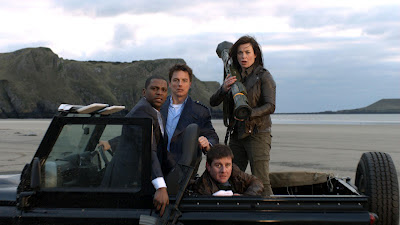
(l-r) Mekhi Phifer, John Barrowman, Kai Owen & Eve Myles
Miracle Day is the most audacious series of scripts the show has yet rolled out, but the problem with audacity is that, if one isn’t game for it, it tends to leave one at best uncomfortable or at worst dismissive. There are moments in Miracle Day that’ll have viewers shifting in their seats, and many more that those same viewers will fluff off as laughable. The premise, for those few of you who are unaware, is that one day, all of a sudden and without explanation, nobody on Earth dies. Then another day goes by, and the same thing happens. And so forth, and so on. This is dubbed “the miracle.” The first six of its ten episodes are an exploration of humanity’s reaction to this brand of immortality. Davies says on a commentary track here that much of the idea was to explore the way mankind would overreact to such a scenario, which, if taken into account, might put a considerably different spin on the events. Either way, as Torchwood is wont to show us, humanity comes off looking ugly and self-absorbed. Give humanity immortality, and they’ll immediately find ways to kill themselves or one another. There’s a grim, joking outlook to much of the proceedings, but that’s only when it isn’t offering up genuinely horrific material. Miracle Day puts knots of various types in my stomach, and that’s why I love it, flaws and all.   

And there are flaws. It’s never discussed or mentioned how the miracle affects life on planet Earth outside of mankind. How about plants and animals? Surely they, too, should play a huge role in the proceedings? Alas, we never find that out. The concept is potentially so vast, that the season could have taken twice as much time to explore the idea and still come up short. The oft-tossed about notion that ten episodes was too long a time to tell this story is, dare I say it, horseshit. Many viewers will immediately want to know why the miracle is happening, but the answer to that isn’t revealed until Episode 10. This is likely part of the reason folks started tuning out en masse when the series was broadcast last summer; for many viewers it was simply taking too long to find out why all of this madness was happening, and the myriad red herrings along the way were probably frustrating. Misguided though this line of thinking is, it nevertheless, as of late, seems to be a real problem. (See also AMC’s The Killing.) Blu-ray or DVD alleviates this problem. You don’t need ten weeks. You just need ten hours.

Bill Pullman as Oswald Danes & Lauren Ambrose as Jilly Kitzinger
The character of Oswald Danes (Bill Pullman) is one such red herring. Since the series doesn’t have a villain proper until the eleventh hour (or the tenth, as the case may be), it gives us pedophile Danes as a through line substitute (mind you, this narrative contains many other “short-term” villains along the way). Danes was the first high profile figure to escape death, and has since used the entire situation to his benefit. The idea of Oswald is maybe a good one, but the execution of the character less so, and even after two viewings I’m not sure if this is because of Pullman’s performance, or because of how the character was (or rather wasn’t) written. For the first couple episodes, Pullman is mesmerizing, playing the character with tics and vocal inflections that are quite unlike anything we’ve ever seen the actor do before. However the gimmick becomes stale, and we care less and less about his story as the show marches on (he probably should’ve been written out halfway through the season, but no, he’s there, unwanted, ‘til the very end).

There’s other stuff the season probably gets wrong, and certainly in tone it shifts wildly all over the place from one episode to the next, but as is always the case (or at least always my case) with Torchwood, it gets more right than wrong. It’s the journey that makes Miracle Day alternately fun and horrifiying, not the destination. That’s why even if the finale feels a little off, or maybe doesn’t make a whole lot of sense, or, alternately, is perhaps too damn convenient, I’m not inclined to bash those aspects. Its divisiveness is exactly what makes this must see sci-fi TV. This is a story that’s about the ride, and first time viewers need to know, going in, that it's simply not about what happens at the end.

(l-r) Alexa Havins (as Esther), Phifer, Myles, Barrowman
Fans worried about involving American money and talent in Torchwood, and the effect it would have on the production. They needn’t have, and clearly Starz knew the show they were getting involved with; if anything, Torchwood is bolder here in its outlook than ever before. It’s bloodier and more violent. It’s as bleak as ever. You want gay sex? An entire episode revolves around Jack’s relationship with a man in 1927, featuring some very graphic sex scenes, and an emotionally engaging storyline to go along with it. (It’s certainly not exploitative just for the sake of it.) The only way the show has been “Americanized” is in its look and location, as there’s no mistaking it’s now being made with American money and equipment, with the bulk of it being shot in L.A. (although much of the story is still set in Wales, and the production did spend three weeks there).  

I’ve become accustomed to believing, over the years, that Torchwood is Captain Jack’s show, and that without John Barrowman, there is no series. With Miracle Day, though, I’m starting to see that maybe that’s not the case, and in fact this concept is even more flexible than I’d previously given it credit for. While new team member Rex Matheson (Mekhi Phifer), with his awesome swagger, might be part of that train of thought, what really led me down this road is Gwen Cooper (Eve Myles). Miracle Day is far more Eve Myles’ show than it is Barrowman’s. She’s the character who’s grown and learned throughout the entirety of Torchwood, not Jack. She’s always the character who’s got the most to lose, and never more so than in this story arc.
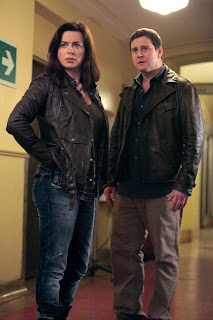
Let’s be honest: John Barrowman isn’t a great actor. He is, however, a great screen presence, and aspects of his personality have been used over the years to help create Jack. On the other hand, Eve Myles is one hell of an actress, and she gets to do stuff with Gwen in Miracle Day that it feels as though she’s been waiting for years to do. Here she’s not someone with whom to fuck, and even Jack learns that. She’s gone far past being the student. She’s his equal, and just as adept at deciphering the cruel way the universe operates as he. On the watch of Miracle Day, Gwen Cooper has become every bit the central figure that Jack Harkness is. If, for whatever unfathomable reason, Barrowman wasn’t available, or no longer wanted to do the show (hey, the thought was prefaced with “unfathomable”), at this point Torchwood could easily continue on with Gwen as the central figure.

Perhaps the most polarizing character in Miracle Day, though, is Jilly Kitzinger (Lauren Ambrose), who, like Oswald, is another surrogate villain, although I wonder if people realize she’s supposed to be this crazy bitch in heels? I mean, you do get that the idea here was to create a camp, over the top villainess, right? Jilly’s a publicist who finds herself thrust in the middle of the miracle madness, and with every step she takes, she finds herself enmeshed deeper in the conspiracy, until finally, at the end, she’s at the very center of it all. I’ve been a fan of Ambrose since her days on Six Feet Under, so I was perhaps predisposed to appreciating her work here, although Claire Fisher Jilly is most certainly not. However, she attacks this role with the same kind of ferocity as she did Claire for five seasons. Unlike Children of Earth, Miracle Day doesn’t end with a complete sense of closure. Although its storyline is tied up nicely, its characters are left dangling, and Jilly is one of them. I don’t pray, but if I did, I’d pray for more Torchwood and more Jilly Kitzinger, because I had so much fun with Miracle Day, and this just simply cannot be the end. Yes, like the best professional entertainers, Russell has left me wanting more.

Blu-ray Extras: This is a crisp, beautiful sounding and looking Blu-ray that to my eyes and ears replicates the experience of watching it in High Def last summer. The star attractions here are probably the two commentary tracks, on the first and last episodes, featuring Davies and Julie Gardner. They’re a reliably fun and informative couple of hours, which cover a great deal of ground and are well worth a listen. Only problem is, they were recorded after only the third episode had aired, so neither of them have any idea that the general public isn’t going to be eating this material up, although Davies confesses that he’s unsure if it’s going to be everyone’s cup of tea. Next up is the bonus web series entitled “Web of Lies,” which is similar in style to one of those animated motion comics. I don’t know exactly how this was presented on the internet, but here all the bits and pieces are edited together into one 30-minute piece. It tells two alternating tales – one in the past with Jack and Gwen, and another set concurrent with Miracle Day, featuring the voice of Eliza Dushku. 

There is also a series of character profiles, a behind-the-scenes special, a special effects featurette, and a short selection of utterly worthless deleted scenes. The most annoying aspect of this set, however, are the intros for each episode featuring Davies and Barrowman talking directly to the camera. These are lowest common denominator type bits, for the dumbest viewers in audience. I can sort of see why they were made for the TV broadcasts (though I'll be damned if I can remember them playing on Starz), but here they're nothing more than an intrusion, taking you out of the drama each and every time. They can be skipped with your remote, yes, but the set should've offered up the option to not play them at all. Your mileage may vary. 

Friday, March 23, 2012

A Dangerous Method Blu-ray review


There’s only one thing I can guarantee you’ll take away from A Dangerous Method, and that’s, for better or worse, a whole new opinion of Keira Knightley. Years from now, when people dissect her career, I believe this movie will be recognized as the one where it all changed and she proved she was more than just a pretty face. Mind you, the “years from now” part is key, because she’s received virtually zero critical recognition for this work, which should perhaps not be all that surprising. When an artist we think we know unexpectedly delivers this kind of fearless, ferocious work, it can be easy to dismiss as “ridiculous” or “overacting.” She rants and raves and stutters and does something with her jaw that could only be found in a David Cronenberg film. It’s polarizing, like great performances can be, and unfortunately many viewers won’t move past what she does here to see the bigger picture.

Knightley plays Sabina Spielrein, who in 1904 is admitted by her mother to the Burgholzli Clinic in Zurich for bouts of hysteria. She finds herself in the care of Carl Jung (Michael Fassbender), who, unusually for the time, uses the “talking method” of treatment. These days we call it psychoanalysis. Slowly, Jung helps Sabina to realize the roots of her problems and the pair forms a friendship. Enter Otto Gross (Vincent Cassel), a free-thinking, cocaine-sniffing psychoanalyst who encourages Jung to explore a sexual relationship with Sabina, which Jung does, complicating his own psyche, as well as his marriage to Emma (Sarah Gadon). Perhaps the only person that can help him is his mentor and father figure, Sigmund Freud (Viggo Mortensen), whose views only make the situation that much more complex, as does Sabina’s own interest in psychoanalysis, at which she herself is becoming more and more adept.

Read the rest of this Blu-ray review by clicking here and visiting Bullz-Eye.

Wednesday, March 21, 2012

Telstar (The Joe Meek Story) DVD review


Joe Meek is not a figure many Americans have ever heard of (me included), but sit down for a viewing of Telstar, a rock and roll biopic which details the highs and lows (mostly the latter) of his life, and you’ll likely never forget him. Few such biopics have a happy story to tell, and Meek’s is as bleak as any I’ve seen, and yet it may be worth a gander, if for no other reason than the riveting performance of Con O’Neill, who portrays its central figure.

The history of art is riddled with one hit wonders, and while Meek, a producer, seems to have been quite the innovator in his time, from today’s vantage point, he’s largely known for one thing, and that’s the 1962 instrumental tune “Telstar,” which he wrote and recorded with his studio band The Tornados. The song was a massive hit on both sides of the Atlantic, reaching #1 in both the U.S. (a first for a British band) and the U.K. Unfortunately for Meek, a French film composer sued him for plagiarism over the song, and the millions of dollars in royalties he would have received from “Telstar” were held up in court for years, forcing Meek to struggle with his art and money over the following years. On February 3rd, 1967 – the eight year anniversary of Buddy Holly’s death, a figure with whom Meek was borderline obsessed – Meek pulled a shotgun on his landlady, Violet Shenton (Pam Ferris), and killed her. Then he killed himself. Three weeks later the French courts ruled in favor of Meek. The movie Telstar aims to show how it all went so wrong for Joe Meek.

Pam Ferris as Violet Shenton and Con O'Neill as Joe Meek
Telstar has its roots in the theatre, as it was first a 2005 stage play, written by Nick Moran and James Hicks, with O’Neill playing Meek. Moran helms the film version, and though he seems eager for the material to shed its staged roots, much of the movie is still set in Meek’s flat, which doubled as his recording studio (no doubt this was the primary set used in the play). It first premiered at the London Film Festival in 2008, so Telstar is also several years old, and now, nearly three years after its U.K. release, it quietly makes its debut on DVD here in the States. While this might normally indicate an inferior film, I think what’s really going on here is that Telstar was found to be a nearly impossible film to market to American audiences. Kevin Spacey is part of the cast (as Major Banks, Meek’s financial backer), yes, but a small part, and not one the movie could be sold on. The rest of the players are nearly as foreign to U.S. audiences as the story being told here. (Fine, fine, fine...yes, James Corden does indeed have a fairly important part as drummer Clem Cattini.) 

O'Neill and JJ Feild as Heinz
The movie offers up numerous reasons for Meek’s downfall, with his money problems being only one of them. His interest in the occult plays a part. He held séances on a regular basis, and thought that Buddy Holly was speaking to him from the grave. He was addicted to pills; a steady regimen of uppers and downers. He was tone deaf, which, as you might surmise, wasn’t a good thing for a music producer. He seemingly had the inability to recognize mega talent when it was presented to him. The movie highlights his dismissing of The Beatles when Brian Epstein sends him a demo reel (while his Wikipedia page also mentions David Bowie and Rod Stewart as artists he could’ve worked with, but chose not to). Meek was also a homosexual at a time when it was illegal to be a homosexual in England, and in one scene he’s arrested for cruising public bathrooms. However, what Telstar really seems to indicate was the cause of his demise, was his blind faith in Heinz Burt (JJ Feild), his lover and musical protégée. Here, Meek seems to believe that Heinz will rule the pop music world, never seeming to notice that audiences can’t stand the guy, and view him as a joke.   

Kevin Spacey as Major Banks
Clearly O’Neill had several years to hone his performance before going before the cameras, and it shows. He attacks the role of Meek with fearless gusto, and in doing so creates a character who’s almost impossible to like, yet enormously easy to sympathize with. The movie itself is a rambling affair, with what feels like at least a couple dozen characters, veering in and out of Meek’s life. Many of them are present for only a scene, and it feels as if they’re going to be important to the proceedings, but then they quickly disappear (much like in life, I suppose – though it doesn’t necessarily make for easy to follow filmmaking). I honestly couldn’t tell what the filmmakers thought of Joe Meek, as they didn’t go out of their way to showcase him in much of a positive light, and the entire film builds and builds toward the murder suicide. Yet they’ve shepherded this material a long way, and O'Neill's dedicated a large chunk of his career to the role. (A commentary track would've been a welcome inclusion on this disc.)

Telstar has a great central performance from Con O’Neill, but a flawed execution of the film itself. It’s nearly impossible to recommend this to anyone except those who’ve an interest in pop music history, however they may very well love it, especially as the movie is jam-packed from beginning to end with all sorts of oddball British music from the era it chronicles. The DVD has no extras outside of a theatrical trailer.