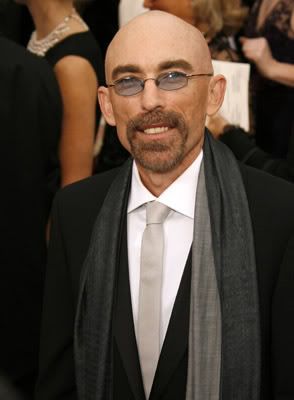
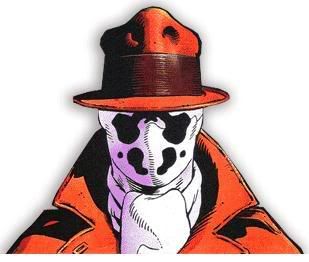
Good thing the cat's now officially out of the bag. Now I can ramble on and on about Jackie Earle Haley playing Rorschach in Zack Snyder's upcoming adaptation of Watchmen. Oddly, at the moment, I've got nothing to say except that it rocks.
Sunday, July 29, 2007
The Biggest (Non)Secret I've Had to Keep in Ages...
Good thing the cat's now officially out of the bag. Now I can ramble on and on about Jackie Earle Haley playing Rorschach in Zack Snyder's upcoming adaptation of Watchmen. Oddly, at the moment, I've got nothing to say except that it rocks.
Friday, July 27, 2007
Who's McHale?
To read the rest of this piece, click here and order a Manhattan over at The House Next Door.
Thursday, July 26, 2007
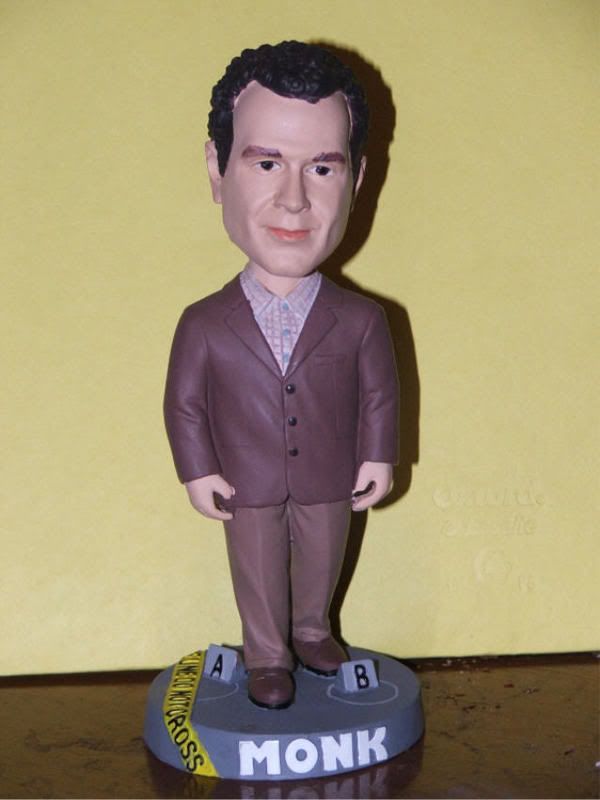
Monk, The Bobblehead
Monk rocks, right? It's one of the coolest, easy series unleashed in recent years. If you follow the formula, you don't have to tune in every single week. Monk shows up and solves the mystery. Sometimes we're in on whodunnit; sometimes not. Either way the show entertains mostly due to its cast and the writers' manner of deftly shoehorning each character into the plot.
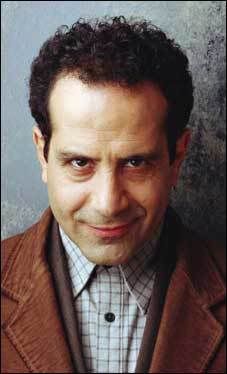
None of this justifies the bobblehead looking nothing like Tony Shalhoub. But in defense of the sculptor, he may very well have too intricate a face for a bobblehead. Sure, it wants to be Shalhoub, but it is not.
To me, it looks like someone else...specifically. Curious if anyone else hones in on what I did (assuming my photo does the sculpture justice).
Hint: Remove the curly hair and focus on the face.
By the way, does anyone have any ideas as to the strength of the Bobblehead Culture? Why is it so prevalent? Why do these doodads keep getting made? I've pondered purchasing numerous characters, but have yet to find one that meets my standards. Do you own a bobblehead, and if so, which one? (Monk was a freebie, FYI.)
Tuesday, July 24, 2007
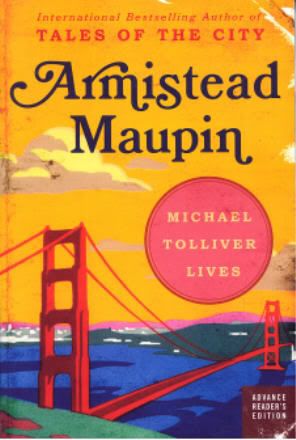
Michael Tolliver Lives
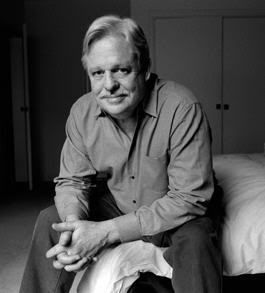
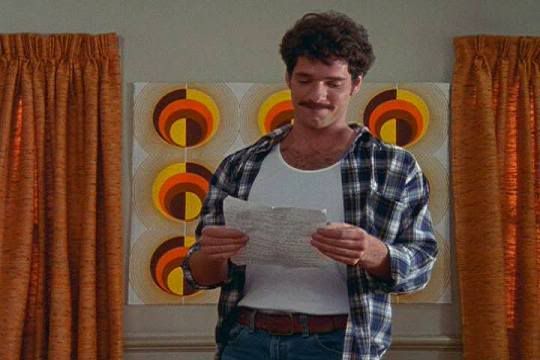
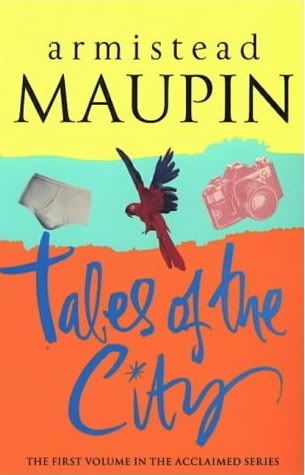
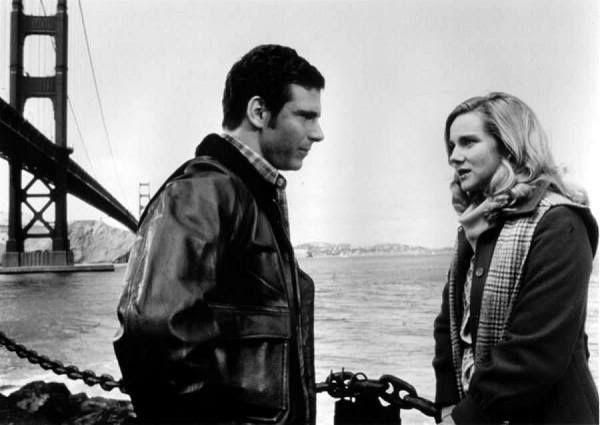
The above quote is on the back of the dust cover for Michael Tolliver Lives, the latest work from Armistead Maupin. After reading the book, I’m in agreement with both Maupin and Publisher’s Weekly. Yes, it chronicles the same characters as the Tales of the City series, but unlike the previous six Tales books, Lives is told in the first person -- a marked departure and it gives Maupin's universe a new texture. Michael Tolliver Lives could have been whorishly titled Tales of the City: The Next Generation; you need no knowledge of the previous works in order to get it. The book takes place in the present, yet it’s been 18 years since we’ve visited these characters. While they’ve moved with and been affected by the times (alas, 28 Barbary Lane is mostly a distant memory), Michael, Brian Hawkins and Mrs. Madrigal are still the same people we love -- and yes, they still get high.
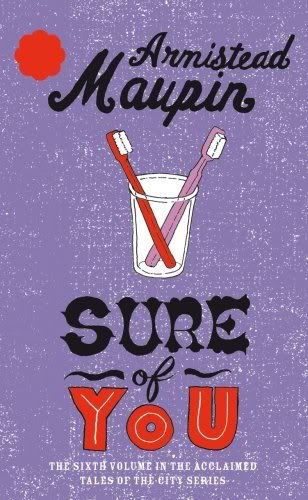
One of the most surprising aspects of Lives is the reappearance of Mary Ann Singleton (now Caruthers) near the book’s close. Mary Ann, for the uninitiated, was basically the central character of the first three Tales novels. As the series progressed, there was less emphasis on her and by the final volume, Sure of You, she’d become a selfish, career-minded bitch who ended up leaving her family for a job in New York. Maupin’s gotten a lot of shit from people over the years about the development of Mary Ann; he’s often been accused of betraying the character. By the time I hit Sure of You, I looked back and felt she’d been heading down this path from the very beginning. She was an opportunist from the word go and dramatically it made perfect sense. In some ways, Mary Ann was the most real character in the series because she wasn’t a happy ending. In Michael Tolliver Lives, I think Maupin seeks to redeem Mary Ann somewhat, as she begs forgiveness from both Michael and the reader. I’m still on the fence as to whether or not it works, but then again forgiveness is a complex issue. Perhaps this isn't the last we've seen of Mary Ann and he'll expand on the issue(s) in a future book. Her inclusion here is a real treat regardless, as she was the one character I didn’t expect to see again.
Monday, July 23, 2007
Leone's Latest Quiz
1) Favorite quote from a filmmaker
Don't make a film if it can't be the film you wanna make. It's a joke - and a sick joke - and it'll kill ya'. - David Lynch
2) A good movie from a bad director
I really don’t have a fair answer to this. How about Ravenswan?
3) Favorite Laurence Olivier performance
Max de Winter in Rebecca (Sleuth’s a close second.)
4) Describe a famous location from a movie that you have visited (Bodega Bay, California, where the action in The Birds took place, for example). Was it anything like the way it was in the film? Why or why not?
There is no basement in the Alamo. That is all.
5) Carlo Ponti or Dino De Laurentiis (Producer)?
Dino. (He produced Blue Velvet!)
6) Best movie about baseball
The Bad News Bears. Not sure it's really "about" baseball, but Jackie's in it, so 'nuff said.
7) Favorite Barbara Stanwyck performance
Well I’ve still not seen many of them, but I’m going with The Lady Eve for the time being.
8) Fast Times at Ridgemont High or Dazed and Confused?
Both rock, but Fast Times has the edge.
9) What was the last movie you saw, and why? (We’ve used this one before, but your answer is presumably always going to be different, so…)
Driving Lessons, because Laura Linney was in it. (Although it turned out that Rupert Grint and Julie Walters made the piece; Linney was great support, but just not “the star”.)
10) Whether or not you have actually procreated or not, is there a movie you can think of that seriously affected the way you think about having kids of your own?
Having never procreated, but having a 14-year old I consider “mine”, all I can say is that question requires too much thought.
11) Favorite Katharine Hepburn performance
Suddenly Last Summer
12) A bad movie from a good director
The Brothers Grimm/Terry Gilliam
13) Salo: The 120 Days of Sodom-- yes or no?
Fucking no fucking way. And I guess my answer just goes to show the power of that nasty piece of filth.
14) Ben Hecht or Billy Wilder (Screenwriter)?
Wilder.
15) Name the film festival you’d most want to attend, or your favorite festival that you actually have attended
Festivals annoy me, but I’ve got great memories of the Twin Peaks marathon at the Alamo Drafthouse in Austin years ago.
16) Head or 200 Motels?
Head -- I’ve not seen the latter, but I love Head.
17) Favorite cameo appearance
David Cronenberg in To Die For.
18) Favorite Rosalind Russell performance
Picnic (see #7 above, though)
19) What movie, either currently available on DVD or not, has never received the splashy collector’s edition treatment you think it deserves? What would such an edition include?
The Avengers. Somewhere there’s a cut of that movie that makes it even more worthwhile…although I am quite fond of the 89-minute version that does exist. I’d treasure a commentary track from director Jeremiah Chechick and screenwriter Don MacPherson wherein they discuss their vision vs. the finished product.
20) Name a performance that everyone needs to be reminded of, for whatever reason
Jeff Bridges in The Fisher King…for every reason.
21) Louis B. Mayer or Harry Cohn (Studio Head)?
No thoughts.
22) Favorite John Wayne performance
I guess The Searchers. Not a big fan.
23) Naked Lunch or Barton Fink?
I like this question, because anyone who was a film freak in ’91 probably equates the two films for numerous reasons. Both rock, but Naked Lunch easily scores my vote.
24) Your Ray Harryhausen movie of choice
Even though he didn’t direct it, I’m going with The Valley of Gwangi, a movie that imprinted itself on me for life.
25) Is there a movie you can think of that you feel like the world would be better off without, one that should have never been made?
Um, see #13 above.
26) Favorite Dub Taylor performance
Damn…looking at his IMDB resume I’ve seen a shitload of stuff he’s been in, but I’ve got no idea who he is. I’ll say The Getaway because I’m sure he was good in that (right?).
27) If you had the choice of seeing three final movies, to go with your three last meals, before shuffling off this mortal coil, what would they be?
Good lord, I hope to whatever higher power may possibly exist that the last thing I’m thinking about in that moment is movies. I’ve devoted so much time to them in my life that in those precious minutes I oughtta be thinking about bigger issues.
That said…
Withnail & I, The Big Lebowski, and Ravenswan (currently my only writer/directorial effort…hey if I’m dying, why not choose something I was part of?).
28) And what movie theater would you choose to see them in?
I guess the Showboat Theatre in Hermann, MO, my hometown. I don’t even know if it’s still a movie theatre, but it’s where I saw my first theatrical movie, which, unless memory cheats me, was Star Wars.
Saturday, July 21, 2007
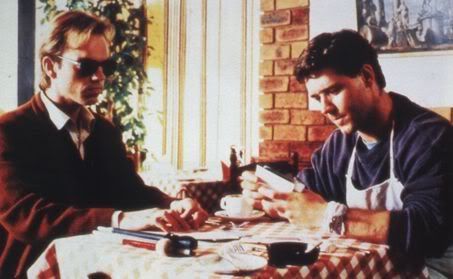
Proof of Not Drowning, Waving
Proof is a little film that came into my life back in the early 90s, before either Crowe or Weaving were the stars they are today. I used to watch it obsessively and can make claim to having been a fan of both actors long before L.A. Confidential or Priscilla, Queen of the Desert. It's the peculiar story of a prickish blind photographer (Weaving) who's befriended by a busboy at his local eatery (Crowe). The pair become fast friends when Weaving's Martin enlists Crowe's Andy to verbally interpret his photographs (a process Martin calls "labelling"). But the only thing neither of them count on is the intrusive presence of Martin's manipulative housekeeper Celia (Geneviève Picot) and her obsession with her employer. I cannot recommend Proof highly enough, especially to anyone who's even a moderate fan of either or both of these men who've gone on to become incredibly successful. It's a charming, easy film to view and will leave a smile on your face. It's about perception and misperception and Moorhouse's yin and yang placement of the two ideas is flawless. Hell, even if you can't stand either of them, you'll dig this film. (Although really -- who hates Hugo Weaving?)
Not Drowning, Waving provide the score for Proof, and whatever they did with it was enough to get me to seek out more of their music. They created a thumping, rhythmic beauty and the music was as much a part of the movie as the stars, script and direction. Some people say the best movie scores aren't noticeable. While there's merit to that notion, I do treasure a score that's listenable as its own entity (Vangelis' work for Blade Runner is an obvious example). The band also did the score for another rarely seen, early Crowe vehicle, Hammers Over the Anvil (which I've not seen, despite the presence of Farscape's Wayne "Scorpius" Pygram). Most of Not Drowning, Waving's albums are out of print here in the States, however Claim and Circus can usually be found on eBay for very reasonable prices and you'll go wrong with neither.
Not Drowning, Waving are one of the great bands that almost nobody's ever heard (at least in my circle of living) and I gather they were most successful in Australia, their home turf. They've got an official website called Follow the Geography, although it's unclear to me whether they're still together as a band or not (the "latest" news is stamped 2005). The site offers up a brief history of the band that's considerably more informative and compelling than anything I could present.
Here's the video for "Spark", which is a fantastic little ditty. An instrumental version of the tune was used in Proof; this version can be found on Circus. If this isn't quite to your liking, don't give up on Not Drowning, Waving. They're full of surprises and "Spark" is only the tip of their eclectic, worldly iceberg.
And here's the trailer for Proof, which is also set to the music of Not Drowning, Waving:
Friday, July 20, 2007
"Jane, get me off this crazy thing!"
To read the rest of this piece, click here to take the exit marked The House Next Door.
Rued Panache
What I find most interesting about Adam's work for this series is the opening paragraph, which he crafts himself based on what he knows about the blogger in question. It's weird to be talked about as though I'm a subject worth talking about (I suspect in my case there may have been some struggle on Adam's part to accomplish this feat). I like this series because it's a blogger dedicating a portion of his blog each week to another blogger. Nice!
My answers to his questions can be found at DVD Panache by clicking here. If you're interested in contributing to the series, contact Adam!
Saturday, July 14, 2007
Stage Fright
Read the rest of this piece by clicking here to creep the boards of The House Next Door.
Thursday, July 12, 2007
007 in '007: Dr. No

To go back and watch the first Bond film is fascinating because so much of the formula is already intact. Aside from a few notable absences, which will be addressed below, most everything is in place, not just the unmistakable theme music, but the stylish set designs and frantic editing…all the technical stuff that is unforgettable. The megalomaniac villain – grand in ego, singular in purpose, is alive and well right out of the gate. The women and their names – the stuff of legend. Hot. With the first Bond film comes Ursula Andress right out of the surf to
become the most recognizable Bond girl. And then there’s Connery – James Bond fully formed with his postmortem sarcasm, particular tastes and cold animal sex drive in full gear. As much as I enjoyed watching Daniel Craig reboot the character and start the developmental process from getting his double 0, honing his taste for inebriants, learning the place of love in the workplace, etc…I couldn’t help but think that as the end credits for Casino Royale rolled, the Bond character was ready to emerge again as the final product that is Sean Connery in Dr. No. And yet, with so much of the formula and style in place, the film manages to be exotic and thrilling to anyone flirting with becoming a Bond aficionado. It was clear that producers Broccoli and Saltzman wanted to make a series of pictures and it’s as if their first experiment was such a home-run that almost everything stuck. The only thing that wasn’t there was the budget, but with such expert filmmaking, you never miss it. And gadgets would come later.
Tuneage – The Dr. No soundtrack is somewhat of an anomaly, based primarily on Monty Norman’s theme and the work of the hottest Jamaican band at the time, Byron Lee & the Dragoneers. John Barry was involved, too, but he was un-credited. It is a livelier soundtrack, with more pop sounds than orchestral sounds, included catchy Carribean dance tunes such as “Jump Up,” and the reoccurring “Underneath the Mango Tree.” The highlight, though, is Norman’s James Bond theme, which has enjoyed a multitude of variants over the last forty-five years, but is most indelibly rendered in Dr. No.Monsieur Binder – The two spheres and the gun barrel are there and so is a black and white Bond wearing a hat, but where are the opening horn blasts introducing the theme? Instead we hear psychedelic radio beams, the types of beams that might topple a guided rocket or missile. The most striking anomaly of Dr. No is the lack of a pre-credit sequence. Instead, the film
launched directly into the inspired graphic design credits of Maurice Binder. It is his crudest effort in the series, but one that is nevertheless striking with its bold dots and vibrantly colored dancing silhouettes. (I had a crush on the one with tassels on her dress. The first one, not the second). They are simple images, but stylistically potent. There are three segments to the credit sequence: the dots and cubes digitally dancing to Monty Norman’s classic theme, then young people dancing to Caribbean music and finally, the blackened silhouettes of three old Jamaicans with walking canes bouncing to a calypso version of “Three Blind Mice.” The lyrics are brutal, much like the film that lies ahead.Monsieur Hunt – What lies immediately ahead in the picture is the jarring assassination of Mr. Strangways, the British agent stationed in Kingston. The sequences that cover the killing of Strangways and then the killing of his secretary have curious jumps and cuts that give the scenes a staccato momentum. The result is a hastened sequence that would set the pacing for this film and the series beyond. According to editor Peter Hunt, director Terence Young left out shots that would traditionally be thought essential for the coherence of a scene, but Hunt managed to mix it up enough to convey the momentum of the action, defying certain established rules by cutting into a panning shot or violating aspects of continuity. The end effect is a uniquely stylized technique that is forever attached to the series. Peter Hunt is not afraid to speed up a motion or cut it off prematurely to get the timing right and the result is high impact fight sequences.

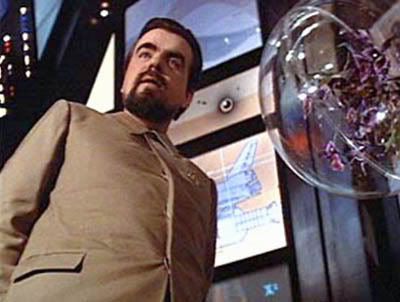
Monsieur Adam – Ken Adam loves circles in the ceiling almost as much as he loves grates in the ceiling. And he’s happiest when he can combine the two, as in the scene where the treacherous Professor Dent visits with the voice of Dr. No. Adam
would go on to do a variety of variations around that circle in the ceiling in countless Bond films. He also likes staircases without hand rails (it’s about comfort, not safety), the combination of natural rock with steel and open fire pits in lavish living areas below the earth’s surface. All present in Dr. No. The villain’s lair contains all the combinations of classical and modern that defines the tastes of Bond villains: copper doors and elevators, wood floors, Victorian and contemporary furnishings, carefully mixed. The villain doctor’s criminal bona-fides are confirmed with the careful placement of a recently stolen Goya portrait of the Duke of Wellington.
Zee Villain –Even without the kicking pad, Dr. No (Joseph Wiseman) would still be the total embodiment of the Bond villain. He’s a recluse with huge ambition. While he is cold and diabolical, he is also refined, and when he meets a worthy adversary, such as Bond, he is civilized enough to treat him and his lady to a nice meal. I’ve never heard of a Bond villain that did not offer Bond a drink. No self-respecting SPECTRE agent goes through life without knowing the libation habits of 007 – so when Bond finally meets the evil villain, Dr. No already has Bond’s drink prepared.Dr. No – [as the drink is handed to Bond] Medium dry martini. Lemon peel. Shaken and not stirred.
Bond – Vodka?
Dr. No – Of course.
And he calls himself a terrorist?
Like a good villain, Dr. No is always calm and collected. He never shares in the blame when something goes wrong, as when Bond luckily escapes an assassin’s bullet. The man in charge of the mission was the nervous Professor Dent, an agent of Dr. No’s who no doubt had a hand in hiring the killers to kill Strangways as well. When Dr. No asks the professor why Bond is still alive, Dent explains: “Our attempts failed.”The soft voice of Dr. No (that’s all the audience is getting at this point) says: “Your attempts failed. I do not like failure.”
With Dr. No, the buck stops at the lower echelons. And fear is his motivator. Still, it’s hard not to blame Dr. No for the next failure, since it was his concoction. It is one of the weakest, most absurd sequences which has Dent placing a tarantula into Bond’s hotel room – something that might make a man shit the bed, but not kill him.
Still, Dr. No remains somewhat daunting if only for the fact that he hasn’t been shown yet. He only appears in the last quarter of the picture, but his presence is obviously felt through a total of four and a half murder attempts (the driver in the beginning did not actually try to kill Bond, but he might have if given the chance and therefore counts for the half). And the visit to his base island, Crab Key, is filled with things to terrorize visitors – high-powered boats with machine guns, the dogs, and, not least, a dragon. All are part of Dr. No’s efforts to keep people off the island. It would take a special kind of man willing to look death in the face in order to confront the villainous doctor.

Les Girls – Besides the introduction of the durably charming Miss Moneypenny (Lois Maxwell), Dr. No also introduced another character intended to continue in the series, Sylvia Trench (Eunice Gayson). Trench is the type of girl that, through sheer sex appeal, could make a man’s departure change from “immediately” to “almost immediately.” She represents Bond’s off-duty time in Dr. No and From Russia With Love, and is more than suitably hot in that role. The shot of her in Bond’s bottomless night shirt, Porky Pig style, playing put-put in Bond’s room while her smackwarm gams steal the show is the first iconic Bond girl image. When Bond throws open the door and squats down low to shoot the intruder dead, she huffs: “There, now you made me miss.”
“You don’t miss a thing,” Bond replies. And he’s right. It’s impossible to look at Sylvia Trench and not take note of the sex appeal that emanates from her like a fine perfume animated by Tex Avery. If the average Bond girl sends a man’s eyes about a foot away from his socket, then Eunice Gayson sends them 10 foot away with a good dozen smaller tracer eyeballs in between.
But the sexy girls don’t stop there. The lovely Marguerite LeWars (former Miss Jamaica) tries twice to snag Bond’s picture for Dr. No before getting her arm twisted and being sent away. Granted, she’s always in duress and therefore has little opportunity to turn on the sex appeal, but she does get to pout like a hellcat, and act like one, too, when she claws Quarrel’s right cheek with a broken light-bulb. The producers managed to get a lot of talent from the local resources of Jamaica, and LeWars was no exception, as she was found working as a flight attendant for Pan Am.The femme fatale, Miss Taro (Zena Marshall), looks slightly awkward in makeup designed to give her a Chinese look, but nevertheless serves well as the bait to lead Bond into a harrowing, if artificial looking, chase sequence that sends the first flaming car off a cliff in a Bond movie. Taro’s main job is to look worried and suspicious…and sexy.
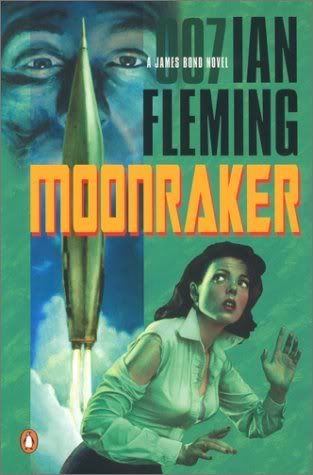
Finally, there is Ursula Andress as Honey Ryder emerging from the surf (with a wounded hind leg according to the commentary track to the film, though you’d never know it). It is a scene that is the most closely identified to the idea of the Bond girl. Her character is remarkably close to Ian Fleming’s Honey Ryder – tough, smart and goddess-like in beauty, but wholly uneducated and a sort of child of nature. Fleming would create several female characters with these types of traits, but Andress comes closest to putting that on film. Fleming was so smitten with Andress during the shooting of the film that he gave her a cameo spot in the ski-lodge of the novel On Her Majesty’s Secret Service, written in 1963, directly after the film. Although Andress did not get the chance to kick some butt, as Ryder did in the novel, she certainly manages to come across as self-reliant in the extreme. Her planned execution in the novel, as laid out by Dr. No, is to be bound to the ground as the tide changes so that black crabs will crawl over her and eat her flesh. The plan comes to naught because Ryder knows the crabs are harmless if she doesn’t resist – another failure that Dr. No would have blamed on others, had he lived to do so. In the film Terrence Young had intended a similar scene, but when the flesh eating crabs arrived to the set frozen and half dead, they had to resort to a simple flooding effect. One can only imagine that this impromptu change was for the best.
Bond, James Bond - The search for an actor to play Bond led Broccoli and Saltzman to consider a number of choices, including Cary Grant (Broccoli decided against him because he wanted an actor that would become part of the series and Grant would have likely been a one time deal) as well as Roger Moore, who was tied up at the time with The Saint. Sean Connery was an up and comer, having worked with Terence Young in Action of the Tiger (1957). Broccoli was impressed with him in Disney’s Darby O’Gill (1959) and he landed the part. It is hard to think of an actor, including Moore, who could have more firmly established the character as quickly and fully as Connery did. Sean Connery in 1962 was, quite simply, a perfect specimen of a man – athletic as hell (he was a Mr. Universe) and equally refined. Although his performance comes across as effortless onscreen, Connery went through an intense Bond indoctrination under the tutelage of director Terence Young. From the style of Bond’s suit to all the particulars of his taste, Connery was a rough cut stone that Young chiseled into the pure dazzling diamond. Bond’s panache is an extension of Young’s panache, something that would endure beyond Dr. No and even beyond Connery. From the very beginning of the series, Sean Connery is a perfect mixture of roughness and sophistication, brute and gentleman. He is at his most ruthless in Dr. No, particularly when he shoots a man in cold blood. Bond explains to the soon-to-be-dead Professor Dent (Anthony Dawson) after the hapless professor has emptied his revolver into the pillow likeness of 007: “That’s a Smith and Wesson and you’ve had your six,” and then pumps three silent slugs into the disarmed doctor. There’s no doubt that Bond is the hero and that his foes are the villains, but rarely does an audience see a hero employing his license to kill in as nonchalant and calculating a way as Connery in Dr. No. In future films, he would make a habit of using femme fatales as body armor, but the cold caste is set in Dr. No. with his murder of Professor Dent.
His humor, too, must have been something new to audiences. This particular hallmark of Bond’s character was the result of impromptu changes by Connery and Young. When he pulls up to Government House with the imposter chauffeur dead in the back seat, he quips to the entrance guard, “Make sure he doesn’t get away,” and hands the guard the keys, walking calmly into Government House without further explanation. Perhaps his death jokes are a subconscious way of dealing with the guilty pain his license to kill forces him to endure. If so, then it apparently turns his skin into a veritable shield of Teflon where guilt slides off of him faster than a fried egg. I think he just likes a good joke. It should be noted that as quippy as he got, Connery never quite reached the sarcastic levels of Roger Moore, but his comments, especially in Dr. No, do tend to be darker.
Connery’s Bond is not only graceful, brutish and athletic, but he’s a scrapper, too. When he’s completely at the mercy of Dr. No, eating his fine cuisine, he still manages to do everything in his cordial way to needle the villain. When Bond picks up a bottle to use as a weapon, the doctor points out that it is a Dom Perignon ’55 and, thus, a pity to waste, in which Bond replies (setting the bottle down): “I prefer the ‘53, myself.” He asks, off-handedly, to his threatening host whether the “toppling of American missiles really compensates for having no hands?” Even though he’s powerless, Bond continually looks for that one thing that might jolt the doctor or change the circumstances. When the doctor boasts about the greatest minds that make up SPECTRE, Bond corrects him by interjecting “criminal brains.” Of course, the doctor has his reply: “The criminal brain is always superior, it has to be.”I’m of the mindset that there really have been no bad Bonds, just unlucky ones. Connery was fortunate enough to enjoy the longest run of Bond masterpieces with the first three films, but it was, in part, due to his immediate ownership of the role.
The Novel – Although the first film in the series, Dr. No was the sixth novel. It brought up the tail end of Flemings early stories (the collection of short stories in For Your Eyes Only being the center point in the series). The film is more or less faithful to the novel with a few notable exceptions. The character of Miss Taro is crooked in the book, but even more crooked in the film. Felix Leiter was a return character in the novel, with a significant handicap he obtained in the second novel, Live and Let Die. The film does not mention the Audubon Society, which, in the novel, is responsible for shedding light on Dr. No’s activities as well as affording Bond’s superior, M, with a chance to share his worldview. Fleming spends a chapter on Bond, Quarrel and Ryder trekking through the mangroves in thrilling detail. The tarantula in the film is a centepede in the book, and it drinks the sweat off Bond's forhead (or so he senses). Also, Bond’s passage through the pipes of Dr. No’s fortress is part of the doctor’s obstacle course of death – planned out by the doctor with a finale confrontation with a giant squid. Finally (and if you plan on reading the book beware of the spoiler that follows), Dr. No meets his fate at the business end of a pile of guano. Oh yeah, and the dragon serves as an escape vehicle for Bond and Ryder. Virtually all of the deviations from the novel were wise moves on the part of the filmmakers.The hidden hand in the creation of the first James Bond film is Terrence Young. He would go on to make two more Bond films: what many consider the best, From Russia with Love, and the lesser, though grander in scope, Thunderball. But Young’s influence went well beyond the films he directed. He, more than any other, brought the Fleming Effect to the screen. He provided the stylistic essence in the series and molded the character of Bond.
Dr. No remains one of the best loved Bond films. I rate it as my favorite, with From Russia With Love and Goldfinger as close seconds. It, along with From Russia With Love and On Her Majesty’s Secret Service, is one of the closest to the novels. It is also one of the simplest.
This entry in the 007 in '007 series was written by Jeffrey of Liverputty fame. Be sure to stop in at Liverputty and check out his ongoing collection of Ian Fleming Bond novel excerpts titled The Fleming Lumber Room. -RR
Saturday, July 07, 2007
Land of a Thousand Words
Doctor Who: Always a Bridesmaid...
Read the rest of this piece, which also covers "Smith and Jones," by clicking here to visit The House Next Door.
Friday, July 06, 2007
Auntie Meme
Copeland tagged me. I still don't entirely understand all this. Everything I know about memes I learned from the Doctor Who episode, "The End of the World", which featured The Adherents of the Repeated Meme. These are the rules I apparently must obey:
1. We have to post these rules before we give you the facts.
2. Players start with eight random facts/habits about themselves.
3. People who are tagged write their own blog about their eight things and post these rules.
4. At the end of your blog, you need to choose eight people to get tagged and list their names. Don't forget to leave them a comment telling them they're tagged, and to read your blog.
UPDATE!
From Wikipedia: Biologist and evolutionary theorist Richard Dawkins coined the term meme in 1976. He gave as examples tunes, catch-phrases, beliefs, clothing fashions, ways of making pots, and the technology of building arches.
I bring this up only because Dawkins is married to former Doctor Who companion Lalla Ward (who was also once married to Tom Baker for about 10 minutes).
So now that that's out of the way, here are my eight random facts/habits:
1. I have actual interests outside of Doctor Who and James Bond.
2. I rarely answer the telephone, but check any and all messages left and will return most calls within 24 hours (unless I just don't feel like it).
3. I loathe the sun and the heat that emanates from it. (Moonlight, on the other hand, is refreshing.)
4. The Simpsons aren't all that funny to me.
5. Indian cuisine is the best way to go.
6. I enjoy eating mayonnaise straight out of the jar. Miracle Whip, however, is nasty.
7. Other people's opinions matter a lot more to me than I let on.
8. I spend far more time in various states of mild depression than you can possibly imagine.
The eight bloggers I'm tagging have been chosen mostly because they either haven't been tagged yet or will have no interest in playing along:
1. Joan
2. The Sheik
3. Keith Uhlich
4. Matt Seitz
5. Figurebuilder
6. Dan
7. Koda
8. Peel
Tuesday, July 03, 2007
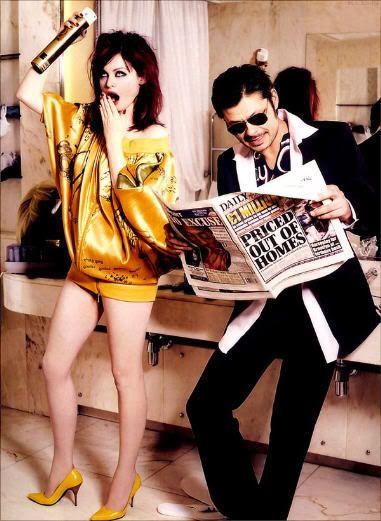
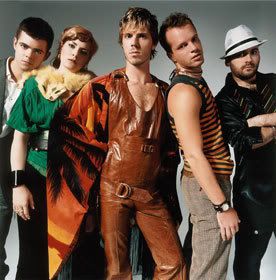
Sophie vs. Scissor Sisters
Sophie Ellis-Bextor came roaring back in late May with her third album of highly danceable and addictive tunes called Trip the Light Fantastic. I gushed about the greatness of Sophie once before, when I extolled the musical virtues of The Feeling (she’s married to the bassist, you see). But now she’s back and has had a hand in making my summer months tolerable. Bextor’s one of the great female artists of recent years and how American record labels haven’t found a way to market her catchy brand of enthusiasm leaves me boggled. This one's a no-brainer, suits. Oh, and somebody really needs to hire Sophie to sing a James Bond theme tune, and pronto, too.
Check out her new videos: “Me and My Imagination” and "Catch You".
See and hear them for yourself: “I Don’t Feel Like Dancing”, which is co-written by Elton John and from their second album, Ta-Dah. And if you’re a Pink Floyd fan, listen to their take on “Comfortably Numb”, which is one of the most peculiar cover versions of anything I’ve ever heard.
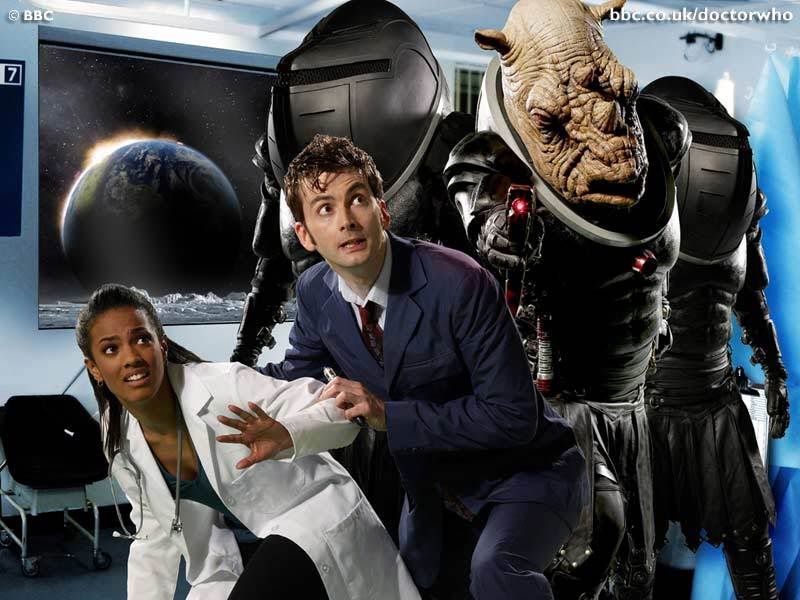
The action starts at 8PM (PST)/7PM (CST). Join me afterwards over at The House Next Door where I'll be unveiling yet another season full of witty and insightful Doctor Who recaps every Friday night.
Sunday, July 01, 2007
Thursday, June 28, 2007
Farscape: A Frellin' Retrospective
Good thing I gave the show another chance a couple years later.
To read the rest of my musings on The Uncharted Territories, visit the most uncharted territory of all: The House Next Door.
Wednesday, June 27, 2007
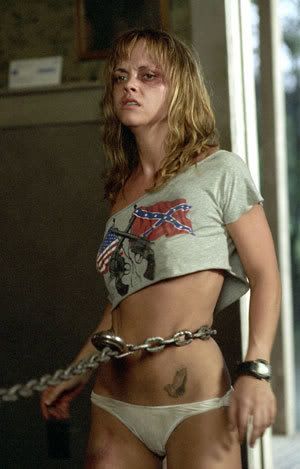
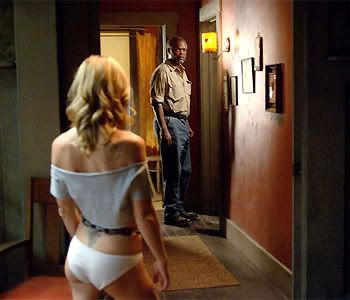
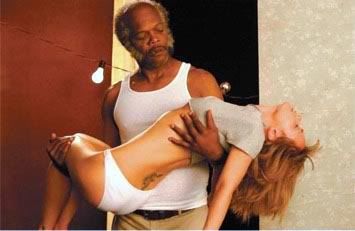
Black Snake Moan
My notes are a little hard to read at this point, but I’m pretty sure I saw everything other than her anus. Little Wednesday Adams done went and growed up on me. Mostly I was shocked because all of a sudden she’s just so damn skinny, which isn’t something I ever expected from Christina, who’s always been just a little curvy and you can’t begin to imagine how much weight the girl’s lost. Her rib cages should’ve gotten third billing here (right after each breast).
It's actually exploitative art. Note the subtle difference.
Thursday, June 07, 2007
Orbital - Doctor ? (Live at Glastonbury '04)
The shame of again failing to entertain both of you who are so dedicated to reading the Rued Ramblings[TM]...
Must break the ice at this party.
I therefore recommend Orbital, so that we may forget our petty differences...here they are rocking an undoubtedly drugged-out audience with a groovy spin on some classic sci-fi.
After that let's hang out under the Little Fluffy Clouds. The Orb are all but forgotten...yet their mark was indelible.
And when was the last time you inhaled from The Tubes?
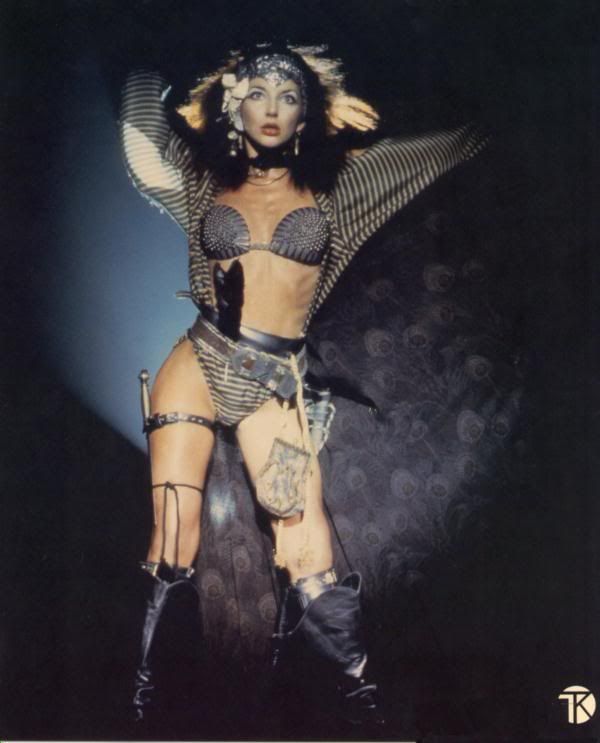
Last but not least - and not by even remotely popular demand - Kate Bush doing Wuthering Heights Live at Hammersmith. Eat your heart out Madonna. (I suspect the audience is relatively sober...but I could be wrong.)
Monday, May 28, 2007
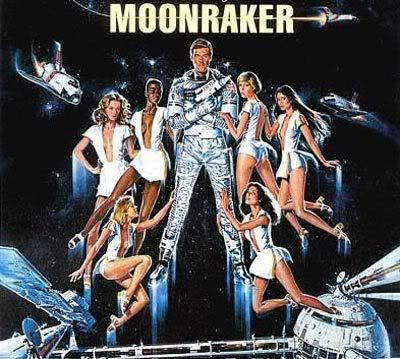
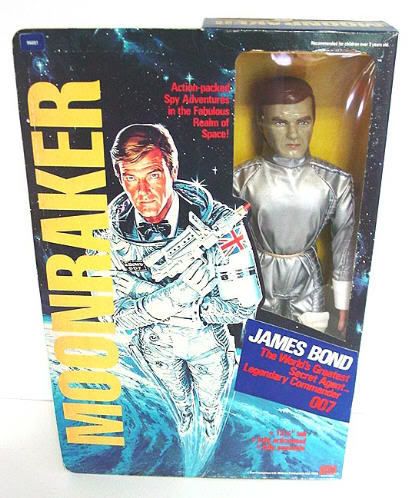
007 in '007: Moonraker
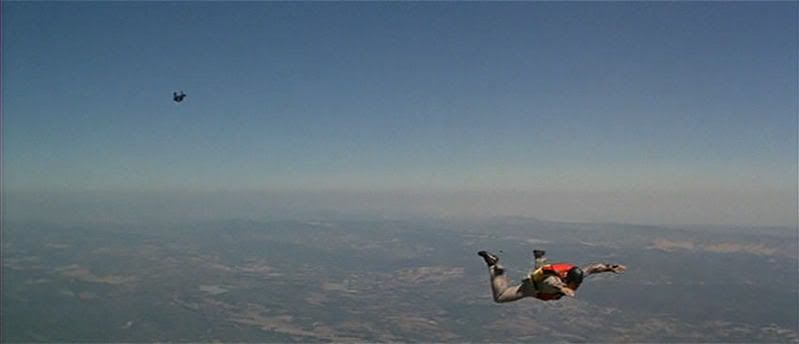
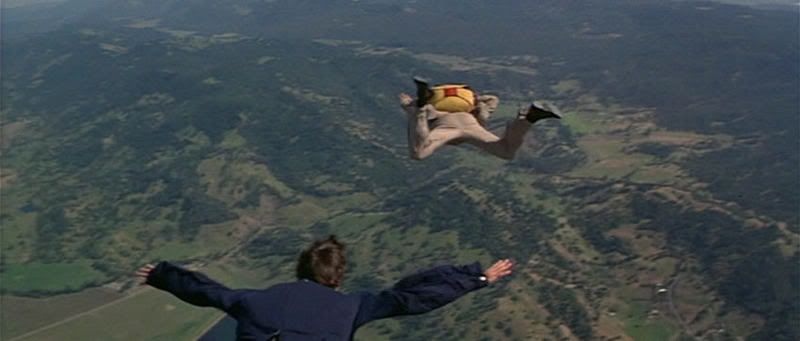
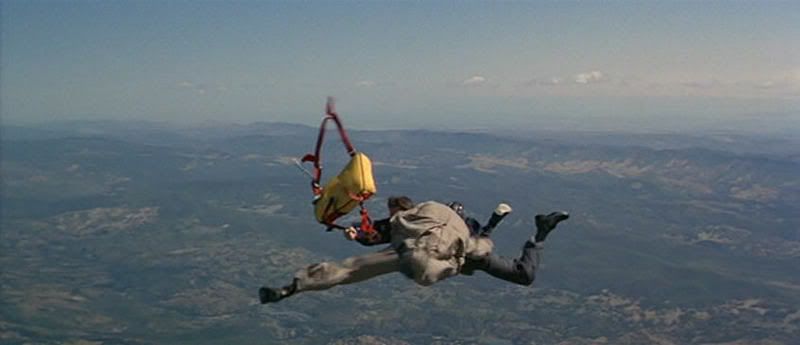
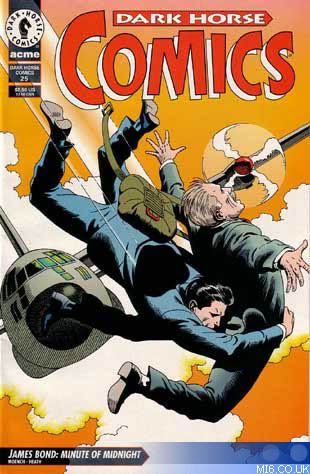
Any talk of Moonraker must begin with the pre-credits sequence, which features the most magnificently jaw(s)-dropping stunt ever performed in a 007 outing: Aboard a private jet, Bond’s busy puttin’ the moves on some babe who quickly reveals herself to be less than charmed by pulling a gun on him. The pilot emerges from the cockpit decked out in skydiving gear. Taking the gun from the girl, he hands her a parachute and proceeds to blast the navigation equipment to pieces.
Evil Pilot: “This is where we leave you, Mr. Bond.”
Bond: “A little premature, isn't it?”
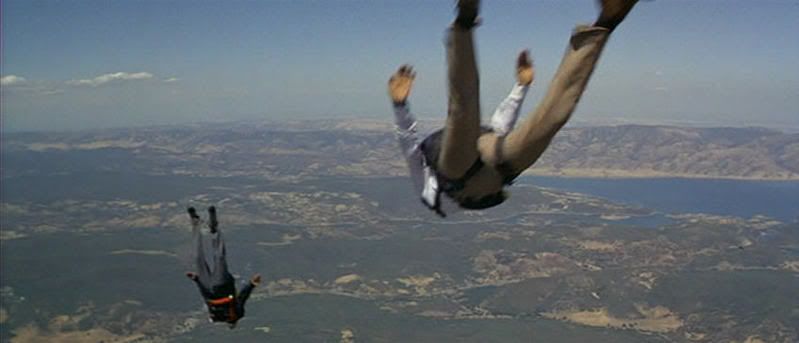
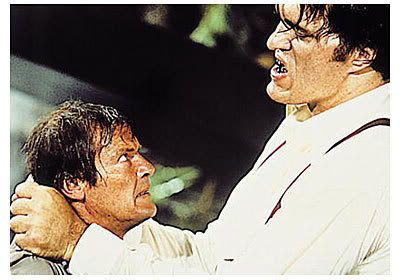
Bond and Evil Pilot scuffle, the door opens…and Bond pushes Evil Pilot out of the plane. 007’s victory is short-lived, however, as he too is pushed out the door by the previously unseen Evil Co-Pilot -- Jaws (Richard Kiel)! And that’s when the sequence really begins…
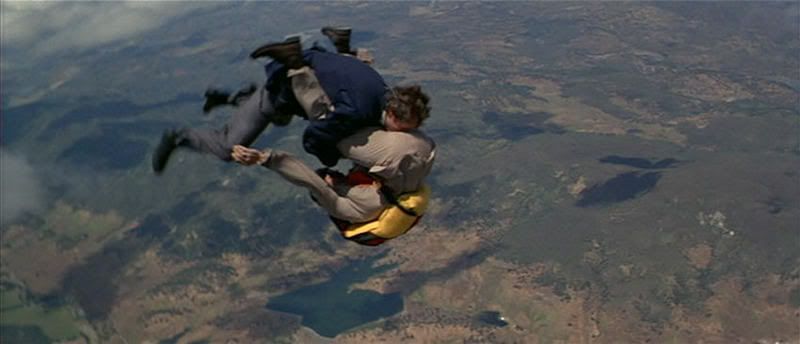
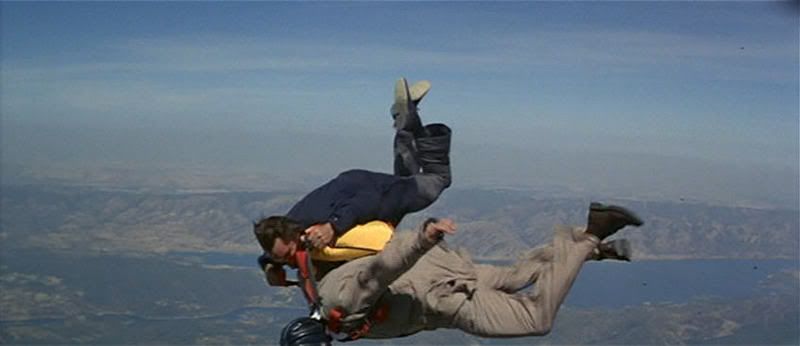
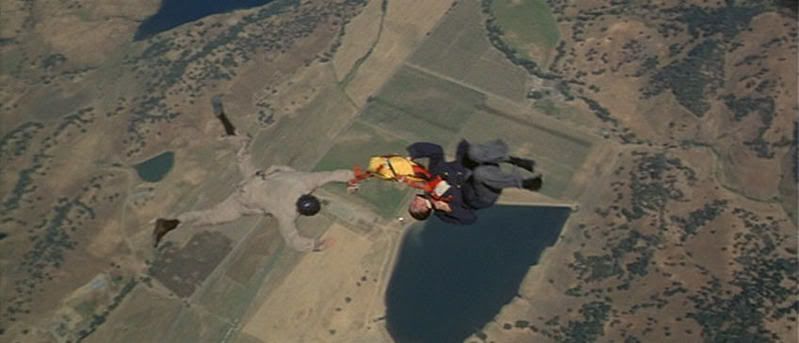
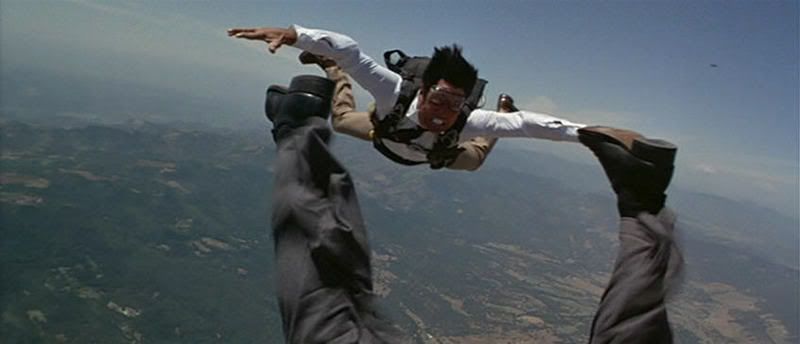
Bond navigates his way sans ‘chute towards Evil Pilot. The pair scuffle for considerably longer this time, in mid-air, as Bond relentlessly fights to remove Evil Pilot’s parachute. (Does the bizarre shot of Bond’s nose nestled in Evil Pilot’s crotch tell us more about James than we ever wanted to know?) This entire fight is a beauty to behold and the jewel in the Bond stunt crown.
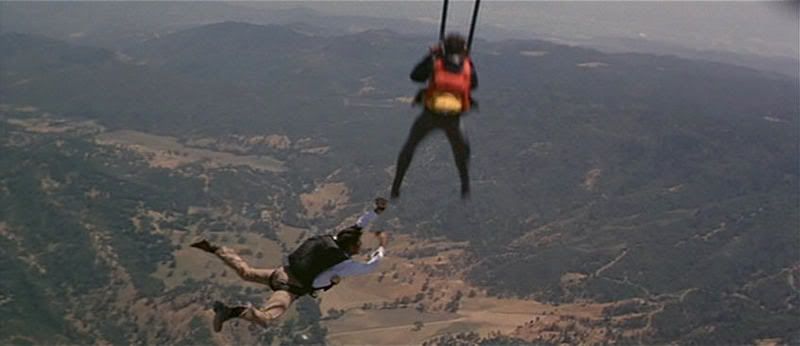
Once Bond snags the chute, Evil Pilot trails away into the atmosphere to meet his maker (clenching his fists at 007 all the way), Round Two begins. Jaws shows up behind James and attempts to sink his tinfoil teeth into Bond's leg, but not before James activates his chute, pulling him to safety. Jaws discovers his chute doesn’t work and crashes to safety through a circus tent on the ground below. (Despite the fact she was seen being given a parachute, we never really find out what happened to the girl.)
While this skydiving sequence has a few problems (i.e. the obvious stuntmen and the goggles Bond is magically wearing), the sheer thrill and spectacle make up for any minor shortcomings. It’s the kind of stuff that cemented Moore’s era as its own.
Tuneage and Credits Sequence: Maurice Binder’s work on the various ‘70s Moore movies is collectively my favorite. He was getting away with showcasing loads of sexy, silhouetted flesh – often dancing with R-rated imagery - and Moonraker is no different (though it does seem a mild attempt to duplicate the perfection of The Spy Who Loved Me’s credits). There’s a bit of dated animation in the mix, but the plethora of bouncing babes makes up for it.
Given the film’s sci-fi premise, the title tune feels too retro due to the recognizable presence of Shirley Bassey’s vocals. Her style is much more at home with her two Connery numbers and this feels like a case of “trying to go home”. The song was apparently offered to Kate Bush before Bassey and she supposedly turned it down (argh!). Kate’s vocal style would have been an inspired match for John Barry’s songwriting and Hal David's lyrics and as a Kate fanatic, I’m incapable of hearing "Moonraker" without dreaming of what might have been. The disco spin on the tune that plays over the end credits seems totally out of place with the rest of Barry’s score, which is pleasingly lush, accentuating the scope of Moonraker’s locations and the vastness of its premise. Interesting to note the movies that bookend Moonraker were not scored by Barry. (It bears worth repeating The Rued Morgue Disclaimer #1: Ross is lousy at writing about music.)
Zee Villain: French actor Michael Lonsdale’s Sir Hugo Drax is unengagingly realized, lifelessly stock and blandly cut from the most common slab of cardboard. The sum total of Drax is his villainy, his technology and his plans. With its focus on spectacle, the Moore era featured some of the least interesting villains and Drax is the weakest of the weak. He's a forgettable bad guy brought to non-life by a phoned-in performance....yet it doesn’t really hurt the film; Moonraker isn't about characterization nor does it even aspire to be.
While Drax the man may be a minus for Moonraker, his scheme – which seems inspired by one too many viewings of 2001 and the maddening thinking that might occur from the inability to figure it all out -- is a big plus. Drax is Hitler without the appreciation for art & history: Wipe out the flawed human race and start over in space. It’s through this comic book conceit that Moonraker scales memorable heights, both thematically and literally.Zee Henchman: While Moore’s era may not have fared well in the Villain Department, it created some pretty memorable henchmen. Richard Kiel’s Jaws was the only villainous lackey who lived to see another movie (having hounded 007 in the previous film, The Spy Who Loved Me). Here, Jaws is played more for laughs than in the previous outing, but given the comic book feel of the proceedings, its never obtrusive and his continual hounding of Bond from one scene to the next is one of the film’s most successful aspects (the cable car fight is undeniably a highlight).
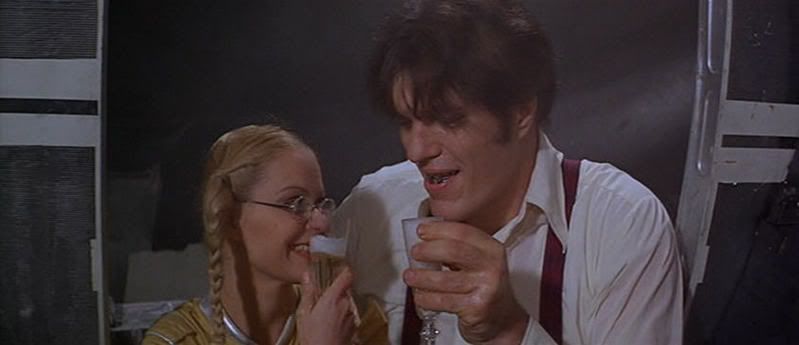
In the finale, Jaws realizes Drax’s master plan wouldn’t include the freakish ilk of either he or his new love, Dolly (Blanche Ravalec), so he turns and helps James win the day. In his last scene, he pops open a champagne bottle with his teeth, toasts the future with Dolly, and speaks his only line of dialogue in either movie: “Well, here’s to us.”
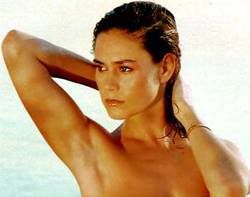
Les Girls: Dr. Holly Goodhead (Lois Chiles) is the central Bond babe, but the producers cast Corinne Clery in the smaller part of Drax’s assistant Corinne Dufour. As one of the truly sexy babes of erotic cinema -- due mostly to The Story of O -- Clery’s mere presence overshadows Chiles, despite having a fraction of the screentime and a dubbed performance. If only the actresses’ roles had been reversed! (Granted, that's a wholly subjective observation and subsequent wish.)
Before Moonraker, Chiles was supposedly considered for Anya Amasova in The Spy Who Loved Me, but was otherwise engaged. Lucky for the actress she got a second chance. Although Goodhead is something of a cold fish with a bland demeanor it doesn't feel out of place due to her being a scientist and a CIA agent. Chiles is quite striking and from a looks standpoint it's easy to see why she was cast, yet every time she speaks Holly becomes a little less captivating.
Bond, James Bond: One of the most refreshing aspects of Roger Moore’s commentary tracks on the Ultimate Edition DVDs is his self-deprecating approach. He never stands on ceremony and doesn’t pretend to be some great actor. Moonraker is the outing in which Moore has the least to do from a character standpoint, and James spends the movie hopping from one outlandish situation to the next. (At one point he even ends up improbably disguised as Eastwood’s Man With No Name with the theme from The Magnificent Seven offering accompaniment.)While writing this piece, it began to feel like a rehash of the Tomorrow Never Dies overview, yet a major difference between the films is the two leads: Brosnan is a great actor capable of heights he was rarely allowed to scale; Moore was the opposite – an actor of limitations, ideally suited to take on even the most shallow of scripts (where Moonraker easily lands). His double takes, line delivery and attitude make it work. Whatever misgivings people may have about Roger Moore, Moonraker proves he was the right Bond for his time and why he lasted so long in the part.
The Bond series has over the years learned to compete in a marketplace that’s learned how to successfully rip off Bond. Spurred on by the success of 1977's The Spy Who Loved Me, Albert Broccoli seemingly decided to do some shameless ripping of his own with Moonraker (including the structure of Spy's script). The industry was changing. Star Wars and Close Encounters were all the rage and The Empire Strikes Back was only a year away. Merchandising had become a major component of blockbuster filmmaking. Although the end of Spy announced “James Bond will return in For Your Eyes Only”, a decision was made to put Eyes on the backburner and have 007 engage in a star war of his own. Moonraker’s budget was astronomical for 1979 -- $34,000,000! By comparison Spy was only $14,000,000, Empire’s was a paltry $18,000,000 and in ‘83 Jedi was still only $32,000,000.
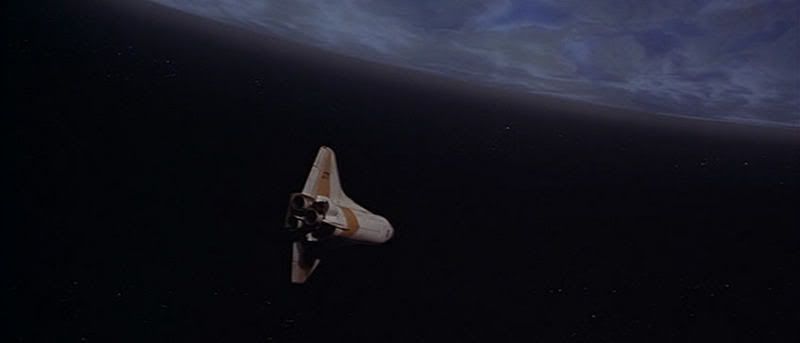
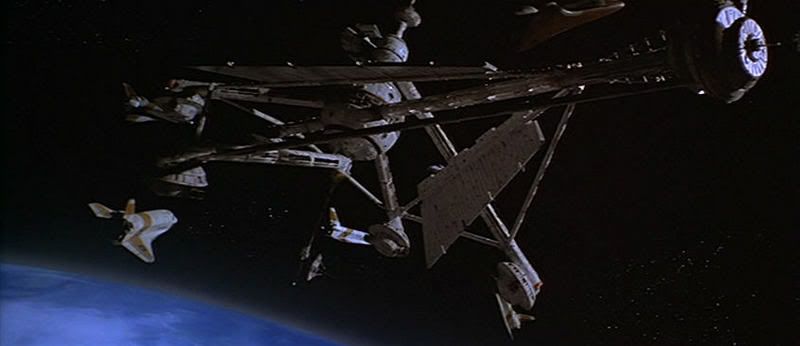
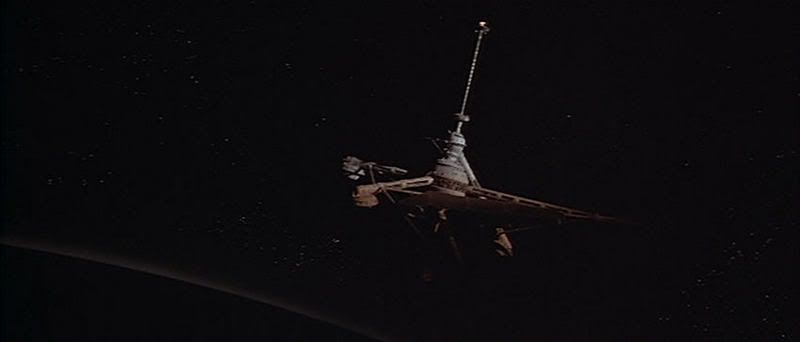
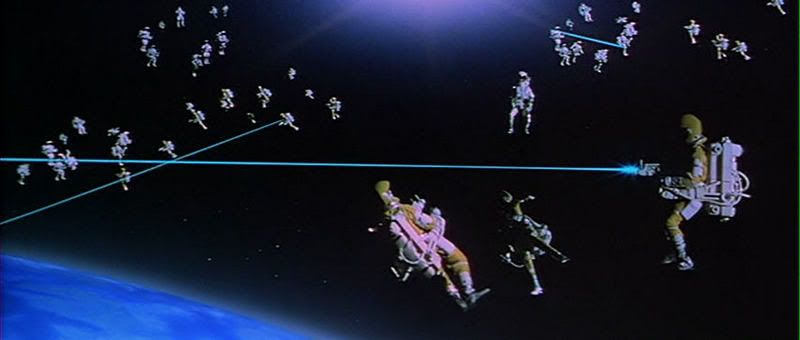
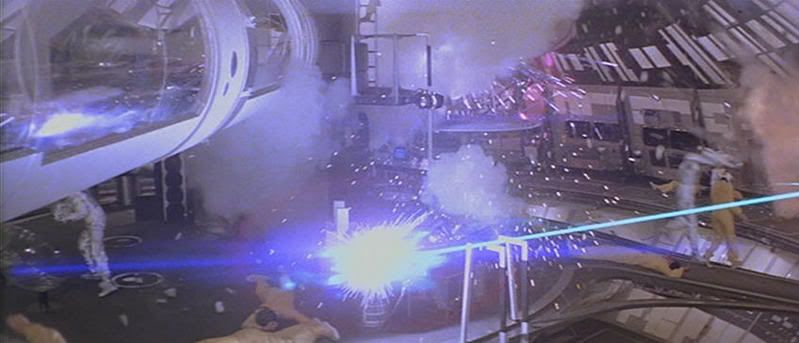
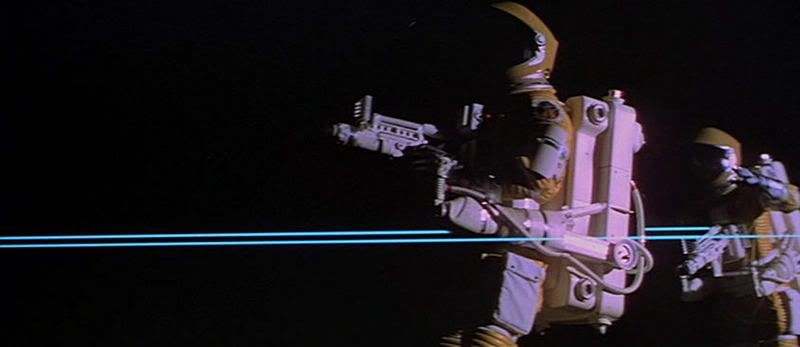
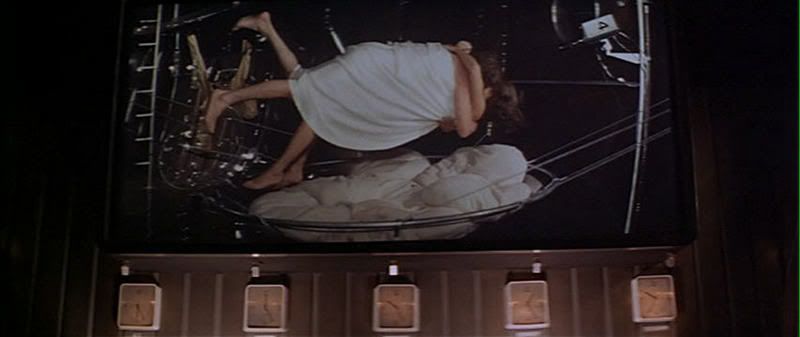
Moonraker’s goal was to take Bond into space, which it more than delivers. The space finale is Star Wars meets 2001 – an epic battle replete with ships, astronauts, laser guns and just about every single cliché imaginable thrown into such a scenario, including having Drax dispatched via an airlock. As my blogger bud Jeffrey pointed out, Moonraker’s really a parody – it parodies the previous Bond films and the finale parodies sci-fi. But any parody worth doing also loves and respects the material it exploits, and Moonraker's third act is drunk on popcorn science fiction. There’s a majestic beauty on display in between the laser beams and it somehow manages to echo the Lucas and Kubrick epics without ever even aspiring to those films' heights.
Q: “I think he's attempting re-entry, sir.”
Some interesting trivia:
* Moonraker was filmed on three continents, in four studios, and across seven countries.
* To build the gigantic three level Space Station set interiors at France's Epinay Studios, the production utilized two tons of nails, one hundred tons of metal, two hundred and twenty technicians and ten thousand feet of set construction woodwork.
* Vehicles featured included NASA / Rockwell International Shuttle Spacecraft designs as the six Moonraker Space Shuttles; a Venezian Gondola that can turn into a hovercraft known as the Hovercraft Gondola or 'Bondola'; Q's Hydrofoil Boat, a Glastron speedboat with attached hang-glider; a white MP Roadster; a Rio de Janeiro Ambulance; a blue Rolls-Royce Silver Wraith II which takes Bond to his Rio hotel; a Bell 206 Jet Ranger helicopter; a Hispano-Suiza; and a Handley Page Jetstream Turboprop plane in the opening sequence.
* The film had the largest number of actors in weightlessness (on wires) ever filmed.
* For the fight between James Bond and Chang, the film had the largest amount of break-away sugar glass used in a single scene.
* The film utilized the largest set ever built in France.
* The final Bond film to feature Bernard Lee as M. He’d played the part in every entry since Dr. No.
Major kudos to fellow Bondphile Jeffrey of Liverputty and House Next Door fame for helping me out with all the great screen captures for this piece.